## Vector Diagram: Decomposition of Velocity Vector **V**
### Overview
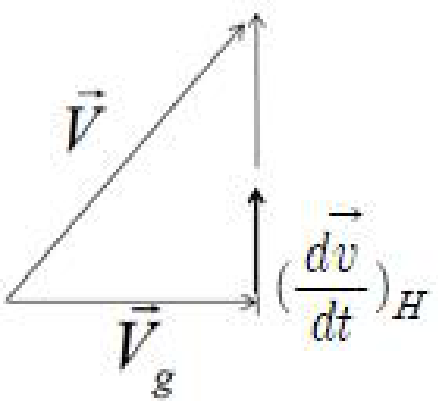
The image depicts a right-triangle vector diagram illustrating the decomposition of a velocity vector **V** into two perpendicular components: **Vg** (horizontal) and **(dv/dt)H** (vertical). The diagram emphasizes the relationship between the resultant vector and its orthogonal components.
### Components/Axes
- **Vectors**:
- **V**: Resultant velocity vector (hypotenuse).
- **Vg**: Horizontal component of **V** (base of the triangle).
- **(dv/dt)H**: Vertical component of **V** (height of the triangle), explicitly labeled with the derivative of velocity with respect to time (**dv/dt**) scaled by **H** (likely a unit vector or scalar factor).
- **Axes**:
- No explicit axes are labeled, but the horizontal and vertical directions are implied by the orientation of **Vg** and **(dv/dt)H**.
- **Legend**:
- No legend is present, as the diagram uses direct labels for vectors.
### Detailed Analysis
- **Vector Relationships**:
- **Vg** and **(dv/dt)H** are orthogonal, forming a right angle.
- The magnitude of **V** is the Euclidean norm of **Vg** and **(dv/dt)H**:
$$|\vec{V}| = \sqrt{|\vec{V_g}|^2 + \left|\frac{d\vec{v}}{dt}\right|^2 H^2}$$
- The vertical component **(dv/dt)H** suggests a time-dependent acceleration term scaled by **H**, which could represent a directional unit vector (e.g., vertical axis).
### Key Observations
1. The diagram assumes a coordinate system where **Vg** and **(dv/dt)H** are mutually perpendicular.
2. The vertical component’s dependence on **dv/dt** implies dynamic motion (e.g., acceleration in the vertical direction).
3. **H** in **(dv/dt)H** may normalize the vertical component or represent a specific physical quantity (e.g., height, gravitational factor).
### Interpretation
This diagram is foundational in physics and engineering for analyzing motion or forces. The decomposition of **V** into **Vg** and **(dv/dt)H** allows for:
- **Kinematic Analysis**: Separating horizontal and vertical motion (e.g., projectile motion).
- **Force Resolution**: Breaking forces into components for equilibrium or dynamics calculations.
- **Time-Dependent Systems**: The explicit inclusion of **dv/dt** highlights scenarios where acceleration (e.g., gravity, thrust) varies with time.
The absence of numerical values or units suggests the diagram is schematic, focusing on conceptual relationships rather than quantitative data. The use of **H** in the vertical component warrants further context (e.g., whether **H** is a constant, variable, or unit vector).