## 3D Surface Plot: Free Energy Landscape
### Overview
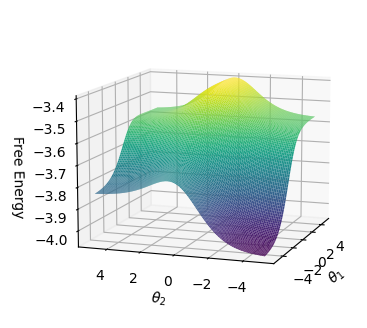
The image depicts a 3D surface plot representing a free energy landscape as a function of two angular variables, θ₁ and θ₂. The plot uses a color gradient (purple to yellow) to indicate free energy values, with grid lines and contour lines for spatial reference. The surface exhibits undulating topography with distinct peaks and troughs.
### Components/Axes
- **X-axis (θ₂)**: Ranges from -4 to 4, labeled "θ₂".
- **Z-axis (θ₁)**: Ranges from -4 to 4, labeled "θ₁".
- **Y-axis (Free Energy)**: Ranges from -4.0 to -3.4, labeled "Free Energy".
- **Color Gradient**: Purple (lowest free energy) to yellow (highest free energy), though no explicit legend is present.
- **Grid/Contour Lines**: Gray grid lines and contour lines overlay the surface for reference.
### Detailed Analysis
- **Peak**: A local maximum occurs near θ₁ ≈ 2, θ₂ ≈ 0, with free energy ≈ -3.4.
- **Trough**: A local minimum is observed near θ₁ ≈ -4, θ₂ ≈ -4, with free energy ≈ -4.0.
- **Saddle Point**: A critical point (saddle) is visible near θ₁ ≈ 0, θ₂ ≈ 0, where the surface transitions between rising and falling.
- **Color Correlation**: Higher free energy regions (yellow) align with peaks, while lower regions (purple) correspond to troughs. Intermediate values (green/blue) represent transitional slopes.
### Key Observations
1. **Peak-Trough Asymmetry**: The highest free energy (yellow) is localized near θ₁=2, θ₂=0, while the lowest (purple) is at θ₁=-4, θ₂=-4.
2. **Critical Points**: The saddle point at θ₁=0, θ₂=0 suggests a bifurcation in the energy landscape.
3. **Spatial Trends**: Free energy decreases monotonically from θ₂=4 to θ₂=-4 for fixed θ₁=0, but exhibits non-linear variations for other θ₁ values.
### Interpretation
The plot illustrates a complex energy landscape with multiple minima and maxima, suggesting competing states or phases. The saddle point at the origin indicates a transition region between these states. The absence of a legend limits precise quantification of the color gradient, but the spatial trends confirm that free energy is highly sensitive to both θ₁ and θ₂. The asymmetry in peak/trough locations implies directional preferences in the system's behavior. This could represent a physical or chemical system with metastable states, where transitions between minima require overcoming energy barriers (e.g., activation energy).