## Diagram: Layered Ecosystem Interactions
### Overview
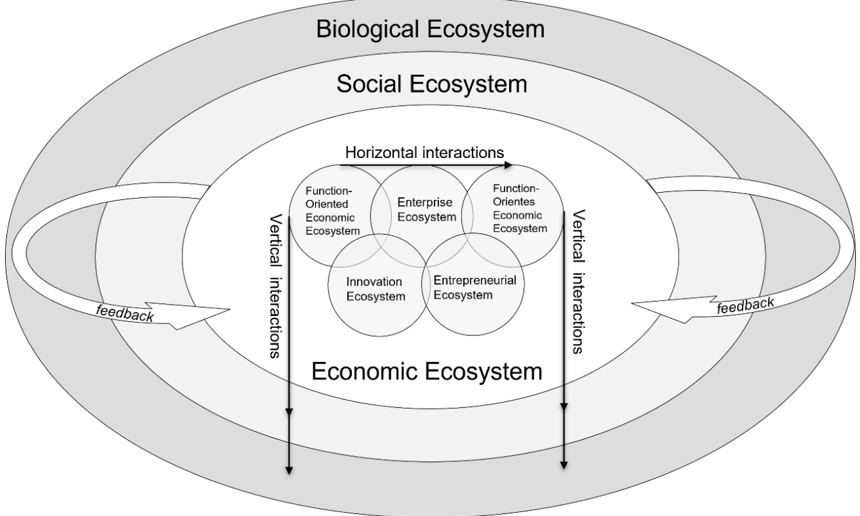
The diagram illustrates a tripartite ecosystem structure with nested layers: **Biological Ecosystem** (outermost), **Social Ecosystem** (middle), and **Economic Ecosystem** (innermost). Feedback loops connect all layers bidirectionally. Within the Social Ecosystem, four overlapping sub-ecosystems are depicted: **Function-Oriented Economic Ecosystem**, **Enterprise Ecosystem**, **Innovation Ecosystem**, and **Entrepreneurial Ecosystem**. Horizontal interactions occur between sub-ecosystems, while vertical interactions link the three main layers.
### Components/Axes
- **Layers**:
- **Biological Ecosystem**: Outermost layer, shaded in light gray.
- **Social Ecosystem**: Middle layer, shaded in medium gray.
- **Economic Ecosystem**: Innermost layer, shaded in white.
- **Sub-ecosystems (within Social Ecosystem)**:
- Function-Oriented Economic Ecosystem (appears twice, possibly a duplication error).
- Enterprise Ecosystem.
- Innovation Ecosystem.
- Entrepreneurial Ecosystem.
- **Interactions**:
- **Horizontal interactions**: Arrows between sub-ecosystems within the Social Ecosystem.
- **Vertical interactions**: Arrows connecting the three main layers (Biological → Social → Economic).
- **Feedback loops**: Curved arrows encircling each layer, labeled "feedback."
### Detailed Analysis
- **Layer Hierarchy**: The Biological Ecosystem encompasses the Social Ecosystem, which in turn encloses the Economic Ecosystem. This suggests a dependency hierarchy where higher-level ecosystems influence lower ones.
- **Sub-ecosystem Overlap**: The repeated label "Function-Oriented Economic Ecosystem" may indicate a mislabeling or intentional emphasis on its role as a bridge between horizontal interactions.
- **Feedback Mechanisms**: Feedback loops are explicitly labeled and connect all layers, implying cyclical interdependence (e.g., economic activity influences social structures, which in turn affect biological systems).
### Key Observations
1. **Repetition of Labels**: The "Function-Oriented Economic Ecosystem" is listed twice in the Social Ecosystem, which may be an error or a deliberate design choice to highlight its centrality.
2. **Bidirectional Flow**: Feedback loops are bidirectional, suggesting dynamic, non-linear relationships between ecosystems.
3. **Central Role of Economic Ecosystem**: Despite being the innermost layer, the Economic Ecosystem is connected to all sub-ecosystems, indicating its foundational role in the system.
### Interpretation
The diagram emphasizes **interconnectedness** and **adaptive feedback** across biological, social, and economic systems. The repetition of the "Function-Oriented Economic Ecosystem" label could imply its critical role in mediating horizontal interactions, though this requires clarification. The feedback loops suggest that changes in one layer (e.g., economic innovation) propagate upward and downward, reinforcing systemic resilience. This model could apply to sustainability studies, where ecological health, social equity, and economic viability are interdependent. The absence of quantitative data limits predictive analysis but highlights conceptual relationships.