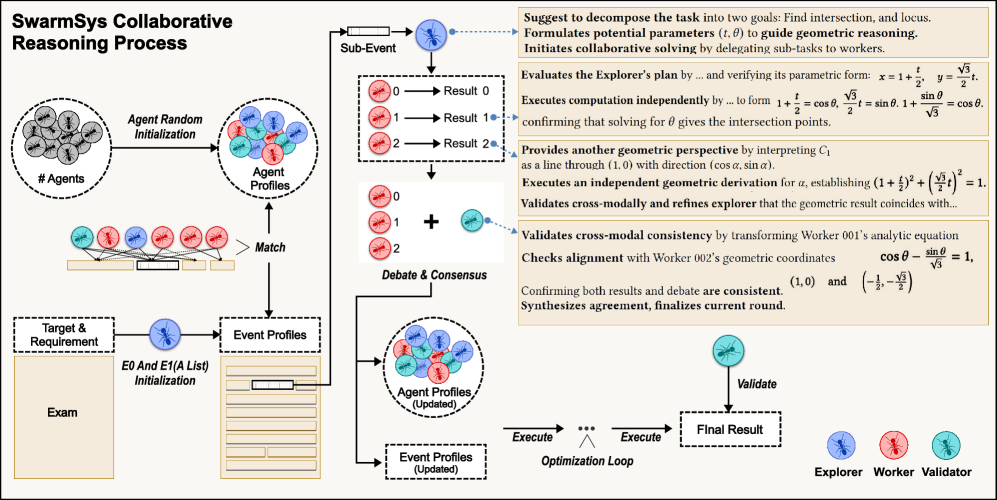
## Diagram: SwarmSys Collaborative Reasoning Process
### Overview
The image is a flowchart illustrating the "SwarmSys Collaborative Reasoning Process." It depicts a multi-agent system where agents collaborate to solve a problem through initialization, debate, consensus, and optimization loops. The process involves different types of agents (Explorers, Workers, Validators) and includes steps such as task decomposition, geometric reasoning, cross-modal validation, and result synthesis.
### Components/Axes
* **Title:** SwarmSys Collaborative Reasoning Process
* **Elements:**
* **Agents:** Represented by ant-like icons, with different colors indicating different roles (Explorer, Worker, Validator).
* **Agent Random Initialization:** Initial state with "# Agents" transitioning to "Agent Profiles".
* **Target & Requirement:** Input to the process, including "Exam".
* **Event Profiles:** Data structures that store event information.
* **Sub-Event:** A decomposed task.
* **Debate & Consensus:** A stage where agents discuss and agree on results.
* **Optimization Loop:** An iterative process to refine the solution.
* **Final Result:** The output of the process.
* **Agent Types (Legend, bottom-right):**
* Blue ant: Explorer
* Red ant: Worker
* Teal ant: Validator
### Detailed Analysis or ### Content Details
1. **Agent Initialization (Top-Left):**
* Starts with a collection of "# Agents" (gray ants).
* Transitions to "Agent Profiles" (a mix of blue, red, and teal ants).
2. **Matching Process:**
* "Agent Profiles" are matched against a set of criteria.
* The result feeds into "Event Profiles".
3. **Target & Requirement (Bottom-Left):**
* Includes "Target & Requirement" and "Exam".
* Initializes "Event Profiles" with "E0 And E1(A List)".
4. **Sub-Event Decomposition (Top-Right):**
* "Sub-Event" is decomposed into tasks.
* Text box:
* "Suggest to decompose the task into two goals: Find intersection, and locus."
* "Formulates potential parameters (t, θ) to guide geometric reasoning."
* "Initiates collaborative solving by delegating sub-tasks to workers."
5. **Result Evaluation (Top-Right):**
* Three results are generated: "Result 0", "Result 1", and "Result 2", each associated with a red ant (Worker).
* Text box:
* "Evaluates the Explorer's plan by ... and verifying its parametric form: x = 1 + t/2, y = (√3/2)t."
* "Executes computation independently by ... to form 1 + t/2 = cos θ, (√3/2)t = sin θ. 1 + (sin θ/√3) = cos θ."
* "Confirming that solving for θ gives the intersection points."
6. **Debate & Consensus (Center-Right):**
* The three results from the workers are combined and debated with a blue ant (Explorer).
7. **Cross-Modal Validation (Center-Right):**
* Text box:
* "Provides another geometric perspective by interpreting C₁ as a line through (1,0) with direction (cos α, sin α)."
* "Executes an independent geometric derivation for α, establishing (1 + t/2)² + ((√3/2)t)² = 1."
* "Validates cross-modally and refines explorer that the geometric result coincides with..."
8. **Cross-Modal Consistency (Center-Right):**
* Text box:
* "Validates cross-modal consistency by transforming Worker 001's analytic equation"
* "Checks alignment with Worker 002's geometric coordinates cos θ - sin θ/√3 = 1,"
* "Confirming both results and debate are consistent."
* "Synthesizes agreement, finalizes current round."
* "(1,0) and (-1/2, -√3/2)"
9. **Optimization Loop (Bottom):**
* "Agent Profiles (Updated)" and "Event Profiles (Updated)" feed into an "Optimization Loop".
* The loop involves "Execute" steps.
10. **Final Result (Bottom-Right):**
* The output of the "Optimization Loop" is validated by a teal ant (Validator).
* Leads to the "Final Result".
### Key Observations
* The process involves a cycle of initialization, matching, debate, consensus, and optimization.
* Different agent types play specific roles in the process.
* Geometric reasoning and cross-modal validation are key steps.
* The optimization loop refines the solution iteratively.
### Interpretation
The diagram illustrates a sophisticated collaborative problem-solving approach using a multi-agent system. The system leverages the strengths of different agent types (Explorers, Workers, Validators) to decompose complex tasks, explore potential solutions, validate results, and refine the solution through an optimization loop. The emphasis on geometric reasoning and cross-modal validation suggests that the system is designed to solve problems that involve spatial or geometric relationships. The iterative nature of the process allows the system to converge on an optimal solution through continuous refinement and consensus-building.