\n
## Diagram: SwarmSys Collaborative Reasoning Process
### Overview
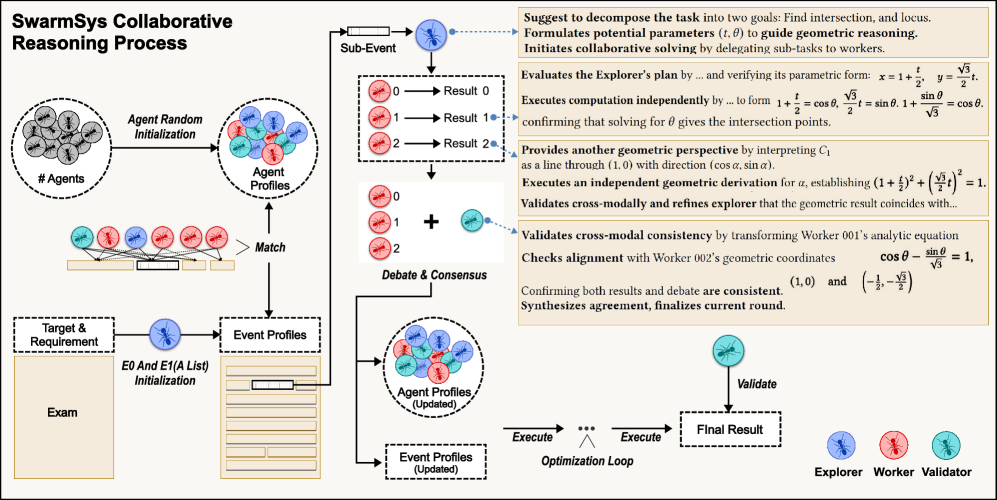
This diagram illustrates the workflow of the SwarmSys collaborative reasoning process. It depicts a multi-stage process involving agent initialization, profile matching, debate & consensus, optimization, and validation, ultimately leading to a final result. The diagram uses a flow chart style with interconnected boxes and arrows to represent the sequence of operations. Text boxes provide detailed descriptions of the actions performed at each stage.
### Components/Axes
The diagram is structured into four main sections, flowing from left to right:
1. **Agent Random Initialization:** Includes "Agent Profiles" and "# Agents"
2. **Debate & Consensus:** Includes "Result 0", "Result 1", "Result 2"
3. **Optimization Loop:** Includes "Execute" and "Execute"
4. **Final Result:** Includes "Explorer", "Worker", "Validator"
There are also supporting components:
* **Target & Requirement:** Input to the process.
* **E0 And E1(A List) Initialization:** Input to the process.
* **Event Profiles:** Intermediate data structure.
* **Sub-Event:** Initiates the process.
The diagram uses arrows to indicate the flow of information and control. Color-coding is used to differentiate between different agent states or results (red, green, blue).
### Detailed Analysis or Content Details
**1. Agent Random Initialization (Leftmost Section):**
* "# Agents": A cloud-shaped box indicating the number of agents involved.
* "Agent Profiles": A series of red, green, and blue circles representing agent profiles.
* "Match": An arrow connecting Agent Profiles to Event Profiles.
* "Event Profiles": A rectangular box representing the event profiles.
* "Target & Requirement": A rectangular box representing the initial target and requirement.
* "E0 And E1(A List) Initialization": A rectangular box representing the initialization of E0 and E1.
* "Exam": A rectangular box representing the exam.
**2. Debate & Consensus (Center-Left Section):**
* "Sub-Event": A circular box initiating the sub-event.
* "Result 0": Red circles labeled "Result 0" (approximately 6 circles).
* "Result 1": Green circles labeled "Result 1" (approximately 6 circles).
* "Result 2": Blue circles labeled "Result 2" (approximately 6 circles).
* Text associated with Sub-Event:
* "Suggest to decompose the task into two goals: Find intersection, and locus."
* "Formulates potential parameters (t, θ) to guide geometric reasoning."
* "Initiates collaborative solving by delegating sub-tasks to workers."
* "Evaluates the Explorer's plan by... and verifying its parametric form: x = 1 + 2t, y = 2t."
* "Executes computation independently by... to form 1 + θ² = cos θ, 1 + θ² = sin θ."
* "Confirming that solving for θ gives the intersection points."
* "Provides another geometric perspective by interpreting C₁ as a line through (1, 0) with direction (cos α, sin α)."
* "Executes an independent geometric derivation for α, establishing (1 + θ²) + (√3/2)² = 1."
* "Validates cross-modally and refines explorer that the geometric result coincides with..."
**3. Optimization Loop (Center-Right Section):**
* "Agent Profiles (Updated)": A series of red, green, and blue circles representing updated agent profiles.
* "Event Profiles (Updated)": A rectangular box representing updated event profiles.
* "Execute": Two arrows labeled "Execute" leading from Agent Profiles (Updated) to the Validation stage.
**4. Final Result (Rightmost Section):**
* "Validate": A rectangular box representing the validation process.
* "Final Result": A rectangular box representing the final result.
* "Explorer": A rectangular box.
* "Worker": A rectangular box.
* "Validator": A rectangular box.
* Text associated with Validation:
* "Validates cross-modal consistency by transforming Worker 001’s analytic equation"
* "Checks alignment with Worker 002’s geometric coordinates"
* "cos θ – sin θ / √3 = 1"
* "(1, 0) and (-½, -√3/2)"
* "Confirming both results and debate are consistent."
* "Synthesizes agreement, finalizes current round."
### Key Observations
* The process is iterative, as indicated by the "Optimization Loop" and the updating of agent and event profiles.
* Multiple agents contribute to the reasoning process, as evidenced by the different colored agent profiles and the "Debate & Consensus" stage.
* The process involves both analytical and geometric reasoning, as highlighted in the text descriptions.
* Validation is a crucial step, ensuring consistency and agreement among different agents.
* The diagram suggests a complex interplay between exploration, worker execution, and validation.
### Interpretation
The diagram depicts a sophisticated collaborative reasoning system where multiple agents work together to solve a geometric problem. The system leverages both analytical and geometric approaches, and incorporates a robust validation mechanism to ensure the accuracy and consistency of the results. The iterative nature of the process allows for refinement and improvement over time. The color-coding of the agent profiles likely represents different roles or perspectives within the system. The "Debate & Consensus" stage suggests a mechanism for resolving disagreements and reaching a common understanding. The diagram highlights the importance of cross-modal validation, ensuring that results obtained through different methods are aligned. The overall system appears to be designed for complex problem-solving, where the combined intelligence of multiple agents is required to achieve a satisfactory outcome. The diagram is a high-level overview and doesn't provide specific details about the algorithms or data structures used within the system.