TECHNICAL ASSET FINGERPRINT
8eef687bb79e4b9270cbd4ee
Click to view fullscreen
Press ESC or click to close
FOUND IN PAPERS
EXPERT: healer-alpha-free VERSION 1
RUNTIME: free/openrouter/healer-alpha
INTEL_VERIFIED
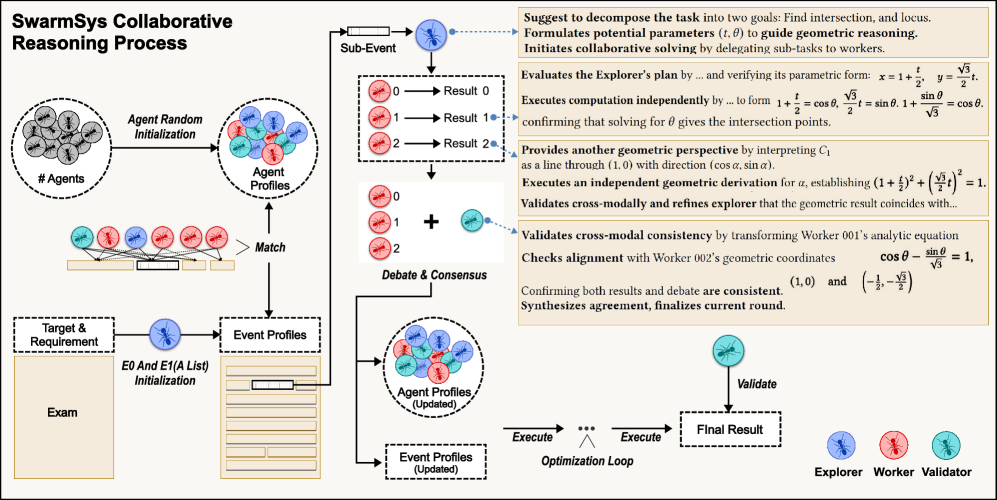
## Diagram: SwarmSys Collaborative Reasoning Process
### Overview
This image is a technical flowchart illustrating the "SwarmSys Collaborative Reasoning Process." It details a multi-agent system where specialized agents (Explorer, Worker, Validator) collaborate to solve a complex problem, likely a geometric or mathematical one, through initialization, task decomposition, independent computation, debate, consensus, and iterative optimization.
### Components/Axes
The diagram is organized into several interconnected regions, flowing generally from left to right and top to bottom.
**1. Left Column (Initialization & Input):**
* **Top-Left:** Title: "SwarmSys Collaborative Reasoning Process".
* **Below Title:** A circle labeled "#Agents" containing multiple small, gray agent icons.
* **Arrow:** Points right to a circle labeled "Agent Profiles" containing colored agent icons (blue, red, teal). The arrow is labeled "Agent Random Initialization".
* **Below Agent Profiles:** A row of colored agent icons (teal, red, blue) above a "Match" bracket, connecting to a box labeled "Event Profiles".
* **Bottom-Left:** A box labeled "Target & Requirement" with an arrow pointing to a blue agent icon labeled "E0 And E1(A List) Initialization". Below this is a box labeled "Exam".
**2. Center-Top (Sub-Event Processing):**
* A box labeled "Sub-Event" with an arrow pointing to a blue "Explorer" agent icon.
* **Dotted Blue Arrow:** Points from the Explorer to a text block describing its actions.
* **Below Explorer:** A dashed box containing three rows:
* `0` -> `Result 0` (with a red "Worker" icon next to `0`)
* `1` -> `Result 1` (with a red "Worker" icon next to `1`)
* `2` -> `Result 2` (with a red "Worker" icon next to `2`)
* **Dotted Red Arrows:** Point from each Worker/Result line to corresponding text blocks on the right describing their actions.
**3. Center-Bottom (Debate & Consensus):**
* A section labeled "Debate & Consensus".
* Shows three red "Worker" icons (labeled 0, 1, 2) and one teal "Validator" icon, with a plus sign between the Workers and Validator.
* A dotted blue arrow points from the Validator to a text block describing its validation actions.
* An arrow leads from this section to an updated "Agent Profiles (Updated)" circle.
* Another arrow leads to an "Event Profiles (Updated)" box.
**4. Right Column (Action Descriptions):**
This column contains detailed text blocks explaining the actions of each agent type, connected by dotted arrows to the central diagram.
* **Explorer Actions (Top):**
* "Suggest to decompose the task into two goals: Find intersection, and locus."
* "Formulates potential parameters `(t, θ)` to guide geometric reasoning."
* "Initiates collaborative solving by delegating sub-tasks to workers."
* **Worker 0 Actions:**
* "Evaluates the Explorer's plan by ... and verifying its parametric form: `x = 1 + t/2`, `y = (√3/2)t`."
* **Worker 1 Actions:**
* "Executes computation independently by ... to form `1 + t/2 = cos θ`, `(√3/2)t = sin θ`. `1 + sin θ/√3 = cos θ`, confirming that solving for `θ` gives the intersection points."
* **Worker 2 Actions:**
* "Provides another geometric perspective by interpreting `C₁` as a line through `(1,0)` with direction `(cos α, sin α)`."
* "Executes an independent geometric derivation for `α`, establishing `(1 + t/2)² + ((√3/2)t)² = 1`."
* "Validates cross-modally and refines explorer that the geometric result coincides with..."
* **Validator Actions:**
* "Validates cross-modal consistency by transforming Worker 001's analytic equation"
* "Checks alignment with Worker 002's geometric coordinates `cos θ - sin θ/√3 = 1`, `(1,0)` and `(-1/2, -√3/2)`."
* "Confirming both results and debate are consistent."
* "Synthesizes agreement, finalizes current round."
**5. Bottom-Right (Output & Legend):**
* An "Optimization Loop" with "Execute" arrows leading to a "Final Result" box.
* A teal "Validator" icon points to the "Final Result" with a "Validate" label.
* **Legend:** Located in the bottom-right corner.
* Blue agent icon: "Explorer"
* Red agent icon: "Worker"
* Teal agent icon: "Validator"
### Detailed Analysis
The process is a structured, multi-stage collaborative reasoning loop:
1. **Initialization:** A pool of agents is randomly initialized into profiles. A target problem ("Exam") and requirements are provided.
2. **Task Delegation:** An "Explorer" agent (blue) receives a sub-event. It decomposes the problem (finding an intersection and a locus) and formulates guiding parameters `(t, θ)`. It then delegates computational sub-tasks to "Worker" agents (red).
3. **Independent Computation:** Three Workers (0, 1, 2) execute tasks in parallel, producing distinct results (`Result 0`, `Result 1`, `Result 2`).
* **Worker 0** verifies a parametric form: `x = 1 + t/2`, `y = (√3/2)t`.
* **Worker 1** performs analytic computation, deriving the equation `1 + sin θ/√3 = cos θ` to find intersection points.
* **Worker 2** offers a geometric perspective, interpreting a line `C₁` and deriving the equation `(1 + t/2)² + ((√3/2)t)² = 1`.
4. **Validation & Consensus:** A "Validator" agent (teal) cross-checks the Workers' outputs. It transforms Worker 1's analytic equation and checks its alignment with Worker 2's geometric coordinates, specifically the points `(1,0)` and `(-1/2, -√3/2)`. It confirms consistency and synthesizes an agreement.
5. **Update & Loop:** The Agent Profiles and Event Profiles are updated based on the consensus. The process enters an "Optimization Loop," executing and validating until a "Final Result" is produced.
### Key Observations
* **Role Specialization:** Clear division of labor: Explorer (strategy/delegation), Worker (computation/analysis), Validator (consistency checking/synthesis).
* **Cross-Modal Validation:** The Validator's primary role is to ensure that different types of reasoning (analytic from Worker 1, geometric from Worker 2) lead to the same conclusion, which is a robust form of verification.
* **Mathematical Context:** The problem involves parametric equations (`x(t), y(t)`), trigonometric identities (`cos θ, sin θ`), and geometric loci (a line `C₁` and a circle implied by the equation `(1 + t/2)² + ((√3/2)t)² = 1`).
* **Iterative Refinement:** The presence of an "Optimization Loop" and updated profiles indicates this is not a one-shot process but an iterative one that refines both the agent understanding and the problem solution.
### Interpretation
This diagram illustrates a sophisticated framework for distributed, collaborative problem-solving in AI. It moves beyond simple parallel computation by incorporating **debate, consensus, and cross-modal validation**. The system mimics a human expert team where a strategist (Explorer) delegates, specialists (Workers) attack the problem from different angles (analytic vs. geometric), and a referee (Validator) ensures all approaches are consistent before finalizing the answer.
The specific mathematical content suggests the system is designed for domains requiring rigorous proof or multi-faceted analysis, such as geometry, engineering, or formal verification. The key innovation highlighted is the **validation step that explicitly checks for consistency between different representational forms** (equations vs. coordinates), which is a powerful method for error detection and building confidence in the result. The "SwarmSys" name implies scalability, where more agents could be deployed for more complex decompositions. The overall process emphasizes robustness, accuracy, and the synergistic value of diverse computational perspectives.
DECODING INTELLIGENCE...