## Textual Analysis: "Do our senses report reality to us?"
### Overview
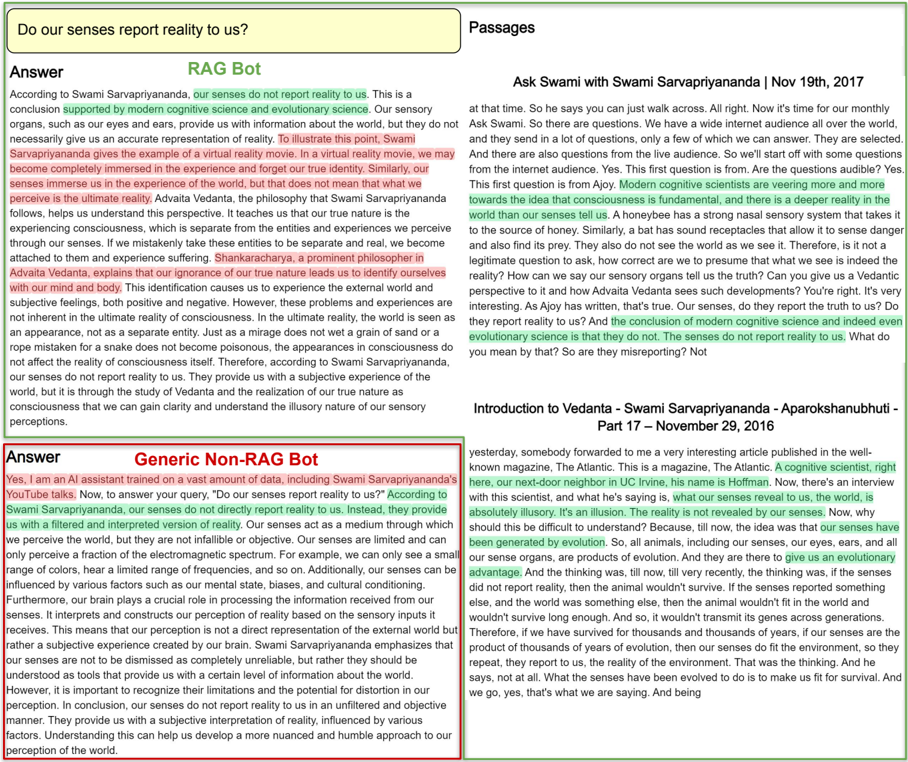
The image presents a collection of text passages discussing the philosophical question of whether our senses accurately represent reality. It includes answers from a "RAG Bot" and a "Generic Non-RAG Bot," along with excerpts from a discussion with Swami Sarvapriyananda and an introduction to a Vedanta lecture.
### Components/Axes
The image is divided into three main sections:
1. **Left Side:** Contains two "Answer" blocks, one labeled "RAG Bot" and the other "Generic Non-RAG Bot."
2. **Top-Right:** Features a passage titled "Ask Swami with Swami Sarvapriyananda | Nov 19th, 2017."
3. **Bottom-Right:** Presents an excerpt titled "Introduction to Vedanta - Swami Sarvapriyananda - Aparokshanubhuti - Part 17 - November 29, 2016."
### Detailed Analysis or Content Details
**1. RAG Bot Answer:**
* **Title:** Do our senses report reality to us?
* **Answer:** RAG Bot
* **Content:** The RAG Bot's answer states that, according to Swami Sarvapriyananda, our senses do not report reality accurately. This conclusion is supported by modern cognitive science and evolutionary science. The answer uses the example of a virtual reality movie to illustrate how we can become immersed in an experience that is not real. It references Advaita Vedanta and Shankaracharya to explain that our ignorance of our true nature leads us to identify ourselves with our mind and body, causing us to experience the external world and subjective feelings. The answer concludes that our senses provide a subjective experience of the world, and understanding Vedanta can help us understand the illusory nature of our sensory perceptions.
**2. Generic Non-RAG Bot Answer:**
* **Title:** Answer
* **Answer:** Generic Non-RAG Bot
* **Content:** The Generic Non-RAG Bot identifies itself as an AI assistant trained on a vast amount of data, including Swami Sarvapriyananda's YouTube talks. It states that our senses do not directly report reality but provide a filtered and interpreted version. It explains that our senses are limited and influenced by various factors, including our mental state, biases, and cultural conditioning. The answer emphasizes that our perception is a subjective experience created by our brain and that our senses should be understood as tools that provide a certain level of information about the world. It concludes that understanding the limitations and potential for distortion in our perception can help us develop a more nuanced and humble approach to our perception of the world.
**3. Ask Swami with Swami Sarvapriyananda | Nov 19th, 2017:**
* **Title:** Ask Swami with Swami Sarvapriyananda | Nov 19th, 2017
* **Content:** This passage is a transcript of a question-and-answer session with Swami Sarvapriyananda. It begins with an introduction to the session and a question from Ajoy about modern cognitive scientists veering towards the idea that consciousness is fundamental. The questioner references the sensory systems of honeybees and bats as examples of how different organisms perceive the world differently. The passage concludes with the statement that modern cognitive science and evolutionary science suggest that our senses do not report reality to us.
**4. Introduction to Vedanta - Swami Sarvapriyananda - Aparokshanubhuti - Part 17 - November 29, 2016:**
* **Title:** Introduction to Vedanta - Swami Sarvapriyananda - Aparokshanubhuti - Part 17 - November 29, 2016
* **Content:** This passage introduces a lecture by Swami Sarvapriyananda on Vedanta. It references an article in The Atlantic magazine by a cognitive scientist named Hoffman, who argues that what our senses reveal to us is illusory. The passage discusses the idea that our senses have been generated by evolution to give us an evolutionary advantage. It argues that if our senses did not report reality, then animals would not survive. However, it also states that the senses have evolved to make us fit for survival, not necessarily to report reality accurately.
### Key Observations
* Both the RAG Bot and the Generic Non-RAG Bot agree that our senses do not directly report reality.
* The passages reference Swami Sarvapriyananda and Advaita Vedanta as sources for this perspective.
* The passages discuss the role of evolution in shaping our sensory perceptions.
* The passages highlight the subjective nature of our sensory experiences.
### Interpretation
The image presents a philosophical discussion about the nature of reality and the role of our senses in perceiving it. The central argument is that our senses do not provide an accurate representation of reality but rather a filtered and interpreted version. This perspective is supported by modern cognitive science, evolutionary science, and the teachings of Advaita Vedanta. The passages suggest that our sensory experiences are subjective and influenced by various factors, including our mental state, biases, and cultural conditioning. The ultimate goal is to encourage a more nuanced and humble approach to our perception of the world, recognizing the limitations and potential for distortion in our sensory experiences.