## Screenshot: Answers to "Do our senses report reality to us?"
### Overview
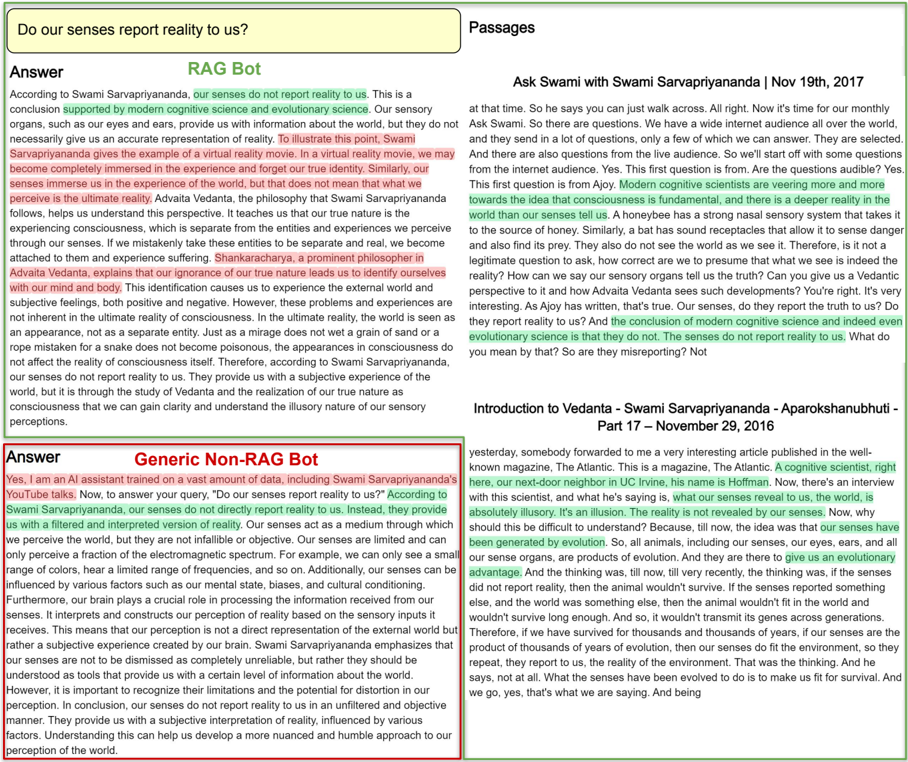
The image shows a webpage with two answers to the question "Do our senses report reality to us?" from two AI bots:
1. **RAG Bot** (green box)
2. **Generic Non-RAG Bot** (red box)
Both answers reference Swami Sarvapriyananda and discuss the idea that human senses do not directly report reality but provide a filtered, subjective interpretation.
---
### Components/Axes
- **Text Blocks**: Two distinct answers with highlighted excerpts.
- **Highlighting**:
- **Green Highlights**: Key premises (e.g., "supported by modern cognitive science and evolutionary science").
- **Red Highlights**: Examples or conclusions (e.g., "virtual reality movie" in RAG Bot; "evolutionary advantage" in Generic Non-RAG Bot).
- **References**:
- Swami Sarvapriyananda (mentioned in both answers).
- Advaita Vedanta (philosophy discussed in RAG Bot’s answer).
- Evolutionary science (cited in both answers).
---
### Detailed Analysis
#### RAG Bot Answer
- **Key Points**:
- Senses do not report reality directly.
- Supported by **modern cognitive science** and **evolutionary science**.
- Sensory organs (eyes, ears) provide information but are not infallible.
- Example: Virtual reality immersion causes detachment from "true identity."
- **Advaita Vedanta** philosophy explains that consciousness is separate from perceived entities.
- Misidentification with the mind/body leads to suffering.
#### Generic Non-RAG Bot Answer
- **Key Points**:
- Senses provide a **filtered, interpreted version** of reality.
- Limited by biological constraints (e.g., visible spectrum, frequency range).
- Brain processes sensory inputs, introducing biases and cultural conditioning.
- Evolutionary perspective: Senses evolved to ensure survival, not to reveal "ultimate reality."
- Example: Animals’ senses help them fit into their environment.
---
### Key Observations
1. **Shared Premise**: Both answers agree that senses do not report objective reality.
2. **Divergent Explanations**:
- RAG Bot emphasizes **Vedantic philosophy** (consciousness as separate from perception).
- Generic Non-RAG Bot focuses on **evolutionary biology** (senses as survival tools).
3. **Highlighted Emphasis**:
- RAG Bot stresses **subjective experience** and **true nature of consciousness**.
- Generic Non-RAG Bot highlights **biological limitations** and **evolutionary advantages**.
---
### Interpretation
The answers reflect two lenses for understanding perception:
- **Philosophical (RAG Bot)**: Reality is an illusion (Maya) created by the mind; true reality is consciousness (Atman/Brahman).
- **Scientific (Generic Non-RAG Bot)**: Senses are evolutionary adaptations optimized for survival, not objective truth.
Both critiques challenge the assumption that sensory input equals reality, but they differ in their proposed solutions:
- RAG Bot advocates for **spiritual realization** (Vedanta) to transcend sensory illusion.
- Generic Non-RAG Bot suggests **critical awareness** of sensory limitations to avoid distortion.
The highlighted text underscores the tension between subjective experience and objective truth, a central theme in both cognitive science and Eastern philosophy.