## Diagram: Neural Network Architecture and Conductance Analysis
### Overview
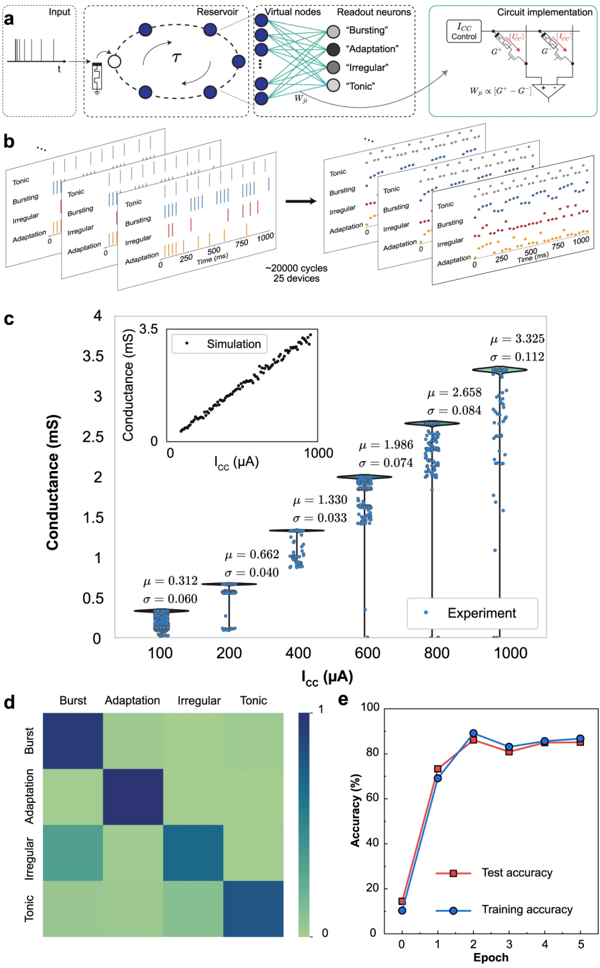
The image presents a multi-part technical diagram analyzing neural network dynamics, conductance measurements, and model performance. It includes circuit schematics, time-series data, scatter plots, heatmaps, and accuracy trends.
---
### Components/Axes
#### a. Neural Network Architecture
- **Input**: Vertical bar graph labeled "t" (time).
- **Reservoir**: Circular nodes connected by bidirectional arrows labeled "τ" (time constant).
- **Virtual Nodes**: Four types:
- Bursting (blue)
- Adaptation (gray)
- Irregular (black)
- Tonic (white)
- **Readout Neurons**: Connected to virtual nodes via green lines.
- **Circuit Implementation**:
- Labeled "I_CC" (current control)
- Gain control: G⁺ (red) and G⁻ (blue)
- Weight update: W_j ∝ (G⁺ - G⁻)
#### b. Time-Series Data
- **X-axis**: Time (0–1000 ms)
- **Y-axis**: Conductance states (Tonic, Bursting, Irregular, Adaptation)
- **Colors**:
- Tonic: Blue
- Bursting: Red
- Irregular: Yellow
- Adaptation: Orange
#### c. Conductance vs. Current Control
- **X-axis**: I_CC (μA) from 0 to 1000
- **Y-axis**: Conductance (ms) from 0 to 3.5
- **Data Points**:
- Experimental (blue dots) with error bars (σ)
- Simulation (black line with crosses)
- **Inset**: Linear simulation trend (I_CC vs. Conductance)
#### d. Heatmap of Node Interactions
- **X/Y-axes**: Burst, Adaptation, Irregular, Tonic
- **Color Scale**: Dark blue (0) to light green (1)
- **Key Observations**:
- Burst-Adaptation interaction: Dark blue (strong)
- Tonic-Tonic interaction: Dark blue (strong)
- Other interactions: Gradual lightening (weaker)
#### e. Accuracy Trends
- **X-axis**: Epoch (0–5)
- **Y-axis**: Accuracy (%)
- **Lines**:
- Test accuracy (red squares): 10% → 85% → 88%
- Training accuracy (blue circles): 5% → 90% → 88%
---
### Detailed Analysis
#### a. Neural Network Architecture
- Circuit implementation shows bidirectional gain control (G⁺/G⁻) modulating weights (W_j).
- Virtual nodes represent dynamic neural states with distinct temporal properties.
#### b. Time-Series Data
- Bursting and Adaptation states show periodic spikes, while Tonic maintains steady conductance.
- Irregular states exhibit chaotic fluctuations.
#### c. Conductance vs. Current Control
- **Simulation**: Linear relationship (R² ≈ 0.99)
- **Experimental Data**:
- μ (mean) increases with I_CC: 0.312 → 3.325 ms/μA
- σ (std dev) ranges: 0.033 → 0.112 ms
- **Key Outlier**: High σ at I_CC=1000 μA (0.112 ms)
#### d. Heatmap of Node Interactions
- Burst-Adaptation and Tonic-Tonic interactions dominate (dark blue).
- Cross-node interactions (e.g., Burst-Irregular) show weaker coupling (green).
#### e. Accuracy Trends
- Test accuracy plateaus at ~88% after 3 epochs.
- Training accuracy overshoots test accuracy (90% vs. 88%) in epoch 2.
---
### Key Observations
1. **Conductance Dynamics**: Experimental data deviates from simulation at high I_CC (1000 μA), suggesting nonlinear effects.
2. **Node Interactions**: Burst-Adaptation coupling is strongest, potentially critical for network stability.
3. **Accuracy Trends**: Training accuracy exceeds test accuracy, indicating possible overfitting.
---
### Interpretation
This study demonstrates how dynamic neural states (bursting, adaptation) modulate conductance in response to current control. The heatmap suggests that Burst-Adaptation interactions are most influential, possibly enabling complex temporal coding. The accuracy trends highlight the need for regularization to prevent overfitting in neural models. The experimental deviation from simulation at high I_CC implies unmodeled biophysical factors affecting conductance.