\n
## Diagram: Spatial Relationship Graph
### Overview
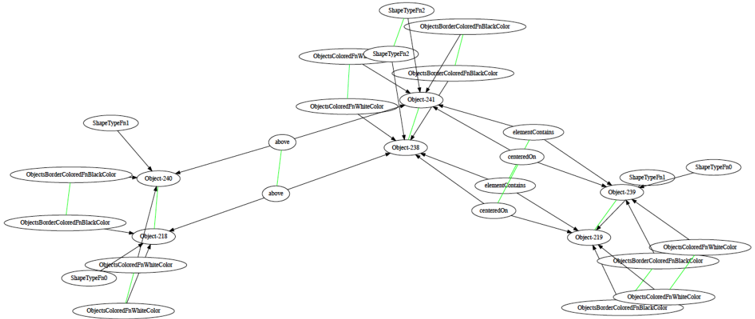
The image depicts a directed graph illustrating spatial relationships between various objects. The graph consists of nodes (ovals) representing objects and edges (arrows) representing relationships like "above", "elementContains", and "consistsOf". The nodes are labeled with object types and properties, such as "ShapeTypeA", "ObjectColoredWithWhiteColor", and "ObjectBorderColoredWithBlackColor".
### Components/Axes
The diagram does not have traditional axes. It consists of nodes and directed edges. The nodes are labeled with the following:
* **ShapeTypeA, ShapeTypeB, ShapeTypeC**: These represent different shape types.
* **ObjectColoredWithWhiteColor, ObjectColoredWithBlackColor**: These describe the color of the objects.
* **ObjectBorderColoredWithBlackColor**: This describes the color of the object's border.
* **Object-240, Object-241, Object-238, Object-239, Object-219**: Unique identifiers for specific objects.
* **elementContains, consistsOf, above**: Relationship types.
### Detailed Analysis or Content Details
The diagram can be broken down into sections based on the central node "Object-238".
**Left Branch (Object-240):**
* "Object-240" is connected to "Object-241" via the relationship "above".
* "Object-241" is connected to "ShapeTypeA" and "ObjectColoredWithWhiteColor" and "ObjectBorderColoredWithBlackColor".
* "Object-240" is connected to "ShapeTypeA" and "ObjectBorderColoredWithBlackColor".
**Central Node (Object-238):**
* "Object-238" is connected to "Object-241" via the relationship "above".
* "Object-238" is connected to "Object-239" via the relationship "consistsOf".
* "Object-238" is connected to "Object-219" via the relationship "elementContains".
* "Object-238" is labeled with "ObjectColoredWithWhiteColor".
**Right Branch (Object-239 & Object-219):**
* "Object-239" is connected to "ShapeTypeC" and "ObjectBorderColoredWithBlackColor" and "ObjectColoredWithBlackColor".
* "Object-219" is connected to "ShapeTypeB" and "ObjectBorderColoredWithBlackColor" and "ObjectColoredWithWhiteColor".
**Top Branch (Object-241):**
* "Object-241" is connected to "ShapeTypeA" and "ObjectColoredWithWhiteColor" and "ObjectBorderColoredWithBlackColor".
### Key Observations
* The diagram represents a hierarchical structure, with "Object-238" acting as a central component.
* The relationships "above", "consistsOf", and "elementContains" define the spatial arrangement and composition of the objects.
* Object properties like color and shape are explicitly linked to the objects.
* The diagram appears to be describing a scene or assembly where objects are positioned relative to each other and have specific characteristics.
### Interpretation
The diagram likely represents a scene description or a component hierarchy within a larger system. The relationships suggest a parent-child or container-contained structure. For example, "Object-238" *contains* "Object-219" and *consists of* "Object-239". The "above" relationship indicates vertical positioning. The consistent use of color properties ("ObjectColoredWithWhiteColor", "ObjectBorderColoredWithBlackColor") suggests these are important attributes for distinguishing or identifying the objects.
The diagram could be used in several contexts:
* **Computer Vision:** Representing the spatial relationships between objects detected in an image.
* **Robotics:** Describing the arrangement of objects in a robot's environment.
* **Scene Graph:** A representation of a 3D scene for rendering or simulation.
* **Knowledge Representation:** Modeling the relationships between entities in a domain.
The diagram's structure suggests a deliberate organization, implying that the spatial relationships and object properties are significant for the intended application. The use of unique object identifiers ("Object-240", etc.) suggests that these objects are distinct instances within a larger set.