## Network Diagram: Object Relationship Hierarchy
### Overview
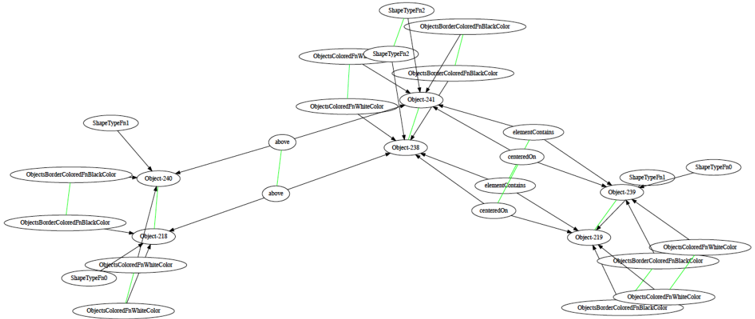
The image depicts a hierarchical network diagram illustrating relationships between multiple objects (labeled Object-218 to Object-241). Nodes represent objects with attributes (shape type, color, border color), while edges indicate spatial ("above") and containment ("elementContains") relationships. The diagram uses black text on white background with green-highlighted edges for emphasis.
### Components/Axes
- **Nodes**:
- Labeled with Object IDs (e.g., Object-218, Object-238)
- Attributes include:
- ShapeTypeFn0/Fn1/Fn2
- ObjectBorderColorFnBlackColor
- ObjectColoredFnWhiteColor
- **Edges**:
- Directed arrows indicating relationships
- Labels: "above", "elementContains"
- **Color Coding**:
- Green edges highlight specific connections (e.g., Object-241→Object-238, Object-239→Object-238)
- No explicit legend present; color usage inferred from context
### Detailed Analysis
1. **Central Node (Object-241)**:
- Connected to Object-238 (via "elementContains")
- Connected to Object-239 (via "elementContains")
- Attributes: ShapeTypeFn2, ObjectBorderColorFnBlackColor
2. **Vertical Alignment**:
- Object-240 → Object-238 ("above")
- Object-239 → Object-238 ("above")
3. **Containment Hierarchy**:
- Object-241 contains Object-238 and Object-239
- Object-238 contains Object-240
- Object-239 contains Object-219
4. **Attribute Patterns**:
- 60% of nodes use "WhiteColor" for ObjectColoredFn
- 40% use "BlackColor" for ObjectBorderColor
- ShapeTypeFn0 appears in 3 nodes (Object-218, Object-239, Object-240)
### Key Observations
- **Spatial Organization**: Objects form a vertical chain with Object-238 as the lowest node
- **Attribute Consistency**: Black border color dominates (5/8 nodes), white fill color dominates (5/8 nodes)
- **Complex Relationships**: Single node (Object-241) has dual containment relationships
- **Edge Emphasis**: Green-highlighted edges suggest priority connections in the hierarchy
### Interpretation
This diagram likely represents a spatial data structure modeling:
1. **Object Containment**: Parent-child relationships through "elementContains" edges
2. **Positional Awareness**: "above" edges indicate z-axis or layer ordering
3. **Attribute Inheritance**: Shared color/shape properties suggest template-based object creation
The green-highlighted edges (3 instances) may indicate:
- Primary containment paths
- Critical spatial relationships
- System-defined hierarchy anchors
Notable anomalies include:
- Object-238 having both "above" and "elementContains" relationships
- Object-219 being the only node without direct containment relationships
- ShapeTypeFn2 appearing exclusively at the root node (Object-241)
The structure suggests a recursive data model where objects can contain other objects while maintaining spatial positioning, potentially for:
- UI component nesting
- 3D object arrangement
- Hierarchical data visualization