## Diagram: Node-Based Workflow with Conditional Paths
### Overview
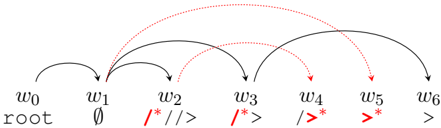
The diagram illustrates a sequential workflow with conditional branching, represented by nodes labeled `w0` to `w6`. Arrows indicate directional flow, with red dotted arrows highlighting alternative or parallel paths originating from the root node (`w0`). The structure suggests a decision tree or state machine with nested conditions.
### Components/Axes
- **Nodes**:
- `w0`: Labeled "root" (starting point).
- `w1`: Labeled "∅" (empty set symbol).
- `w2`: Labeled "/**//>".
- `w3`: Labeled "/*>".
- `w4`: Labeled "/*>*".
- `w5`: Labeled ">*".
- `w6`: Labeled ">".
- **Arrows**:
- **Black solid arrows**: Sequential flow (`w0 → w1 → w2 → w3 → w4 → w5 → w6`).
- **Red dotted arrows**: Conditional branches from `w0` to `w2`, `w3`, `w4`, and `w5`.
### Detailed Analysis
- **Sequential Flow**:
- The primary path progresses linearly from `w0` (root) to `w6`, with each node representing a discrete state or step.
- Labels on nodes (`∅`, `/**//>`, `/*>`, etc.) imply nested conditional logic or hierarchical operations.
- **Conditional Branches**:
- Red dotted arrows from `w0` to `w2`, `w3`, `w4`, and `w5` suggest alternative pathways that bypass intermediate nodes (`w1` for `w2`, `w1` and `w2` for `w3`, etc.).
- The labels on these nodes (`/**//>`, `/*>`, `/*>*`, `>*`) may represent increasing complexity or specificity in conditions.
### Key Observations
1. **Root Node Dominance**: `w0` (root) is the sole source of all paths, emphasizing its central role in initiating the workflow.
2. **Nested Conditions**: The labels on nodes (`/**//>`, `/*>`, etc.) suggest a hierarchy of operations, where later nodes depend on earlier ones.
3. **Redundant Paths**: The red dotted arrows introduce non-linear dependencies, allowing the system to skip steps under certain conditions.
4. **Terminal Node**: `w6` (labeled ">") acts as the endpoint, with no outgoing arrows, indicating a final state.
### Interpretation
The diagram likely represents a computational or decision-making process where:
- The **root node** (`w0`) triggers an initial action or state.
- **Sequential steps** (`w1` to `w6`) refine or transform data, with each node adding constraints (e.g., `∅` for emptiness, `/**//>` for nested conditions).
- **Conditional branches** (red dotted arrows) allow the system to adapt dynamically, bypassing unnecessary steps based on context.
- The **terminal node** (`w6`) signifies completion, with the ">" symbol possibly denoting output or termination.
This structure could model algorithms like parsing, state transitions in software, or workflow automation, where efficiency depends on conditional shortcuts. The absence of a legend implies the arrow styles (solid vs. dotted) are self-explanatory, with red indicating optional or alternative routes.