## Bar Chart: Multiplier: Time vs Core count
### Overview
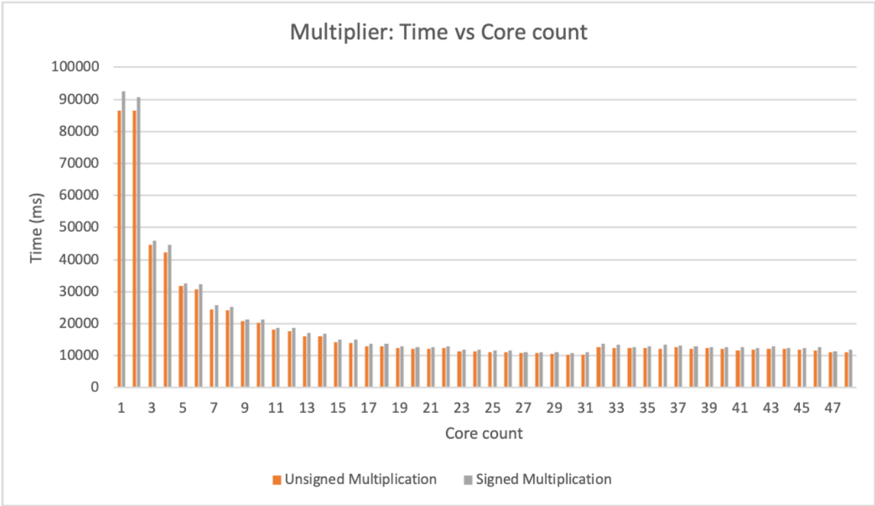
The bar chart displays the relationship between the core count and the time taken for multiplication operations. The x-axis represents the core count, ranging from 1 to 47, while the y-axis represents the time in milliseconds, ranging from 0 to 100,000 ms.
### Components/Axes
- **X-axis (Core count)**: Ranges from 1 to 47, with each bar representing a different core count.
- **Y-axis (Time (ms))**: Ranges from 0 to 100,000 ms, with each bar representing the time taken for multiplication operations at a specific core count.
- **Legend**: Two bars represent the time taken for unsigned multiplication (orange) and signed multiplication (gray).
### Detailed Analysis or ### Content Details
- **Unsigned Multiplication**: The bars for unsigned multiplication are consistently higher than those for signed multiplication across all core counts.
- **Signed Multiplication**: The bars for signed multiplication are generally lower than those for unsigned multiplication, indicating that signed multiplication is faster.
- **Time Distribution**: The time taken for multiplication operations decreases as the core count increases, suggesting that more cores can process multiplication operations more efficiently.
- **Core Count 1**: The time taken for multiplication operations is the highest, indicating that the core count has a significant impact on the time taken.
- **Core Count 47**: The time taken for multiplication operations is the lowest, indicating that the core count has a significant impact on the time taken.
### Key Observations
- **Unsigned Multiplication is Faster**: The bars for unsigned multiplication are consistently higher than those for signed multiplication, indicating that unsigned multiplication is faster.
- **Core Count Impact**: The time taken for multiplication operations decreases as the core count increases, suggesting that more cores can process multiplication operations more efficiently.
- **Core Count 1 is the Slowest**: The time taken for multiplication operations is the highest at core count 1, indicating that the core count has a significant impact on the time taken.
### Interpretation
The data suggests that the time taken for multiplication operations is significantly influenced by the core count. Unsigned multiplication is faster than signed multiplication, and the time taken decreases as the core count increases. Core count 1 is the slowest, indicating that the core count has a significant impact on the time taken. This information is crucial for optimizing the performance of multiplication operations in parallel processing environments.