## Diagram: Knowledge Distillation Taxonomy
### Overview
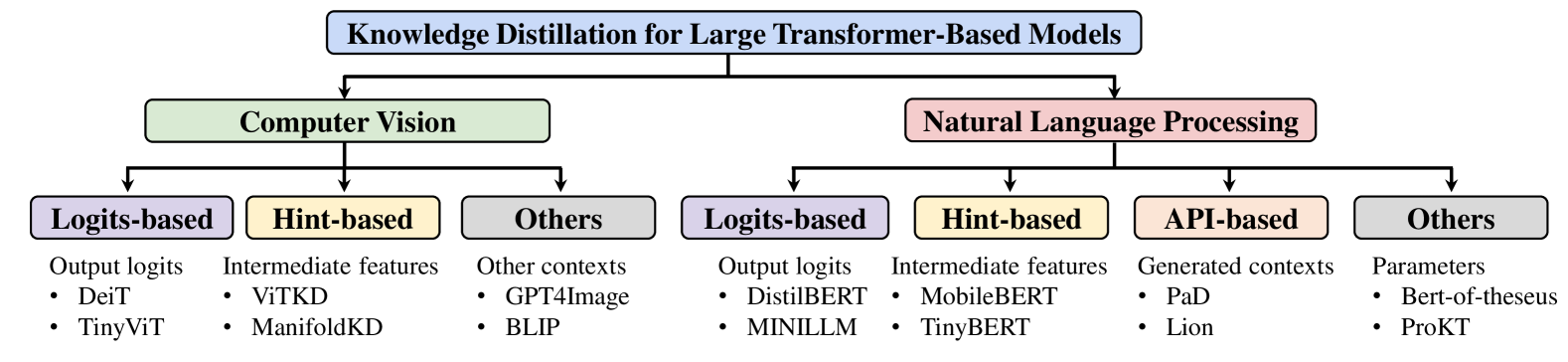
The image is a hierarchical diagram illustrating a taxonomy of knowledge distillation techniques for large transformer-based models. The diagram branches from a central topic into two main categories: Computer Vision and Natural Language Processing. Each of these categories is further divided into subcategories based on the distillation method used: Logits-based, Hint-based, and Others. Natural Language Processing has an additional category: API-based. Each subcategory lists specific models or techniques.
### Components/Axes
* **Main Title:** Knowledge Distillation for Large Transformer-Based Models (Blue box at the top)
* **First Level Categories:**
* Computer Vision (Green box, left side)
* Natural Language Processing (Red box, right side)
* **Second Level Categories (Computer Vision):**
* Logits-based (Purple box, left)
* Description: Output logits
* Hint-based (Yellow box, center-left)
* Description: Intermediate features
* Others (Gray box, right-left)
* Description: Other contexts
* **Second Level Categories (Natural Language Processing):**
* Logits-based (Purple box, left)
* Description: Output logits
* Hint-based (Yellow box, center-left)
* Description: Intermediate features
* API-based (Orange box, center-right)
* Description: Generated contexts
* Others (Gray box, right)
* Description: Parameters
### Detailed Analysis or ### Content Details
**Computer Vision:**
* **Logits-based:**
* DeiT
* TinyViT
* **Hint-based:**
* ViTKD
* ManifoldKD
* **Others:**
* GPT4Image
* BLIP
**Natural Language Processing:**
* **Logits-based:**
* DistilBERT
* MINILLM
* **Hint-based:**
* MobileBERT
* TinyBERT
* **API-based:**
* PaD
* Lion
* **Others:**
* Bert-of-theseus
* ProKT
### Key Observations
* The diagram provides a structured overview of knowledge distillation methods.
* Computer Vision and Natural Language Processing are the two main application areas.
* Logits-based and Hint-based approaches are common to both domains.
* Natural Language Processing has an additional category, API-based, which is not present in Computer Vision.
* The "Others" category exists in both domains, suggesting that there are knowledge distillation techniques that do not fit neatly into the Logits-based, Hint-based, or API-based categories.
### Interpretation
The diagram illustrates the landscape of knowledge distillation techniques applied to large transformer-based models, specifically in the fields of Computer Vision and Natural Language Processing. The categorization highlights the different types of information used to transfer knowledge from a larger, more complex model (teacher) to a smaller, more efficient model (student). Logits-based methods focus on matching the output probabilities of the teacher, Hint-based methods use intermediate feature representations, and API-based methods leverage generated contexts. The "Others" category suggests the existence of less conventional or hybrid approaches. The diagram serves as a useful reference for researchers and practitioners in the field, providing a clear overview of the available techniques and their applications.