## Diagram: Distributed Machine Learning Training Workflow
### Overview
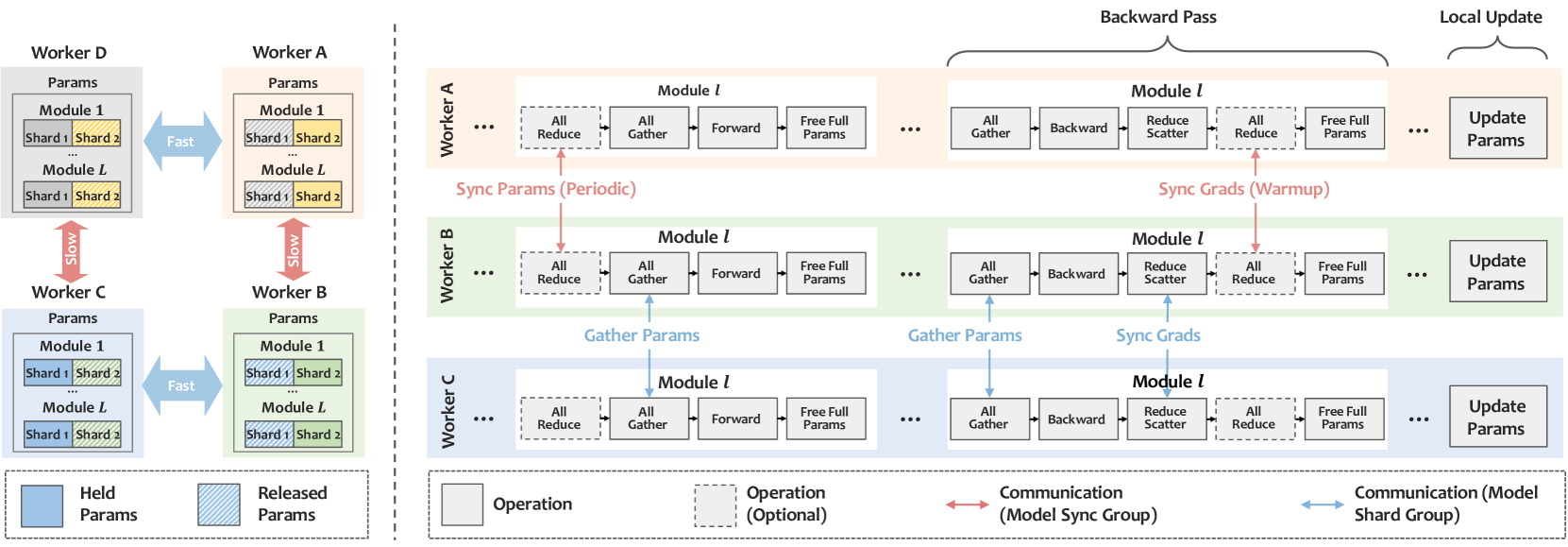
The diagram illustrates a distributed training workflow across multiple workers (A, B, C, D) with modular parameter synchronization and communication. It highlights parameter states (held/released), communication groups (Model Sync Group, Model Shard Group), and training phases (Forward Pass, Backward Pass, Local Update).
### Components/Axes
1. **Workers**:
- **Worker A, B, C, D**: Represent distributed training nodes.
- **Modules**: Each worker contains multiple modules (e.g., Module 1, Module L).
- **Shards**: Parameters within modules are split into shards (e.g., Shard 1, Shard 2).
- **Parameter States**:
- **Held Params**: Blue shading (locked during training).
- **Released Params**: Striped shading (active during training).
2. **Training Phases**:
- **Forward Pass**: Parameters are gathered and forwarded across modules.
- **Backward Pass**: Gradients are reduced, scattered, and synchronized.
- **Local Update**: Parameters are updated locally after gradient synchronization.
3. **Communication**:
- **Model Sync Group**: Red arrows (periodic full-parameter synchronization).
- **Model Shard Group**: Blue arrows (shard-specific communication).
4. **Legend**:
- Blue: Held Params.
- Striped: Released Params.
- Red: Model Sync Group.
- Blue: Model Shard Group.
### Detailed Analysis
- **Worker Grouping**:
- Workers A and D belong to the same **Model Sync Group** (fast communication).
- Workers B and C belong to a separate **Model Shard Group** (slower communication).
- **Parameter Flow**:
- **Forward Pass**: Released parameters are gathered and forwarded across modules.
- **Backward Pass**: Gradients are reduced, scattered, and synchronized (with "Warmup" for stability).
- **Local Update**: Parameters are updated after synchronization.
- **Communication Patterns**:
- **Sync Params (Periodic)**: Full-parameter synchronization occurs periodically.
- **Sync Grads (Warmup)**: Gradient synchronization includes a warmup phase to stabilize updates.
### Key Observations
1. **Communication Efficiency**:
- Workers in the same sync group (A/D) communicate faster than those in different groups (B/C).
- Shard-specific communication (blue arrows) reduces data transfer overhead.
2. **Parameter Management**:
- Held parameters (blue) remain static during training, while released params (striped) are actively updated.
3. **Phase Dependencies**:
- Forward Pass → Backward Pass → Local Update forms a cyclical workflow.
- Gradient synchronization ("Warmup") precedes local updates to ensure stability.
### Interpretation
The diagram demonstrates a structured approach to distributed training, balancing efficiency and consistency. By grouping workers into sync/shard groups, the system minimizes communication latency while ensuring parameter consistency. The periodic full-parameter sync (red arrows) prevents divergence between workers, while shard-specific communication (blue arrows) optimizes data transfer. The "Warmup" phase in gradient synchronization suggests a focus on numerical stability, likely addressing issues like gradient explosion. This workflow is critical for large-scale models where centralized training is impractical.
**Note**: No numerical data or trends are present; the diagram focuses on architectural design and workflow logic.