\n
## Heatmap Grid: Room Classification Rules
### Overview
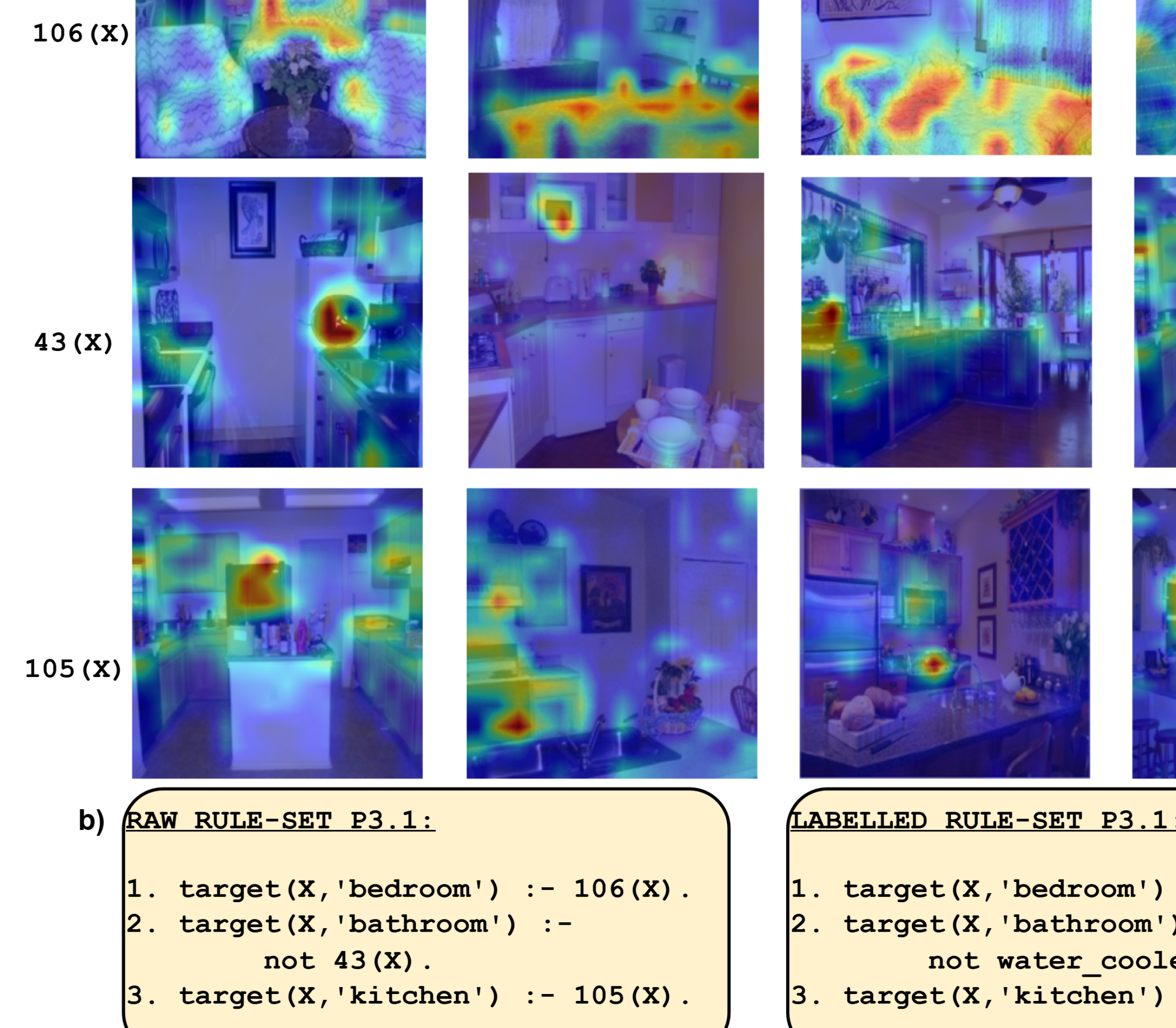
The image presents a 3x3 grid of heatmaps overlaid on interior room scenes, accompanied by two blocks of text detailing rule sets for classifying these rooms. The heatmaps visually represent areas of focus or "attention" within each image, likely indicating features used for classification. The rule sets provide a logical framework for identifying rooms as 'bedroom', 'bathroom', or 'kitchen'.
### Components/Axes
The image consists of:
* **Nine Heatmap Images:** Each image depicts a different room scene with a heatmap overlay.
* **Numerical Labels:** Each heatmap image has a numerical label in the top-left corner (106 (X), 43 (X), 105 (X)).
* **Two Text Blocks:** Located at the bottom of the image, these blocks contain the "RAW RULE-SET P3.1" and "LABELLED RULE-SET P3.1".
* **Rule Set Structure:** Each rule set consists of numbered rules with a specific format: `target(X, 'room_type') :- value (X).`
### Detailed Analysis or Content Details
**Heatmap Images:**
The heatmaps use a color gradient, ranging from blue (low attention) to red/yellow (high attention). The intensity and location of the heatmaps vary across the images, suggesting different features are important for classifying each room.
* **Top Row:**
* Image 1 (106 (X)): Heatmap focuses on the bed and surrounding area.
* Image 2: Heatmap focuses on the sink and counter area.
* Image 3: Heatmap focuses on the window and plants.
* **Middle Row:**
* Image 4 (43 (X)): Heatmap focuses on the toilet and surrounding area.
* Image 5: Heatmap focuses on the sink, counter, and mirror.
* Image 6: Heatmap focuses on the plants and window.
* **Bottom Row:**
* Image 7 (105 (X)): Heatmap focuses on the counter and stove area.
* Image 8: Heatmap focuses on the sink and counter area.
* Image 9: Heatmap focuses on the counter and dining table.
**RAW RULE-SET P3.1:**
1. `target(X, 'bedroom') :- 106(X).` - If X is 106, then the target is 'bedroom'.
2. `target(X, 'bathroom') :- not 43(X).` - If X is not 43, then the target is 'bathroom'.
3. `target(X, 'kitchen') :- 105(X).` - If X is 105, then the target is 'kitchen'.
**LABELLED RULE-SET P3.1:**
1. `target(X, 'bedroom') :- 106(X).` - If X is 106, then the target is 'bedroom'.
2. `target(X, 'bathroom') :- not water_cooler(X).` - If X is not a water cooler, then the target is 'bathroom'.
3. `target(X, 'kitchen') :- 105(X).` - If X is 105, then the target is 'kitchen'.
### Key Observations
* The numerical labels (106, 43, 105) appear to be identifiers for specific room scenes.
* The RAW rule set uses these numerical identifiers directly for classification.
* The LABELLED rule set introduces a new feature, 'water\_cooler', suggesting a more sophisticated classification approach.
* The rule `target(X, 'bathroom') :- not 43(X).` in the RAW rule set is potentially problematic, as it classifies anything *not* 43 as a bathroom, which is overly broad.
* The LABELLED rule set attempts to refine this by using a more specific feature ('water\_cooler').
### Interpretation
The image demonstrates a rule-based approach to room classification using visual features represented by heatmaps. The RAW rule set provides a simple, albeit potentially inaccurate, classification scheme based on numerical identifiers. The LABELLED rule set attempts to improve accuracy by incorporating more meaningful features like the presence or absence of a 'water\_cooler'.
The heatmaps themselves suggest that the system is focusing on key objects and areas within each room to make its classification decisions. For example, the heatmap in the bedroom image focuses on the bed, while the heatmap in the kitchen image focuses on the stove.
The difference between the RAW and LABELLED rule sets highlights the importance of feature engineering in machine learning. By moving from simple numerical identifiers to more descriptive features, the system can potentially achieve higher accuracy and robustness. The introduction of 'water\_cooler' suggests an attempt to address the limitations of the initial rule set and improve the classification of bathrooms. The use of "not" in the rules indicates a negative constraint, which can be useful but also prone to errors if not carefully considered.