## [Composite Image]: Heatmap Grid with Rule Sets
### Overview
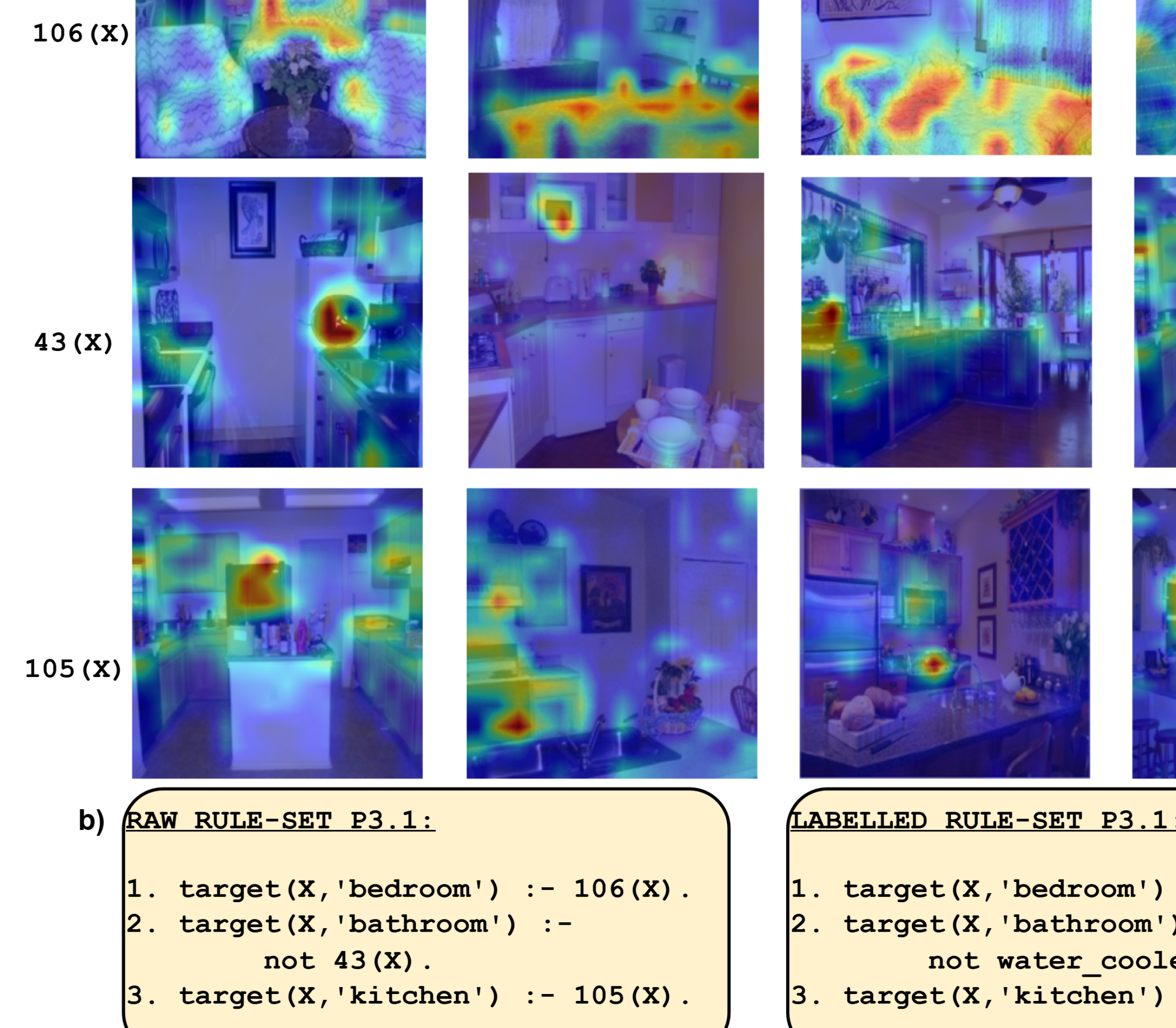
The image is a composite figure containing a grid of nine indoor scene photographs, each overlaid with a colored heatmap (likely representing attention, activation, or saliency from a computer vision model). Below the grid are two text boxes containing logical rule sets. The overall context appears to be from a technical paper or presentation on scene classification or visual reasoning, where heatmaps indicate model focus and rules define classification logic.
### Components/Axes
1. **Heatmap Grid (3x3):**
* **Structure:** Nine individual images arranged in three rows and three columns.
* **Image Identifiers:** To the left of each row, a numeric identifier followed by "(X)" is displayed:
* Top row: `106 (X)`
* Middle row: `43 (X)`
* Bottom row: `105 (X)`
* **Heatmap Overlay:** Each photograph has a semi-transparent color overlay ranging from blue (cool/low) to red (hot/high), indicating regions of interest or high activation.
* **Scene Content:** All images depict indoor domestic environments, primarily kitchens and what appear to be bedrooms or living areas.
2. **Text Boxes (Bottom):**
* **Left Box (b):** Labeled `RAW RULE-SET P3.1:`. Contains three numbered rules in a Prolog-like syntax.
* **Right Box:** Labeled `LABELLED RULE-SET P3.1`. Contains a partially visible, semantically enriched version of the rules from the left box.
### Detailed Analysis
#### Heatmap Grid Content
* **Row 1 (Identifier: 106 (X)):**
* **Image 1 (Top-Left):** Bedroom scene with a bed, pillows, and a small table. Heatmap shows high activation (red/yellow) on the bedspread and pillows.
* **Image 2 (Top-Center):** Kitchen scene with cabinets and a countertop. Heatmap shows strong, scattered activation across the countertop and lower cabinets.
* **Image 3 (Top-Right):** Kitchen/dining area with a table and chairs. Heatmap shows broad, high activation across the table surface and surrounding area.
* **Row 2 (Identifier: 43 (X)):**
* **Image 1 (Middle-Left):** Kitchen corner with a refrigerator. Heatmap shows a very concentrated, high-intensity (red) circular activation on the refrigerator door.
* **Image 2 (Middle-Center):** Kitchen with white cabinets and a dishwasher. Heatmap shows moderate activation on the upper cabinets and a bright spot on a small appliance (possibly a microwave or coffee maker).
* **Image 3 (Middle-Right):** Kitchen with a window and hanging pots. Heatmap shows activation along the countertop and lower cabinets.
* **Row 3 (Identifier: 105 (X)):**
* **Image 1 (Bottom-Left):** Kitchen with an island. Heatmap shows activation on the island countertop and upper cabinets.
* **Image 2 (Bottom-Center):** Kitchen sink area with a window. Heatmap shows activation on the countertop, sink, and a basket.
* **Image 3 (Bottom-Right):** Kitchen with a wine rack and countertop appliances. Heatmap shows a focused activation point on the countertop near a bowl of fruit.
#### Text Box Content (Transcription)
**Left Box (b): RAW RULE-SET P3.1:**
```
1. target(X,'bedroom') :- 106(X).
2. target(X,'bathroom') :- not 43(X).
3. target(X,'kitchen') :- 105(X).
```
**Right Box: LABELLED RULE-SET P3.1:**
```
1. target(X,'bedroom') :- ...
2. target(X,'bathroom') :- not water_cooler...
3. target(X,'kitchen') :- ...
```
*(Note: The right box is partially cropped. The transcribed text is what is visible. The ellipses (...) indicate where text is cut off.)*
### Key Observations
1. **Heatmap Specificity:** The heatmaps are not uniform. Some, like the refrigerator in `43(X)` row 1, show extremely localized activation. Others, like the tables in `106(X)` row 2 and 3, show broader activation across surfaces.
2. **Identifier-Scene Association:** The numeric identifiers (`106`, `43`, `105`) are associated with specific visual features highlighted by the heatmaps, which are then used in the rule set.
3. **Rule Set Logic:** The raw rule set uses the identifiers as predicates.
* Rule 1: If feature `106` is present in image `X`, classify it as a 'bedroom'.
* Rule 2: If feature `43` is *not* present in image `X`, classify it as a 'bathroom'.
* Rule 3: If feature `105` is present in image `X`, classify it as a 'kitchen'.
4. **Semantic Labeling:** The labelled rule set begins to replace the numeric identifiers with semantic concepts (e.g., `43(X)` becomes `not water_cooler...`). This suggests `43` might correspond to a "water cooler" feature, and its absence is indicative of a bathroom.
### Interpretation
This image illustrates a pipeline for **explainable scene classification**. The heatmaps provide visual evidence of what features a model uses (e.g., beds for bedrooms, countertops for kitchens, a specific appliance for non-bathrooms). The rule sets translate these visual features into human-readable, logical classification rules.
* **Data Suggestion:** The system demonstrates that complex scene recognition can be decomposed into detecting specific, localized visual concepts. The high activation on the refrigerator (`43`) is particularly notable as a strong negative indicator for a bathroom.
* **Element Relationships:** The heatmaps are the *grounding* for the symbolic rules. Each numeric predicate (`106`, `43`, `105`) in the raw rule set corresponds to a specific pattern of visual activation shown in the grid. The labelled rule set represents the next step: interpreting those patterns as named objects or concepts.
* **Anomalies/Patterns:** The rule for 'bathroom' is defined by the *absence* of a feature (`not 43(X)`), which is a common logical construct but interesting in a visual context. It implies the model identifies bathrooms partly by what they lack (e.g., a prominent water cooler or similar appliance found in kitchens). The heatmaps for the `105` (kitchen) identifier consistently highlight countertops and appliances, reinforcing the rule's validity.