## Diagram: Commutative Diagram of Mathematical Objects
### Overview
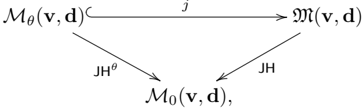
The image presents a commutative diagram illustrating relationships between mathematical objects. It involves three objects labeled as $\mathcal{M}_{\theta}(\mathbf{v}, \mathbf{d})$, $\mathcal{M}(\mathbf{v}, \mathbf{d})$, and $\mathcal{M}_{0}(\mathbf{v}, \mathbf{d})$, connected by arrows representing morphisms or transformations.
### Components/Axes
* **Nodes:**
* Top-left: $\mathcal{M}_{\theta}(\mathbf{v}, \mathbf{d})$
* Top-right: $\mathfrak{M}(\mathbf{v}, \mathbf{d})$
* Bottom-center: $\mathcal{M}_{0}(\mathbf{v}, \mathbf{d})$
* **Arrows:**
* From $\mathcal{M}_{\theta}(\mathbf{v}, \mathbf{d})$ to $\mathfrak{M}(\mathbf{v}, \mathbf{d})$: Labeled "j"
* From $\mathcal{M}_{\theta}(\mathbf{v}, \mathbf{d})$ to $\mathcal{M}_{0}(\mathbf{v}, \mathbf{d})$: Labeled "JH$^{\theta}$"
* From $\mathfrak{M}(\mathbf{v}, \mathbf{d})$ to $\mathcal{M}_{0}(\mathbf{v}, \mathbf{d})$: Labeled "JH"
### Detailed Analysis
The diagram shows the following relationships:
1. The object $\mathcal{M}_{\theta}(\mathbf{v}, \mathbf{d})$ maps to $\mathfrak{M}(\mathbf{v}, \mathbf{d})$ via a morphism denoted by "j".
2. The object $\mathcal{M}_{\theta}(\mathbf{v}, \mathbf{d})$ also maps to $\mathcal{M}_{0}(\mathbf{v}, \mathbf{d})$ via a morphism denoted by "JH$^{\theta}$".
3. The object $\mathfrak{M}(\mathbf{v}, \mathbf{d})$ maps to $\mathcal{M}_{0}(\mathbf{v}, \mathbf{d})$ via a morphism denoted by "JH".
The diagram implies that the composition of the morphisms from $\mathcal{M}_{\theta}(\mathbf{v}, \mathbf{d})$ to $\mathfrak{M}(\mathbf{v}, \mathbf{d})$ and then from $\mathfrak{M}(\mathbf{v}, \mathbf{d})$ to $\mathcal{M}_{0}(\mathbf{v}, \mathbf{d})$ is equivalent to the direct morphism from $\mathcal{M}_{\theta}(\mathbf{v}, \mathbf{d})$ to $\mathcal{M}_{0}(\mathbf{v}, \mathbf{d})$. This is the essence of a commutative diagram.
### Key Observations
* The diagram illustrates a commutative relationship between three mathematical objects and their connecting morphisms.
* The labels "JH" and "JH$^{\theta}$" likely represent specific mathematical operations or transformations.
* The object $\mathcal{M}_{\theta}(\mathbf{v}, \mathbf{d})$ appears to be a starting point, with transformations leading to both $\mathfrak{M}(\mathbf{v}, \mathbf{d})$ and $\mathcal{M}_{0}(\mathbf{v}, \mathbf{d})$.
### Interpretation
This diagram likely represents a mathematical theorem or construction where the transformation from $\mathcal{M}_{\theta}(\mathbf{v}, \mathbf{d})$ to $\mathcal{M}_{0}(\mathbf{v}, \mathbf{d})$ can be achieved either directly via "JH$^{\theta}$" or indirectly via "j" followed by "JH". The commutativity of the diagram ensures that both paths yield the same result. The specific meaning of $\mathcal{M}_{\theta}(\mathbf{v}, \mathbf{d})$, $\mathfrak{M}(\mathbf{v}, \mathbf{d})$, $\mathcal{M}_{0}(\mathbf{v}, \mathbf{d})$, "j", "JH", and "JH$^{\theta}$" would depend on the context in which this diagram is used.