## Diagram Type: Flowchart
### Overview
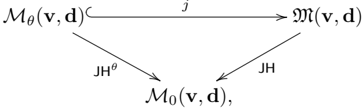
This flowchart represents the relationship between three mathematical functions: \( \mathcal{M}_0(v, d) \), \( \mathcal{M}_\theta(v, d) \), and \( \mathcal{M}(v, d) \). The diagram shows the flow of information from one function to another, indicating how each function is derived or transformed from the previous one.
### Components/Axes
- **\( \mathcal{M}_0(v, d) \)**: This is the starting point of the flowchart.
- **\( \mathcal{M}_\theta(v, d) \)**: This function is derived from \( \mathcal{M}_0(v, d) \) through a transformation labeled \( JH^\theta \).
- **\( \mathcal{M}(v, d) \)**: This is the final function, which is derived from \( \mathcal{M}_\theta(v, d) \) through another transformation labeled \( JH \).
### Detailed Analysis or Content Details
- **\( \mathcal{M}_0(v, d) \)** is the base function, which serves as the foundation for the subsequent transformations.
- **\( \mathcal{M}_\theta(v, d) \)** is the function that is derived from \( \mathcal{M}_0(v, d) \) by applying a transformation \( JH^\theta \). This transformation is likely a scaling or shifting operation that modifies the values of \( v \) and \( d \).
- **\( \mathcal{M}(v, d) \)** is the final function, which is derived from \( \mathcal{M}_\theta(v, d) \) by applying a transformation \( JH \). This transformation is likely another scaling or shifting operation that further modifies the values of \( v \) and \( d \).
### Key Observations
- The flowchart indicates that \( \mathcal{M}(v, d) \) is derived from both \( \mathcal{M}_0(v, d) \) and \( \mathcal{M}_\theta(v, d) \), suggesting that \( \mathcal{M}_\theta(v, d) \) is an intermediate step in the derivation of \( \mathcal{M}(v, d) \).
- The transformations \( JH^\theta \) and \( JH \) are applied to \( \mathcal{M}_0(v, d) \) and \( \mathcal{M}_\theta(v, d) \) respectively, indicating that each transformation modifies the values of \( v \) and \( d \) in a specific way.
### Interpretation
The flowchart suggests that the functions \( \mathcal{M}_0(v, d) \), \( \mathcal{M}_\theta(v, d) \), and \( \mathcal{M}(v, d) \) are related through a series of transformations. The transformations \( JH^\theta \) and \( JH \) likely represent scaling or shifting operations that modify the values of \( v \) and \( d \). The flowchart indicates that \( \mathcal{M}(v, d) \) is derived from both \( \mathcal{M}_0(v, d) \) and \( \mathcal{M}_\theta(v, d) \), suggesting that \( \mathcal{M}_\theta(v, d) \) is an intermediate step in the derivation of \( \mathcal{M}(v, d) \). The transformations \( JH^\theta \) and \( JH \) are applied to \( \mathcal{M}_0(v, d) \) and \( \mathcal{M}_\theta(v, d) \) respectively, indicating that each transformation modifies the values of \( v \) and \( d \) in a specific way. The flowchart provides a visual representation of the relationship between the functions and the transformations applied to them.