## Diagram Type: Commutative Diagram of Moduli Spaces
### Overview
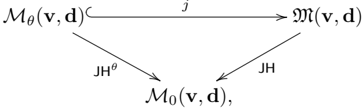
This image is a mathematical commutative diagram illustrating the relationships between three different moduli spaces, denoted by script and fraktur 'M' symbols with various subscripts and parameters. The diagram consists of three objects (nodes) and three morphisms (arrows) connecting them, forming a triangle.
### Components
#### Objects (Nodes)
The diagram features three mathematical objects, likely representing moduli spaces, positioned at the vertices of a triangle:
1. **Top-Left:** `ℳ_θ(v, d)` (Script M with subscript θ, dependent on parameters v and d).
2. **Top-Right:** `𝔐(v, d)` (Fraktur M, dependent on parameters v and d).
3. **Bottom-Center:** `ℳ_0(v, d)` (Script M with subscript 0, dependent on parameters v and d).
#### Morphisms (Arrows)
There are three maps connecting these objects:
1. **Top Arrow (`j`):** A hooked arrow pointing from `ℳ_θ(v, d)` to `𝔐(v, d)`. The hook at the tail (`⊂`) indicates that this is an inclusion or embedding map. It is labeled with the letter `j`.
2. **Left-Diagonal Arrow (`JH^θ`):** An arrow pointing from `ℳ_θ(v, d)` down to `ℳ_0(v, d)`. It is labeled with `JH^θ` (JH with superscript θ).
3. **Right-Diagonal Arrow (`JH`):** An arrow pointing from `𝔐(v, d)` down to `ℳ_0(v, d)`. It is labeled with `JH`.
### Diagram Flow and Relations
The arrangement of the objects and arrows implies that the diagram is commutative. This means that following the path from `ℳ_θ(v, d)` to `ℳ_0(v, d)` via `𝔐(v, d)` (composing map `j` with map `JH`) yields the same result as the direct map `JH^θ`.
Mathematically, this relationship can be expressed as:
`JH ∘ j = JH^θ`
### Interpretation
Based on standard notation in algebraic geometry and the theory of moduli spaces (particularly Geometric Invariant Theory):
* `ℳ_θ(v, d)` likely represents a moduli space of **θ-stable** objects with invariants `(v, d)`.
* `𝔐(v, d)` likely represents a larger moduli stack or space of all (possibly semistable or unstable) objects with invariants `(v, d)`.
* `ℳ_0(v, d)` likely represents a moduli space of **S-equivalence classes** of semistable objects, often constructed as a categorical quotient.
* The map `j` is the inclusion of the stable locus into the larger space.
* The maps `JH` and `JH^θ` are likely related to **Jordan-Hölder filtrations**, sending an object to its associated graded object (which represents its S-equivalence class).
* The commutativity of the diagram expresses the consistency of these maps: for a θ-stable object, its image under the general Jordan-Hölder map `JH` (after inclusion into `𝔐`) is the same as its image under the specific map `JH^θ`.