## Diagram: Hierarchical Fuzzy Logic System
### Overview
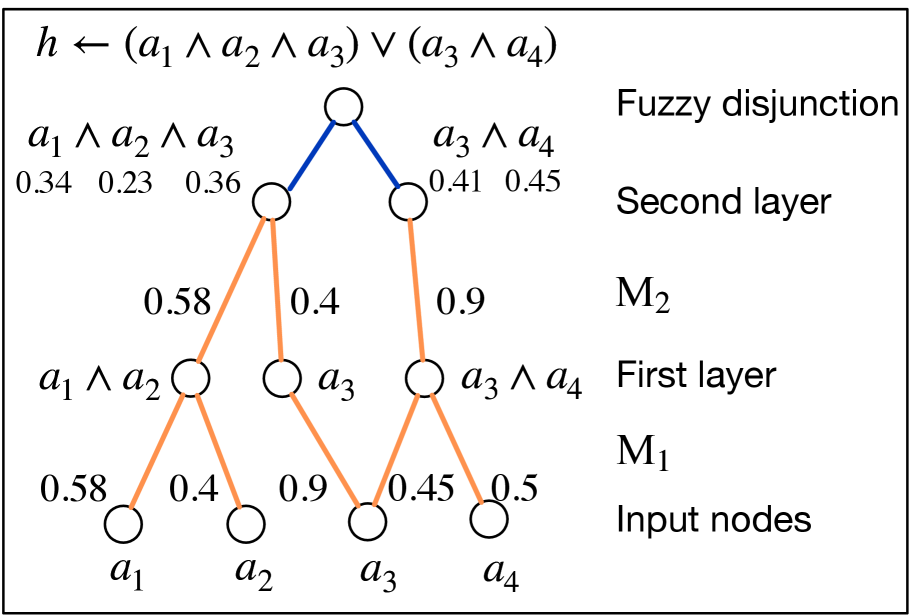
The image displays a hierarchical tree diagram representing a fuzzy logic inference system. It visually decomposes a complex logical rule into simpler, interconnected components across multiple layers. The system computes an output `h` based on four input variables (`a₁`, `a₂`, `a₃`, `a₄`) through a series of fuzzy conjunction (AND) and disjunction (OR) operations, with associated numerical values likely representing membership degrees or rule strengths.
### Components/Axes
The diagram is structured vertically into distinct layers, labeled on the right side from bottom to top:
* **Input nodes**: The base layer containing four nodes labeled `a₁`, `a₂`, `a₃`, and `a₄`.
* **M₁**: A label for the first set of connections/weights from the input nodes to the first layer.
* **First layer**: Contains three nodes representing intermediate fuzzy conjunctions: `a₁ ∧ a₂`, `a₃`, and `a₃ ∧ a₄`.
* **M₂**: A label for the second set of connections/weights from the first layer to the second layer.
* **Second layer**: Contains two nodes representing higher-level conjunctions: `a₁ ∧ a₂ ∧ a₃` and `a₃ ∧ a₄`.
* **Fuzzy disjunction**: The top layer, represented by a single node that combines the outputs of the second layer using a logical OR (∨) operation.
**Title/Header**: The overarching logical rule is stated at the top: `h ← (a₁ ∧ a₂ ∧ a₃) ∨ (a₃ ∧ a₄)`.
**Connections & Color Coding**:
* **Orange lines**: Connect nodes within the lower three layers (Input to First, First to Second). These represent the flow of fuzzy conjunction operations.
* **Blue lines**: Connect the two nodes of the Second layer to the top Fuzzy disjunction node. This represents the final fuzzy disjunction (OR) operation.
### Detailed Analysis
**1. Input Nodes (Bottom Layer):**
* Nodes: `a₁`, `a₂`, `a₃`, `a₄`.
* Associated numerical values (likely initial membership degrees or input strengths):
* Near `a₁`: `0.58`
* Near `a₂`: `0.4`
* Near `a₃`: `0.9`
* Between `a₃` and `a₄`: `0.45` and `0.5` (These values are positioned along the connections from `a₃` and `a₄` to the `a₃ ∧ a₄` node in the first layer).
**2. First Layer (Fuzzy Conjunctions):**
* **Node `a₁ ∧ a₂`**: Receives inputs from `a₁` (value `0.58`) and `a₂` (value `0.4`).
* **Node `a₃`**: Receives input directly from `a₃` (value `0.9`).
* **Node `a₃ ∧ a₄`**: Receives inputs from `a₃` (value `0.45`) and `a₄` (value `0.5`).
**3. Second Layer (Higher-Order Conjunctions):**
* **Node `a₁ ∧ a₂ ∧ a₃`**: Receives inputs from the `a₁ ∧ a₂` node (connection value `0.58`) and the `a₃` node (connection value `0.4`).
* Output values listed below this node: `0.34`, `0.23`, `0.36`.
* **Node `a₃ ∧ a₄`**: Receives input from the `a₃ ∧ a₄` node in the first layer (connection value `0.9`).
* Output values listed below this node: `0.41`, `0.45`.
**4. Top Layer (Fuzzy Disjunction):**
* The single node combines the outputs from the two second-layer nodes via blue connection lines.
* The logical operation performed here is the OR (∨) of `(a₁ ∧ a₂ ∧ a₃)` and `(a₃ ∧ a₄)` to produce the final output `h`.
### Key Observations
1. **Hierarchical Decomposition**: The diagram clearly breaks down the complex rule `h ← (a₁ ∧ a₂ ∧ a₃) ∨ (a₃ ∧ a₄)` into a computable network of simpler AND operations, culminating in a final OR operation.
2. **Dual Pathways**: There are two distinct pathways to activate the output `h`:
* **Pathway 1**: Requires the conjunction of `a₁`, `a₂`, and `a₃`.
* **Pathway 2**: Requires the conjunction of `a₃` and `a₄`.
* Variable `a₃` is critical, as it is a necessary component in both pathways.
3. **Numerical Flow**: Numerical values are propagated and transformed through the network. The values at the input nodes (`0.58`, `0.4`, `0.9`, `0.45`, `0.5`) are processed through the conjunction nodes, resulting in different output values at the second layer (`0.34, 0.23, 0.36` and `0.41, 0.45`).
4. **Visual Encoding**: The use of orange lines for conjunctions and blue lines for the final disjunction provides a clear visual distinction between the types of logical operations being performed at different stages.
### Interpretation
This diagram is a **fuzzy inference system** or a **fuzzy neural network** structure. It models a rule-based decision process where conditions are not simply true or false but have degrees of membership (represented by the numerical values).
* **What it demonstrates**: The system shows how to evaluate a compound logical statement (`h`) by computing the truth value of its sub-expressions in a layered, modular fashion. Each node performs a fuzzy AND (typically modeled as a `min` operation) on its inputs, and the top node performs a fuzzy OR (typically a `max` operation).
* **Relationship between elements**: The lower layers handle specific, granular conditions (`a₁ AND a₂`, `a₃ AND a₄`). These results are then combined into more general conditions (`a₁ AND a₂ AND a₃`). The top layer makes the final decision by checking if *any* of the high-level conditions is sufficiently true.
* **Notable patterns/anomalies**: The presence of multiple numerical values under the second-layer nodes (`0.34, 0.23, 0.36` and `0.41, 0.45`) is interesting. They may represent:
* The membership values for each input variable contributing to that node's output.
* Different possible output strengths based on different fuzzy inference methods (e.g., product vs. minimum).
* The values could also be weights (`M₁`, `M₂`) associated with the connections, though their placement suggests they are node outputs.
* **Underlying Meaning**: This structure is used in control systems, decision-making algorithms, and AI to handle uncertainty and imprecise data. It translates human-like, linguistic rules (e.g., "If conditions A, B, and C are true, or if conditions C and D are true, then do H") into a mathematical framework that can process numerical inputs. The specific numerical values would determine the final strength of the output `h` for a given set of inputs `a₁-a₄`.