## Flowchart: Fuzzy Logic System Architecture
### Overview
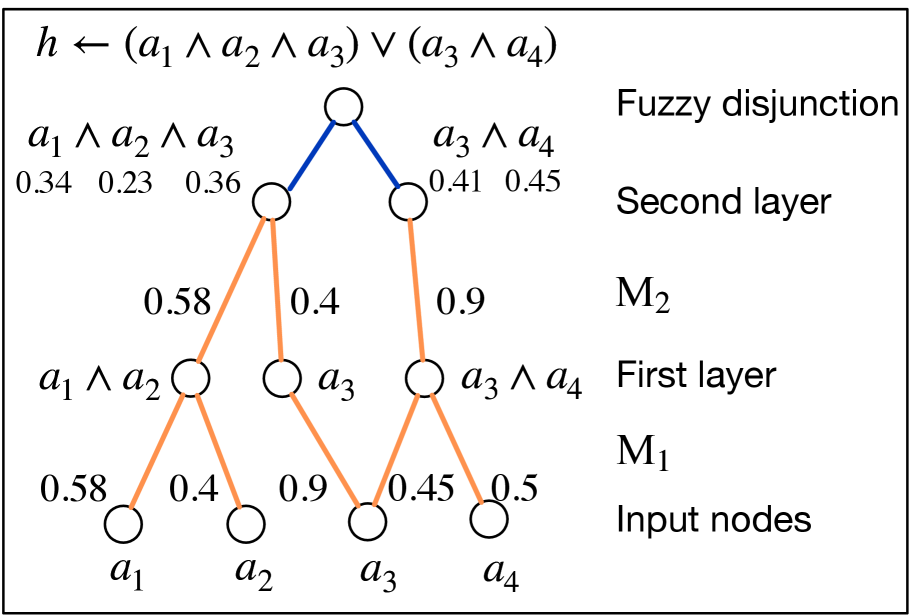
The image depicts a hierarchical fuzzy logic system with input nodes, two processing layers (M1 and M2), and a final output node (h). The system combines input variables (a1-a4) through AND/OR operations with weighted edges, culminating in a disjunctive output.
### Components/Axes
- **Nodes**:
- **Input Layer (M1)**: Four nodes labeled a1 (0.34), a2 (0.23), a3 (0.36), a4 (0.45)
- **First Layer (M1)**: Three nodes combining inputs via AND operations:
- a1 ∧ a2 (0.58)
- a3 (0.4)
- a3 ∧ a4 (0.45)
- **Second Layer (M2)**: Two nodes combining first-layer outputs via OR operations:
- (a1 ∧ a2 ∧ a3) (0.58)
- (a3 ∧ a4) (0.41)
- **Output Node (h)**: Final disjunction of second-layer results (0.9)
- **Edges**:
- Colored orange (first layer) and blue (second layer)
- Weights shown as decimal values (e.g., 0.58, 0.4)
- **Legend**:
- Right-aligned, with:
- Blue: "Fuzzy disjunction" (OR operations)
- Orange: "Second layer" (M2)
### Detailed Analysis
1. **Input Nodes (M1)**:
- a1: 0.34
- a2: 0.23
- a3: 0.36
- a4: 0.45
2. **First Layer (M1)**:
- a1 ∧ a2: 0.58 (AND operation)
- a3: 0.4 (direct pass-through)
- a3 ∧ a4: 0.45 (AND operation)
3. **Second Layer (M2)**:
- (a1 ∧ a2 ∧ a3): 0.58 (OR operation combining first-layer nodes)
- (a3 ∧ a4): 0.41 (OR operation combining first-layer nodes)
4. **Output Node (h)**:
- h ← (a1 ∧ a2 ∧ a3) ∨ (a3 ∧ a4): 0.9 (final fuzzy disjunction)
### Key Observations
- **Weight Distribution**:
- Highest weight (0.9) on a3 ∧ a4 edge suggests dominant influence from a3 and a4
- Lowest input weight (0.23) on a2 indicates weakest individual contribution
- **Layer Progression**:
- First-layer weights decrease from 0.58 to 0.4
- Second-layer weights increase from 0.41 to 0.58
- **Final Output**:
- h = 0.9 demonstrates strong system activation despite mixed input strengths
### Interpretation
This architecture implements a fuzzy logic system where:
1. **Input Aggregation**: Weak individual inputs (a1-a4) are combined through AND operations to form intermediate nodes
2. **Path Diversification**: Two distinct paths emerge:
- Path 1: a1 ∧ a2 ∧ a3 (0.58)
- Path 2: a3 ∧ a4 (0.41)
3. **Disjunctive Synthesis**: The final OR operation (fuzzy disjunction) combines these paths, with the a3 ∧ a4 path showing stronger influence despite lower individual weights
The system appears designed to:
- Amplify correlated inputs (a3 appears in both paths)
- Create redundancy through parallel processing
- Produce a robust output (0.9) even with moderate input strengths
Notable anomaly: The a3 node (0.36) has higher weight than a1 (0.34) despite lower input value, suggesting a3 plays a more critical role in the system's logic.