## Textual Content Analysis: Animal Survival Mechanisms and Arctic Fox Adaptation
### Overview
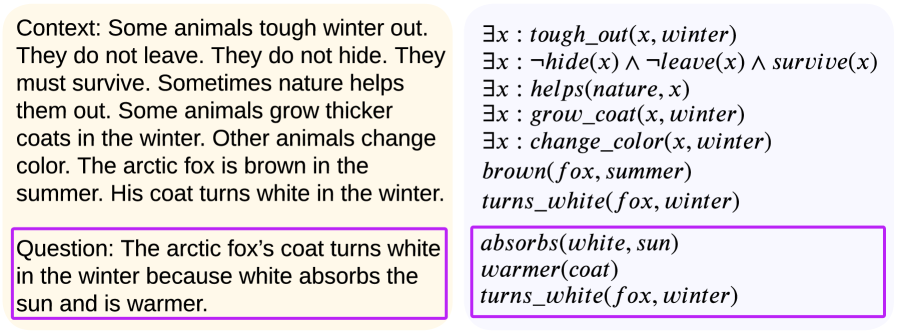
The image contains two distinct text blocks. The left block provides biological context about animal survival strategies in winter, while the right block presents logical formalisms and a question-answer pair about Arctic fox coat coloration. Both sections include highlighted text elements.
### Components/Axes
**Left Block (Context):**
- **Text Content:**
- "Some animals tough winter out. They do not leave. They do not hide. They must survive. Sometimes nature helps them out. Some animals grow thicker coats in the winter. Other animals change color. The arctic fox is brown in the summer. His coat turns white in the winter."
- **Highlighted Text:**
- Question: "The arctic fox’s coat turns white in the winter because white absorbs the sun and is warmer."
- Position: Bottom-left quadrant, enclosed in a purple rectangular border.
**Right Block (Logical Formalism):**
- **Logical Expressions:**
- ∃ₓ : tough_out(x, winter)
- ∃ₓ : ¬hide(x) ∧ ¬leave(x) ∧ survive(x)
- ∃ₓ : helps(nature, x)
- ∃ₓ : grow_coat(x, winter)
- ∃ₓ : change_color(x, winter)
- brown(fox, summer)
- turns_white(fox, winter)
- **Highlighted Text:**
- Answer: "absorbs(white, sun) warmer(coat) turns_white(fox, winter)"
- Position: Bottom-right quadrant, enclosed in a purple rectangular border.
### Detailed Analysis
**Left Block Structure:**
1. **Survival Strategies:**
- Animals that "tough out" winter (∃ₓ : tough_out(x, winter))
- Non-migratory/non-hiding behavior (∃ₓ : ¬hide(x) ∧ ¬leave(x) ∧ survive(x))
- Natural assistance mechanisms (∃ₓ : helps(nature, x))
2. **Adaptation Mechanisms:**
- Thicker coat growth (∃ₓ : grow_coat(x, winter))
- Color change (∃ₓ : change_color(x, winter))
3. **Arctic Fox Specifics:**
- Seasonal coloration: brown in summer (brown(fox, summer)), white in winter (turns_white(fox, winter))
**Right Block Structure:**
1. **Logical Framework:**
- Existential quantifiers (∃ₓ) for animal behaviors
- Negation (¬) for non-hiding/non-leaving
- Conjunction (∧) for combined survival conditions
2. **Highlighted Answer Analysis:**
- Contains three triples:
- absorbs(white, sun)
- warmer(coat)
- turns_white(fox, winter)
### Key Observations
1. **Highlighted Contradiction:**
- The answer claims "white absorbs the sun and is warmer," which contradicts basic physics (white reflects sunlight, black absorbs heat).
2. **Logical Completeness:**
- The formalism includes all mentioned survival strategies but lacks explicit connections between color change and survival advantages.
3. **Spatial Organization:**
- Left block: Contextual narrative (top-left)
- Right block: Formal logic + QA (top-right)
- Highlighted elements: Bottom quadrants
### Interpretation
The image juxtaposes biological narrative with formal logic to explore Arctic fox adaptation. While the context correctly identifies seasonal color change as a survival mechanism, the highlighted answer contains a factual error regarding heat absorption. The logical formalism successfully captures the described behaviors but fails to incorporate the (incorrect) reasoning about thermal properties. This suggests either:
1. A deliberate test of logical vs. factual reasoning
2. An error in the answer key
3. An incomplete formalization of the biological mechanism
The structured presentation implies this could be part of an educational module testing both biological knowledge and logical formalization skills. The spatial separation of context and formalism may encourage cross-referencing between narrative and symbolic representations.