\n
## Textual Document: Logical Reasoning Example
### Overview
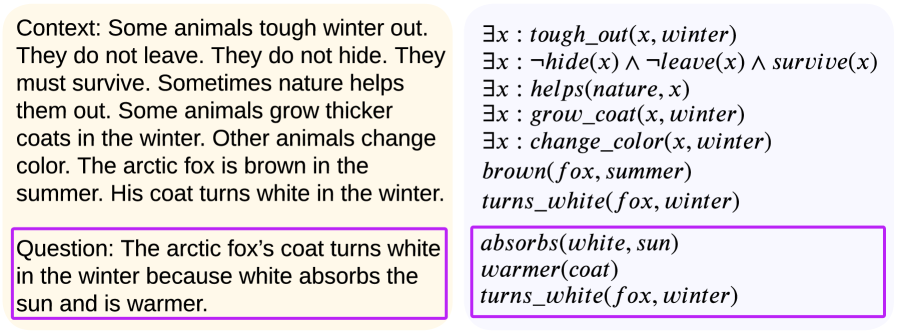
The image presents a logical reasoning example, contrasting a natural language context and question with a formal logical representation. The document is split into two main columns, with highlighted sections indicating key information.
### Components/Axes
The image consists of three distinct text blocks, each highlighted with a different color:
* **Yellow:** Contextual information in natural language.
* **Purple:** A question posed in natural language.
* **Light Blue:** Logical statements representing the context and question.
### Detailed Analysis or Content Details
**Column 1 (Yellow & Purple):**
* **Context:** "Some animals tough winter out. They do not leave. They do not hide. They must survive. Sometimes nature helps them out. Some animals grow thicker coats in the winter. Other animals change color. The arctic fox is brown in the summer. His coat turns white in the winter."
* **Question:** "The arctic fox’s coat turns white in the winter because white absorbs the sun and is warmer."
**Column 2 (Light Blue):**
* `∃x : tough_out(x, winter)` - There exists an x such that x toughs out winter.
* `∃x : ¬hide(x) ∧ ¬leave(x) ∧ survive(x)` - There exists an x such that x does not hide and x does not leave and x survives.
* `∃x : helps(nature, x)` - There exists an x such that nature helps x.
* `∃x : grow_coat(x, winter)` - There exists an x such that x grows a coat in winter.
* `∃x : change_color(x, winter)` - There exists an x such that x changes color in winter.
* `brown(fox, summer)` - The fox is brown in the summer.
* `turns_white(fox, winter)` - The fox turns white in the winter.
* `absorbs(white, sun)` - White absorbs the sun.
* `warmer(coat)` - The coat is warmer.
* `turns_white(fox, winter)` - The fox turns white in the winter.
### Key Observations
The logical statements attempt to formalize the natural language context and question. The question is presented as a claim that can be evaluated based on the provided context. The use of existential quantifiers (`∃x`) indicates that the statements apply to at least one entity. The logical notation uses predicates like `tough_out`, `hide`, `leave`, `survive`, `helps`, `grow_coat`, `change_color`, `brown`, `turns_white`, `absorbs`, and `warmer`.
### Interpretation
This example demonstrates the translation of natural language reasoning into formal logic. The context establishes a scenario involving animals surviving winter, and the arctic fox specifically. The question proposes a reason for the fox's coat color change – that white absorbs the sun and is warmer. The logical representation aims to capture these ideas in a precise, unambiguous form. The repetition of `turns_white(fox, winter)` in the logical statements suggests an emphasis on this fact. The example is likely used to illustrate how logical reasoning can be applied to understand and evaluate natural language claims. The question itself is likely intended to be evaluated as true or false based on the context and the logical representation. The claim that white absorbs the sun and is warmer is scientifically incorrect, which may be a deliberate element of the example to highlight the importance of verifying the truthfulness of premises.