## Line Chart: Ecosystem Job Trends (2018-2023)
### Overview
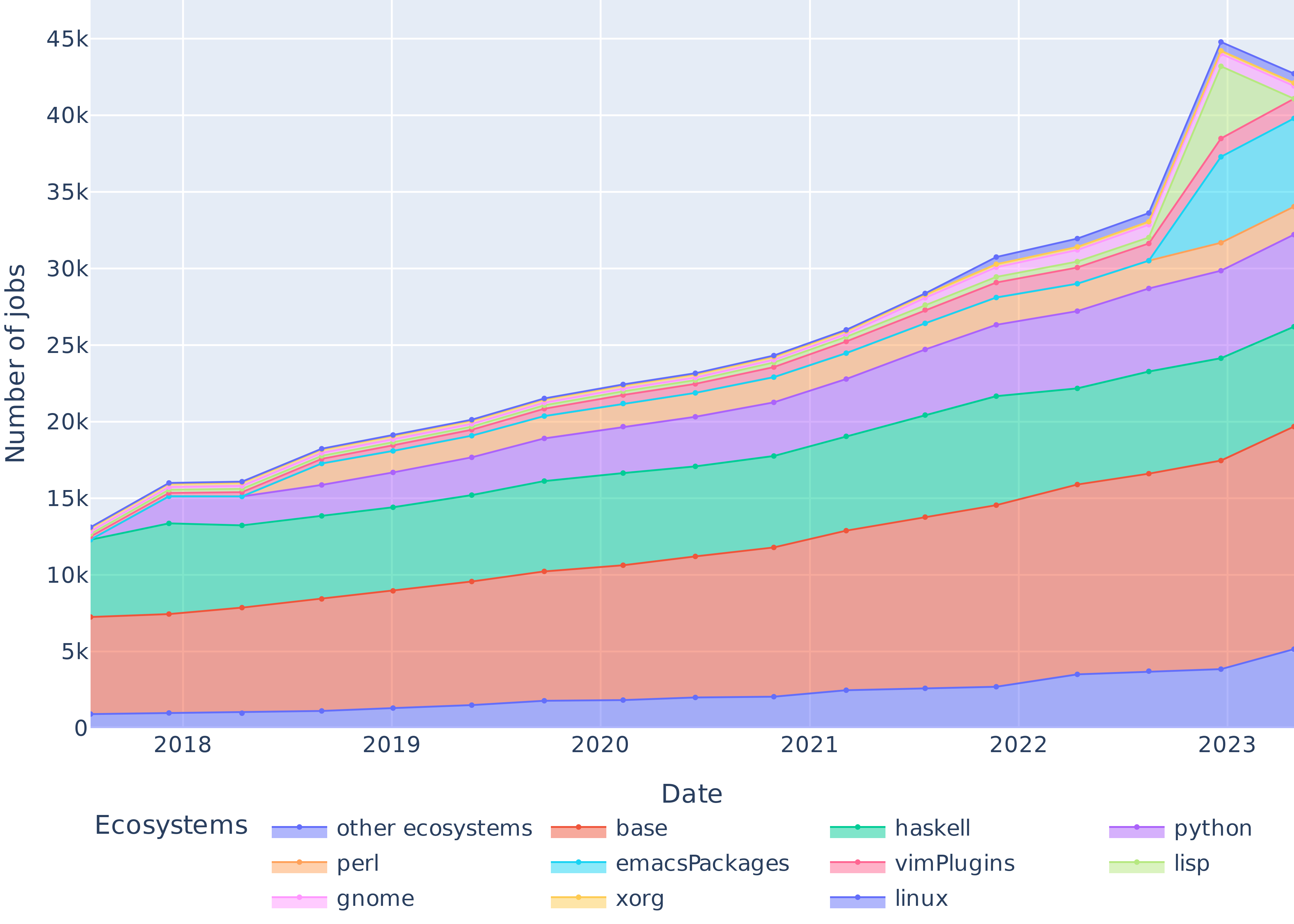
This line chart depicts the trend of job postings related to various software ecosystems from 2018 to 2023. The y-axis represents the "Number of Jobs" (in thousands), and the x-axis represents the "Date" (years 2018 through 2023). Multiple colored lines represent the job posting trends for each ecosystem. The chart includes a legend at the bottom identifying each ecosystem with its corresponding color.
### Components/Axes
* **X-axis:** "Date" - Years 2018, 2019, 2020, 2021, 2022, 2023.
* **Y-axis:** "Number of Jobs" - Scale ranges from 0 to 45,000, with increments of 5,000. The scale is represented in 'k' (thousands).
* **Legend:** Located at the bottom of the chart, listing the following ecosystems and their corresponding colors:
* Python (Blue)
* Other Ecosystems (Grey)
* Perl (Orange)
* Base (Green)
* Haskell (Teal)
* EmacsPackages (Pink)
* VimPlugins (Purple)
* Gnome (Magenta)
* Xorg (Yellow)
* Lisp (Light Green)
* Linux (Dark Blue)
### Detailed Analysis
The chart displays the number of job postings over time for each ecosystem. Here's a breakdown of the trends and approximate data points, verified by color matching with the legend:
* **Python (Blue):** Shows a consistent upward trend throughout the period.
* 2018: ~15k
* 2019: ~18k
* 2020: ~22k
* 2021: ~28k
* 2022: ~35k
* 2023: ~42k
* **Other Ecosystems (Grey):** Displays a generally increasing trend, but with more fluctuations.
* 2018: ~14k
* 2019: ~16k
* 2020: ~19k
* 2021: ~23k
* 2022: ~28k
* 2023: ~35k
* **Perl (Orange):** Shows a relatively flat trend, with a slight decline towards the end.
* 2018: ~5k
* 2019: ~5k
* 2020: ~5k
* 2021: ~4k
* 2022: ~3k
* 2023: ~2k
* **Base (Green):** Shows a steady, moderate increase.
* 2018: ~10k
* 2019: ~12k
* 2020: ~15k
* 2021: ~18k
* 2022: ~23k
* 2023: ~28k
* **Haskell (Teal):** Shows a moderate increase, with some fluctuations.
* 2018: ~3k
* 2019: ~4k
* 2020: ~5k
* 2021: ~7k
* 2022: ~10k
* 2023: ~13k
* **EmacsPackages (Pink):** Shows a slight increase, remaining relatively low.
* 2018: ~2k
* 2019: ~2k
* 2020: ~3k
* 2021: ~3k
* 2022: ~4k
* 2023: ~5k
* **VimPlugins (Purple):** Shows a slight increase, remaining relatively low.
* 2018: ~2k
* 2019: ~2k
* 2020: ~3k
* 2021: ~4k
* 2022: ~5k
* 2023: ~6k
* **Gnome (Magenta):** Shows a moderate increase.
* 2018: ~3k
* 2019: ~4k
* 2020: ~5k
* 2021: ~7k
* 2022: ~9k
* 2023: ~11k
* **Xorg (Yellow):** Shows a slight decline.
* 2018: ~3k
* 2019: ~3k
* 2020: ~2k
* 2021: ~2k
* 2022: ~1k
* 2023: ~1k
* **Lisp (Light Green):** Shows a slight increase, remaining relatively low.
* 2018: ~1k
* 2019: ~1k
* 2020: ~2k
* 2021: ~2k
* 2022: ~3k
* 2023: ~4k
* **Linux (Dark Blue):** Shows a moderate increase.
* 2018: ~4k
* 2019: ~5k
* 2020: ~7k
* 2021: ~9k
* 2022: ~12k
* 2023: ~15k
### Key Observations
* Python consistently has the highest number of job postings and exhibits the strongest growth.
* "Other Ecosystems" represents a significant portion of job postings, and its trend is similar to Python, though slightly lower.
* Perl and Xorg show declining or stagnant trends, indicating decreasing demand.
* The job postings for most ecosystems have increased significantly between 2018 and 2023.
* There's a noticeable surge in job postings across most ecosystems around 2022-2023.
### Interpretation
The data suggests a growing demand for software development skills in general, with Python being the dominant ecosystem. The increasing trend for "Other Ecosystems" indicates a diversification of technologies being used in the job market. The decline in Perl and Xorg suggests these technologies are becoming less relevant or are being replaced by newer alternatives. The surge in job postings around 2022-2023 could be attributed to the post-pandemic economic recovery and increased investment in technology. The chart provides valuable insights into the current and future trends in software development job markets, helping individuals and organizations make informed decisions about skill development and resource allocation. The relative stability of EmacsPackages and VimPlugins suggests a niche but consistent demand for expertise in these areas.