## Diagram: Entity Representation Learning System Architecture
### Overview
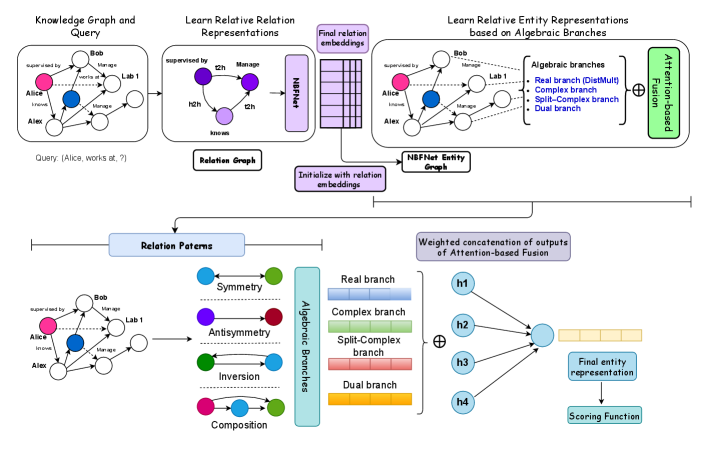
The diagram illustrates a multi-stage system for learning relative entity representations using algebraic branches and attention-based fusion. It combines knowledge graph analysis, relation pattern recognition, and algebraic branch processing to generate final entity representations through weighted concatenation and scoring.
### Components/Axes
1. **Left Section (Knowledge Graph & Query)**
- Entities: Alice (pink), Bob (blue), Alex (red), Lab 1 (gray)
- Relations: "supervised by", "manages", "works at", "knows"
- Query: "Alice works at ?"
2. **Middle Section (Relation Learning)**
- Process: Learn Relative Relation Representations → Final Relation Embeddings
- Tools: NBFNet (Neural Branch Fusion Network)
3. **Right Section (Entity Representation)**
- NBFNet Entity Graph with Algebraic Branches:
- Real branch (DistMult)
- Complex branch
- Split-Complex branch
- Dual branch
- Attention-based Fusion
4. **Bottom Section (Algebraic Branches)**
- Relation Patterns:
- Symmetry (blue)
- Antisymmetry (purple)
- Inversion (green)
- Composition (red)
- Corresponding Algebraic Branches:
- Real (blue)
- Complex (green)
- Split-Complex (red)
- Dual (yellow)
### Detailed Analysis
1. **Knowledge Graph Processing**
- Initial query resolution using entity relations
- Relation patterns identified through graph traversal
2. **Algebraic Branch Processing**
- Four distinct branches handle different relation properties:
- Real branch (blue): Basic numerical operations
- Complex branch (green): Handles antisymmetry
- Split-Complex branch (red): Manages inversion
- Dual branch (yellow): Processes composition
3. **Attention-Based Fusion**
- Four attention heads (h1-h4) process branch outputs
- Weighted concatenation combines branch representations
- Final entity representation generated through scoring function
### Key Observations
1. **Color-Coded Branches**
- Real branch (blue) consistently connects to symmetry patterns
- Complex branch (green) links to antisymmetry
- Split-Complex branch (red) associates with inversion
- Dual branch (yellow) correlates with composition
2. **Flow Progression**
- Top-to-bottom processing: Query → Relation Learning → Entity Representation
- Bottom-up integration: Relation patterns → Algebraic branches → Final representation
3. **Attention Mechanism**
- Four attention heads suggest multi-perspective processing
- Weighted combination implies dynamic importance weighting
### Interpretation
This architecture demonstrates a sophisticated approach to knowledge graph embedding by:
1. **Multi-perspective Analysis**: Using four algebraic branches to capture different relation properties simultaneously
2. **Dynamic Attention**: Implementing attention mechanisms to weigh branch contributions contextually
3. **Pattern Recognition**: Explicitly modeling relation patterns (symmetry, antisymmetry, etc.) through specialized branches
The system appears designed for complex knowledge graph tasks requiring nuanced relation understanding, with particular strength in handling inverse and composed relations through specialized algebraic structures. The attention-based fusion suggests an adaptive approach to combining different relation perspectives based on query context.