## Bar Chart: Time vs Core Count
### Overview
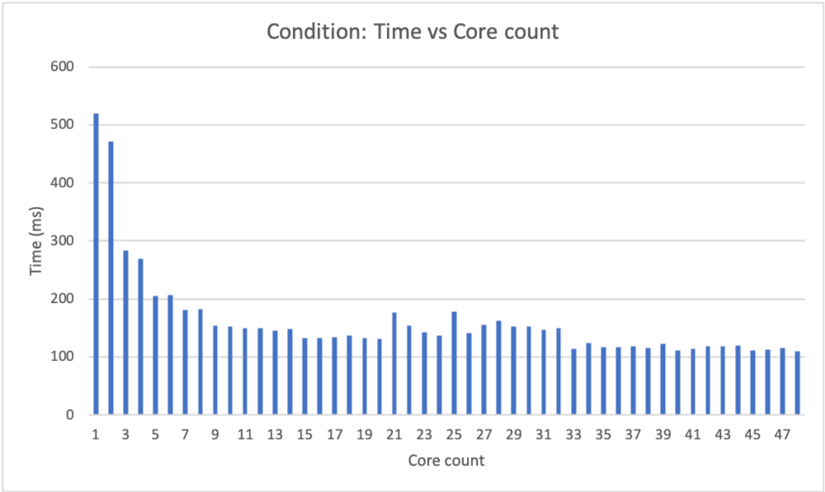
The chart visualizes the relationship between computational core count and processing time (in milliseconds) under a specific condition. It uses vertical bars to represent time values for core counts ranging from 1 to 47. The y-axis shows time in milliseconds (0–600 ms), while the x-axis lists core counts in increments of 2.
### Components/Axes
- **Title**: "Condition: Time vs Core count" (centered at the top).
- **X-axis**:
- Label: "Core count" (bottom).
- Values: 1, 3, 5, ..., 47 (odd numbers from 1 to 47).
- **Y-axis**:
- Label: "Time (ms)" (left).
- Scale: 0–600 ms in increments of 100.
- **Bars**:
- Color: Blue (no legend present; assumed uniform).
- Heights vary inversely with core count (taller bars for lower core counts).
### Detailed Analysis
- **Core Count 1**: Tallest bar (~520 ms).
- **Core Count 3**: Second tallest (~470 ms).
- **Core Count 5**: ~270 ms.
- **Core Counts 7–13**: Gradual decline (~180–210 ms).
- **Core Counts 15–47**: Plateau (~100–150 ms), with minor fluctuations (e.g., ~120 ms at 21, ~140 ms at 25, ~110 ms at 33, ~105 ms at 47).
### Key Observations
1. **Inverse Relationship**: Time decreases as core count increases, but the rate of improvement diminishes after ~13 cores.
2. **Diminishing Returns**: The steepest time reduction occurs between 1–13 cores; beyond this, gains are marginal.
3. **Plateau Effect**: Core counts ≥15 show minimal time variation (~100–150 ms), suggesting saturation or parallelization limits.
### Interpretation
The data suggests that increasing core count improves performance up to ~13 cores, after which additional cores yield negligible time savings. This could indicate:
- **Parallelization Limits**: The workload may not scale efficiently beyond 13 cores.
- **Overhead Saturation**: System-level overhead (e.g., inter-core communication) becomes dominant.
- **Hardware Constraints**: The test environment might cap effective core utilization.
The absence of a legend implies uniform data representation, but the lack of error bars or confidence intervals limits statistical certainty. The plateau at higher core counts warrants further investigation into parallelization efficiency or hardware bottlenecks.