TECHNICAL ASSET FINGERPRINT
906fb7c86546a0d49553b07c
Click to view fullscreen
Press ESC or click to close
FOUND IN PAPERS
EXPERT: gemini-3-pro VERSION 1
RUNTIME: nugit/gemini/gemini-3-pro-preview
INTEL_VERIFIED
## Diagram: AI Agent Architecture
### Overview
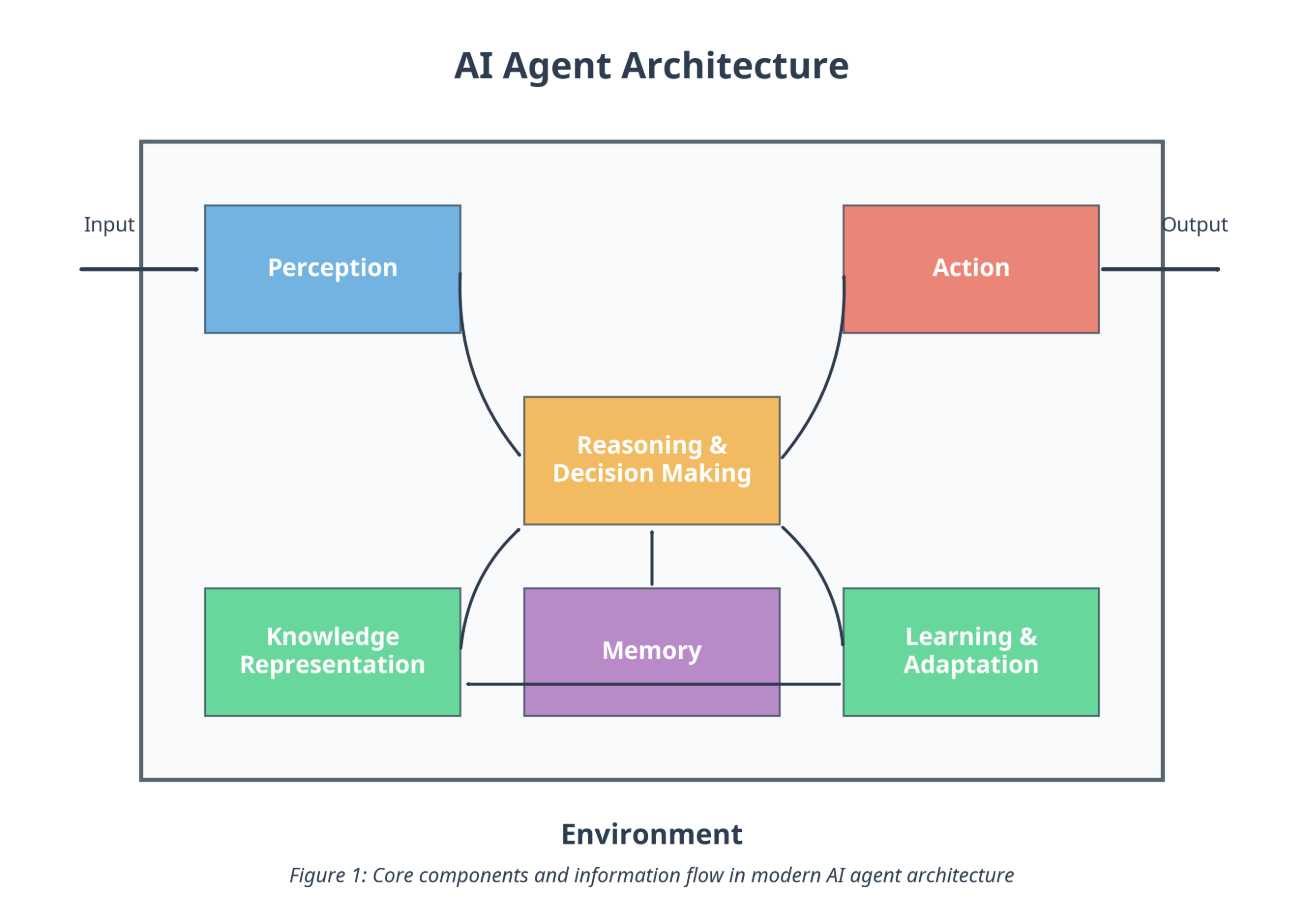
This image presents a conceptual block diagram illustrating the internal structure and information flow of a modern AI Agent. It depicts the agent as a system enclosed within a boundary, interacting with an external environment through inputs and outputs. The architecture is composed of six distinct functional modules connected by lines indicating relationships and data flow.
### Components/Axes
**1. Header:**
* **Title:** "AI Agent Architecture" (Centered at the top in bold, dark text).
**2. External Interface (Inputs/Outputs):**
* **Input:** A horizontal line entering the main boundary from the left, labeled "Input". This feeds directly into the "Perception" module.
* **Output:** A horizontal line exiting the main boundary to the right, originating from the "Action" module, labeled "Output".
* **Environment:** The label "Environment" is placed below the main diagram box, suggesting the context in which the agent operates.
**3. Internal Modules (The Agent):**
The agent is represented by a large rectangular outline containing six colored rectangular blocks.
* **Perception (Top-Left):**
* **Color:** Light Blue.
* **Text:** "Perception".
* **Connection:** Receives the external "Input". Connects via a curved line downwards to the central "Reasoning & Decision Making" block.
* **Action (Top-Right):**
* **Color:** Salmon/Light Red.
* **Text:** "Action".
* **Connection:** Sends the external "Output". Connects via a curved line downwards/leftwards to the central "Reasoning & Decision Making" block.
* **Reasoning & Decision Making (Center):**
* **Color:** Orange/Gold.
* **Text:** "Reasoning & Decision Making".
* **Position:** Central hub of the diagram.
* **Connections:**
* Receives input from "Perception" (top-left).
* Sends output to "Action" (top-right).
* Connects downwards to "Memory" (center-bottom).
* Connects via curved lines to "Knowledge Representation" (bottom-left) and "Learning & Adaptation" (bottom-right).
* **Knowledge Representation (Bottom-Left):**
* **Color:** Light Green.
* **Text:** "Knowledge Representation".
* **Connections:** Connects via a curved line upwards to the central "Reasoning & Decision Making" block. Also has a horizontal line connecting it to the "Memory" block.
* **Memory (Bottom-Center):**
* **Color:** Purple/Lavender.
* **Text:** "Memory".
* **Connections:** Connects vertically upwards to "Reasoning & Decision Making". Connects horizontally to "Knowledge Representation" (left) and "Learning & Adaptation" (right).
* **Learning & Adaptation (Bottom-Right):**
* **Color:** Medium Green.
* **Text:** "Learning & Adaptation".
* **Connections:** Connects via a curved line upwards to the central "Reasoning & Decision Making" block. Also has a horizontal line connecting it to the "Memory" block.
**4. Footer:**
* **Label:** "Environment" (Bold text, centered below the main box).
* **Caption:** "Figure 1: Core components and information flow in modern AI agent architecture" (Italicized text at the very bottom).
### Detailed Analysis of Flow & Connections
* **Central Hub Dynamic:** The "Reasoning & Decision Making" block acts as the central processing unit. It is the only block that connects directly to all other internal components (Perception, Action, Knowledge Representation, Memory, Learning & Adaptation).
* **Input/Output Flow:** The primary flow is linear from left to right:
`Input -> Perception -> Reasoning & Decision Making -> Action -> Output`.
* **Support Systems:** The bottom three blocks (Knowledge Representation, Memory, Learning & Adaptation) act as a support layer. They are interconnected horizontally, suggesting a shared data layer or tight integration between how knowledge is stored, how past experiences are recalled (memory), and how the system improves (learning).
* **Feedback Loops:** While explicit directional arrows are missing on the internal lines, the curvature suggests a convergence toward the center. The connection between "Action" and "Reasoning" implies that decisions drive actions, but in many agent architectures, the results of actions (feedback) would loop back into the system (often through Perception or Learning), though this specific loop is implicit rather than drawn explicitly.
### Key Observations
1. **Modularity:** The system is highly modular, separating distinct cognitive functions into specific blocks.
2. **Centralized Control:** The architecture relies heavily on the central "Reasoning & Decision Making" module to orchestrate the other components. It is the bridge between the sensory input (Perception) and the physical/digital output (Action).
3. **Interconnected Support Layer:** The bottom row (Knowledge, Memory, Learning) is fully connected horizontally. This implies that "Learning" updates "Memory" and "Knowledge," and "Reasoning" draws upon all three simultaneously.
4. **Abstraction:** The diagram is a high-level abstraction. It does not specify *how* perception works (e.g., computer vision vs. NLP) or the specific algorithms used for reasoning (e.g., LLMs vs. symbolic logic).
### Interpretation
This diagram represents a classic **cognitive architecture** for an intelligent agent. It moves beyond a simple stimulus-response model (reflex agent) by including internal state and learning capabilities.
* **The "Brain" Analogy:**
* **Perception** acts as the senses (eyes/ears).
* **Action** acts as the limbs/voice.
* **Reasoning** acts as the frontal cortex (executive function).
* **Memory** acts as the hippocampus (storage).
* **Learning & Adaptation** represents neuroplasticity (improvement over time).
* **Knowledge Representation** represents the semantic understanding of the world.
* **Operational Logic:** The agent perceives the environment, processes that information against its current knowledge and memory, makes a decision, and executes an action. Crucially, the "Learning & Adaptation" block suggests this is not a static system; it evolves based on its interactions, likely updating the "Memory" and "Knowledge Representation" blocks to improve future "Reasoning."
* **Relevance to Modern AI:** This structure aligns well with current Large Language Model (LLM) based agents (like AutoGPT or BabyAGI), where the LLM serves as the "Reasoning" engine, vector databases serve as "Memory," and various APIs serve as "Perception" and "Action" tools.
DECODING INTELLIGENCE...