\n
## Diagram: AI Agent Architecture
### Overview
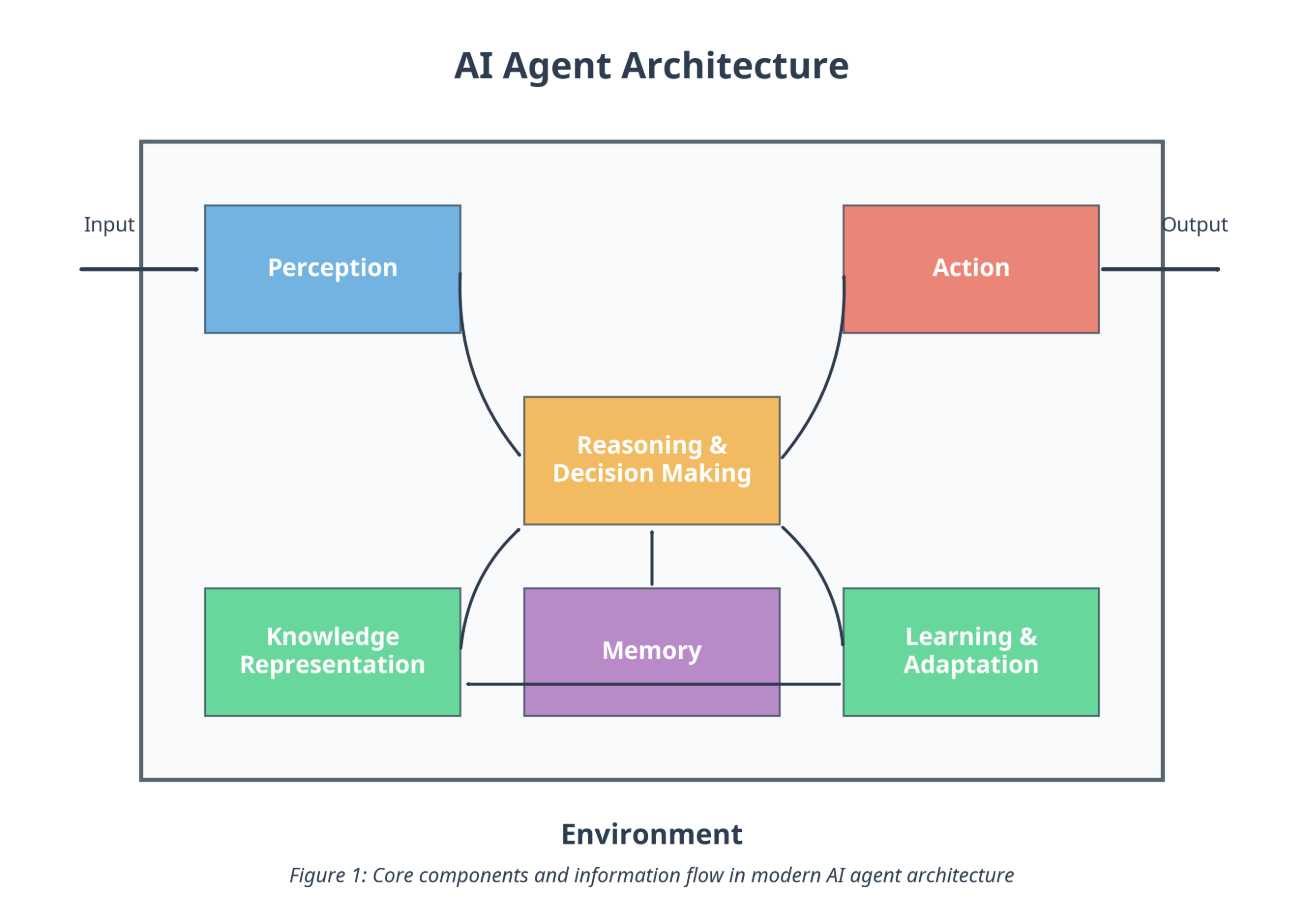
The image is a diagram illustrating the architecture of an AI agent. It depicts the core components of an AI agent and the flow of information between them, situated within an "Environment". The diagram uses colored rectangles to represent different modules, connected by arrows indicating information flow.
### Components/Axes
The diagram consists of the following components:
* **Input:** Located on the left side of the diagram.
* **Output:** Located on the right side of the diagram.
* **Perception:** A light blue rectangle.
* **Action:** A red rectangle.
* **Reasoning & Decision Making:** A yellow rectangle, centrally located.
* **Knowledge Representation:** A purple rectangle.
* **Memory:** A purple rectangle.
* **Learning & Adaptation:** A light green rectangle.
* **Environment:** Text at the bottom of the diagram.
* **Figure 1: Core components and information flow in modern AI agent architecture:** Caption below the "Environment" text.
The diagram uses arrows to show the flow of information.
### Detailed Analysis or Content Details
The diagram shows a cyclical flow of information.
1. **Input** feeds into **Perception**.
2. **Perception** sends information to **Reasoning & Decision Making**.
3. **Reasoning & Decision Making** receives input from **Knowledge Representation**, **Memory**, and **Learning & Adaptation**.
4. **Reasoning & Decision Making** sends information to **Action**.
5. **Action** produces **Output**.
6. **Output** interacts with the **Environment**, which in turn influences **Perception**, completing the cycle.
The diagram does not contain numerical data or precise measurements. It is a conceptual representation of the AI agent's architecture.
### Key Observations
The central role of "Reasoning & Decision Making" is emphasized by its central position and the multiple inputs it receives. The diagram highlights the interconnectedness of the different components, suggesting a holistic approach to AI agent design. The cyclical nature of the information flow indicates a continuous learning and adaptation process.
### Interpretation
This diagram illustrates a common model for AI agent architecture. It demonstrates how an AI agent interacts with its environment through perception and action, and how internal components like reasoning, knowledge, memory, and learning contribute to the agent's decision-making process. The diagram suggests that a successful AI agent requires not only the ability to perceive and act but also the capacity to learn, remember, and reason effectively. The emphasis on the environment highlights the importance of context in AI agent design. The diagram is a high-level overview and does not delve into the specific algorithms or techniques used within each component. It serves as a conceptual framework for understanding the overall structure of an AI agent.