## Diagram: AI Agent Architecture
### Overview
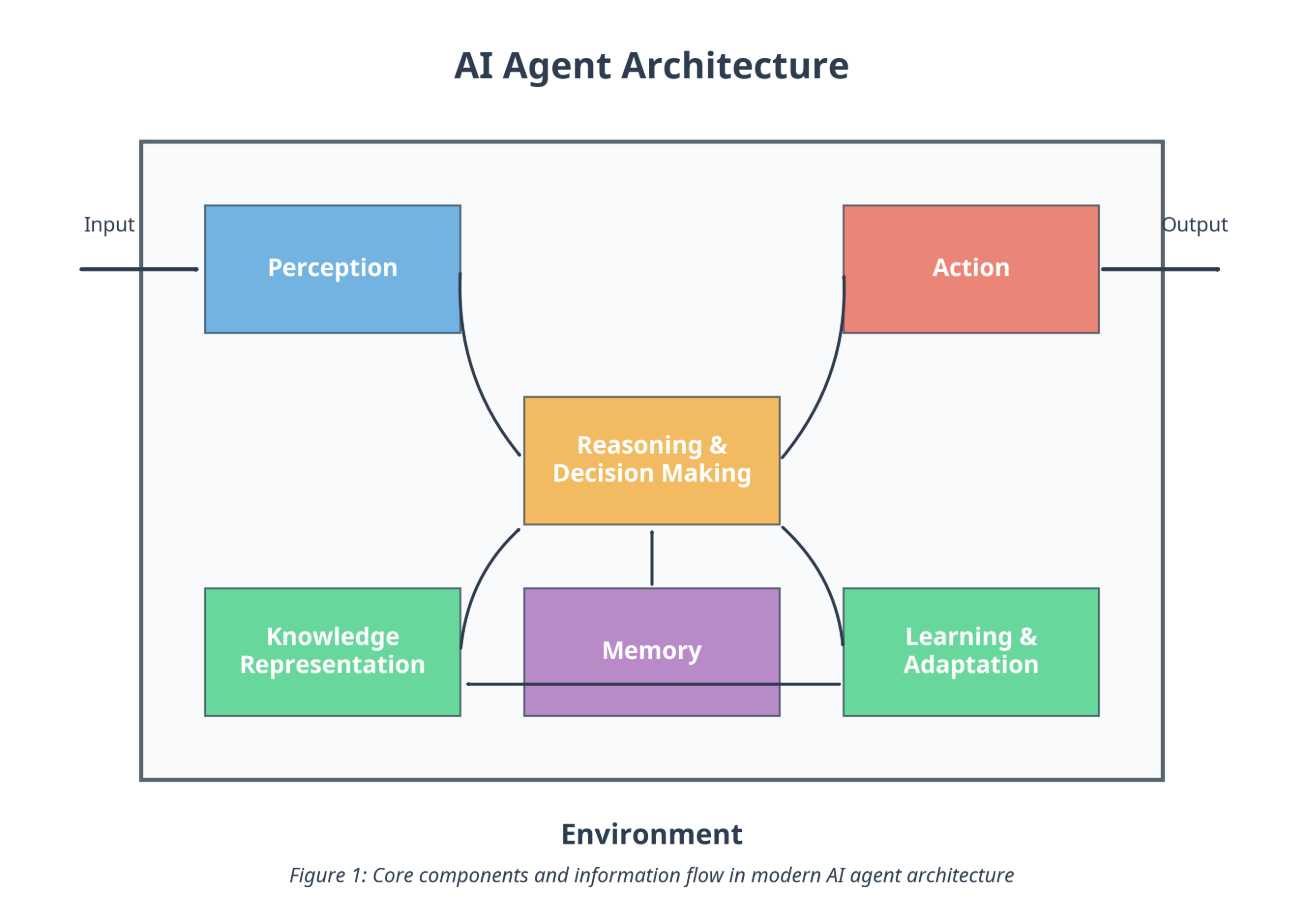
The diagram illustrates the core components and information flow in a modern AI agent architecture. It depicts a cyclical system where input is processed through perception, reasoning, and action, while integrating knowledge, memory, and learning/adaptation.
### Components/Axes
- **Title**: "AI Agent Architecture" (top center).
- **Input/Output**:
- **Input**: Left side (black arrow pointing to "Perception").
- **Output**: Right side (black arrow from "Action").
- **Environment**: Labeled at the bottom center.
- **Core Components**:
1. **Perception** (blue box, top-left).
2. **Reasoning & Decision Making** (orange box, center).
3. **Action** (red box, top-right).
4. **Knowledge Representation** (green box, bottom-left).
5. **Memory** (purple box, bottom-center).
6. **Learning & Adaptation** (green box, bottom-right).
### Detailed Analysis
- **Flow of Information**:
- **Input → Perception → Reasoning & Decision Making → Action (Output)**.
- **Reasoning & Decision Making** connects to **Knowledge Representation**, **Memory**, and **Learning & Adaptation**.
- **Memory** feeds back into **Reasoning & Decision Making**.
- **Learning & Adaptation** loops back to **Perception**, indicating iterative improvement.
- **Color Coding**:
- Blue (Perception), Orange (Reasoning), Red (Action), Green (Knowledge/Adaptation), Purple (Memory).
### Key Observations
1. **Central Role of Reasoning**: The orange "Reasoning & Decision Making" block acts as the hub, integrating inputs from perception, memory, and learning.
2. **Feedback Loops**:
- Memory directly influences reasoning.
- Learning & Adaptation refines perception, enabling continuous adaptation.
3. **Environmental Interaction**: The system operates within an "Environment," suggesting external context influences the agent’s behavior.
### Interpretation
This architecture emphasizes a **closed-loop system** where perception, reasoning, and action are interdependent with memory and learning. The feedback from **Learning & Adaptation** to **Perception** implies the agent dynamically adjusts its understanding of the environment, enhancing its decision-making over time. The separation of **Knowledge Representation** and **Memory** suggests distinct mechanisms for storing structured knowledge and retaining experiences. The design prioritizes adaptability, as learning directly impacts perception, creating a self-improving cycle.
*Note: No numerical data or trends are present; the diagram focuses on structural relationships and information flow.*