## Diagram: Foundation Model - MLP Probe Architecture
### Overview
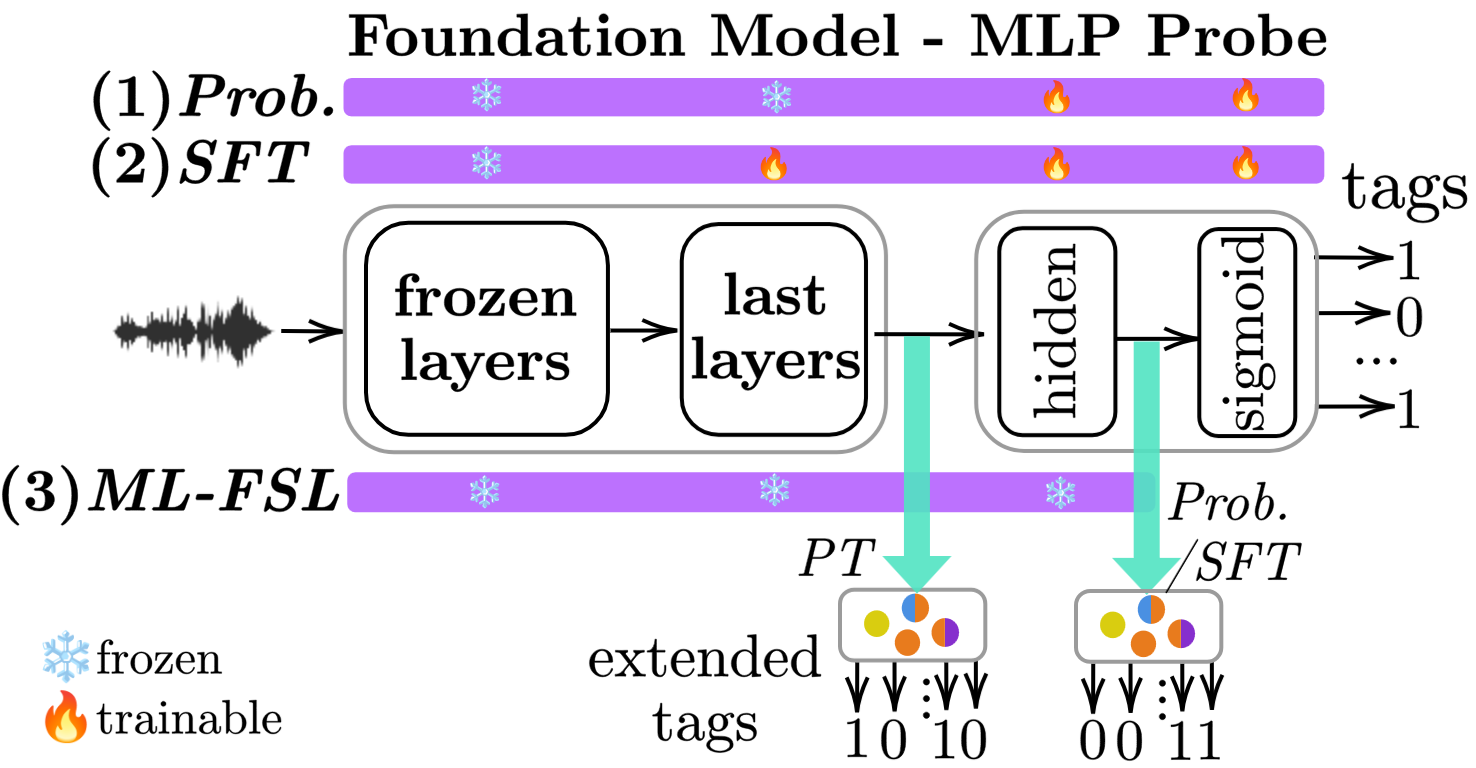
This diagram illustrates the architecture of a machine learning model called "Foundation Model - MLP Probe," which processes input data (e.g., audio waveforms) through a series of neural network layers to generate binary tags. The model incorporates frozen and trainable components, supervised fine-tuning (SFT), and meta-learning few-shot learning (ML-FSL) stages.
---
### Components/Axes
1. **Input**: Audio waveform (black squiggly line) enters the model.
2. **Frozen Layers**: Initial layers marked as "frozen" (snowflake icon), indicating non-trainable parameters.
3. **Last Layers**: Trainable layers (flame icon) following the frozen layers.
4. **Hidden Layer**: Intermediate processing layer.
5. **Sigmoid**: Final activation function converting outputs to probabilities.
6. **Tags**: Binary outputs (1, 0, ...) representing classifications.
7. **PT (Prompt Tuning)**: Section with "extended tags" (e.g., `10`, `10`) and binary outputs (`0`, `11`).
8. **Legend**:
- Snowflake (❄️): Frozen (non-trainable) components.
- Flame (🔥): Trainable components.
---
### Detailed Analysis
- **Flow**:
- Input → Frozen Layers → Last Layers → Hidden Layer → Sigmoid → Tags.
- PT section branches off with extended tags and binary outputs.
- **Key Elements**:
- **Frozen Layers**: Represent pre-trained, fixed parameters (e.g., base model weights).
- **Last Layers**: Adjustable parameters for task-specific adaptation.
- **Sigmoid**: Converts hidden layer outputs to probabilities (0–1 range).
- **Tags**: Binary labels (e.g., `1`, `0`, `10`, `11`) for classification.
- **PT Section**: Uses extended tags (e.g., `10`, `10`) to fine-tune the model via prompt tuning.
---
### Key Observations
1. **Trainable vs. Frozen**:
- Frozen layers (❄️) are non-trainable, while last layers (🔥) and PT components are trainable.
2. **Tag Generation**:
- Sigmoid outputs probabilities, which are thresholded to binary tags (e.g., `1`, `0`).
- PT section generates extended tags (e.g., `10`, `10`) for meta-learning tasks.
3. **Stages**:
- **(1) Prob.**: Likely refers to probabilistic outputs from the sigmoid layer.
- **(2) SFT**: Supervised fine-tuning stage for task adaptation.
- **(3) ML-FSL**: Meta-learning few-shot learning for efficient adaptation with limited data.
---
### Interpretation
- **Model Design**: The architecture balances pre-trained knowledge (frozen layers) with task-specific adaptation (trainable layers). This reduces overfitting while enabling customization.
- **SFT and ML-FSL**:
- SFT refines the model using labeled data.
- ML-FSL enables learning from limited examples via meta-learning, critical for few-shot scenarios.
- **Prompt Tuning (PT)**:
- Extended tags (e.g., `10`, `10`) suggest structured input prompts to guide the model’s behavior.
- Binary outputs (`0`, `11`) indicate task-specific classification after tuning.
- **Efficiency**: Freezing early layers preserves computational resources while allowing fine-tuning of later layers for specific tasks.
---
### Notable Patterns
- **Hierarchical Processing**: Input is progressively transformed through layers, with each stage refining the representation.
- **Binary Outputs**: Tags (`1`, `0`, `10`, `11`) suggest hierarchical or multi-class classification.
- **Trainable Components**: Only the last layers and PT section are updated during training, preserving the foundation model’s generalizability.
This architecture demonstrates a hybrid approach combining pre-trained models with efficient fine-tuning strategies for specialized tasks.