\n
## Diagram: COPRAsystem Workflow
### Overview
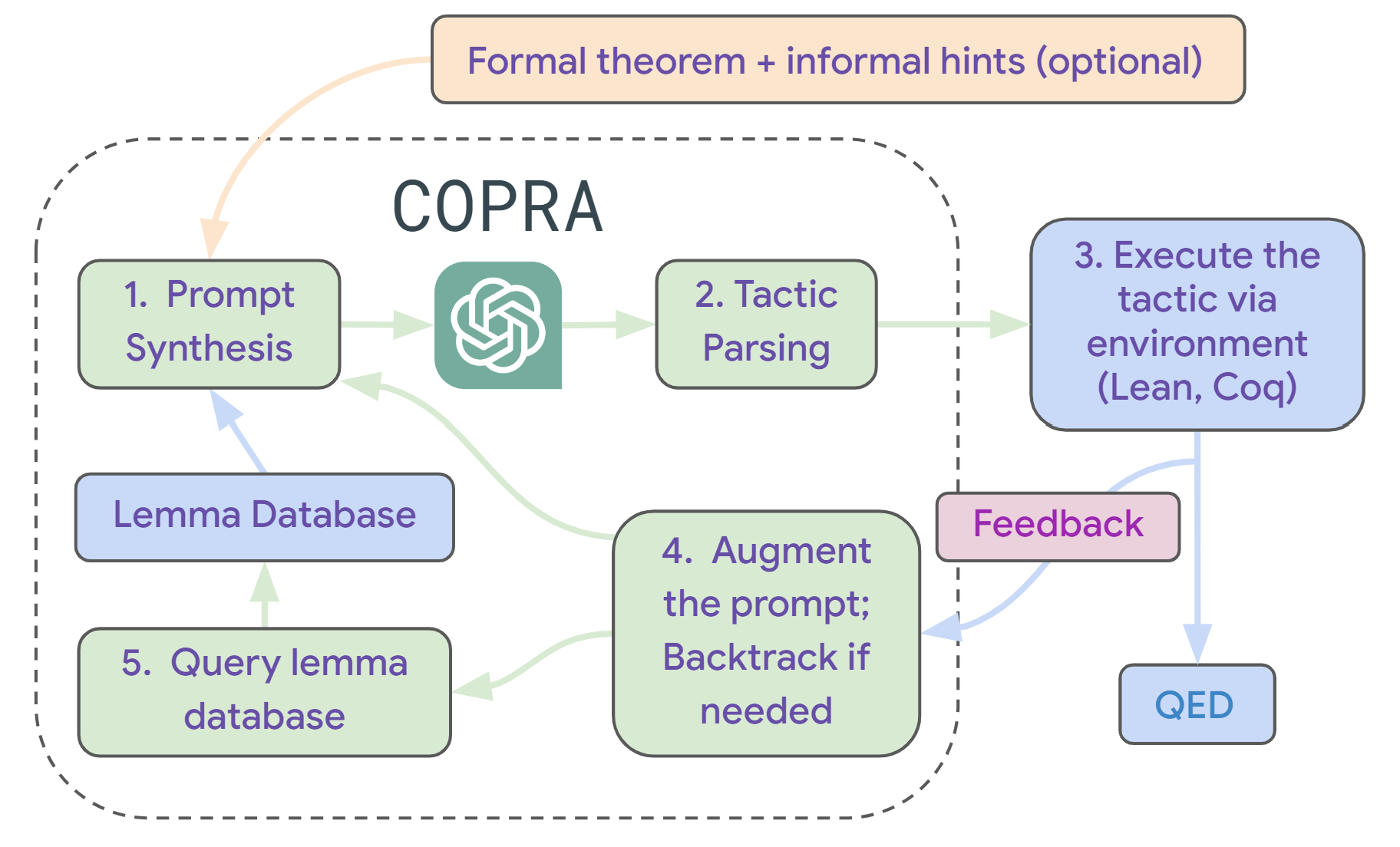
The image depicts a workflow diagram illustrating the COPRAsystem, a process for formal theorem proving with optional informal hints. The diagram shows a cyclical process with five numbered steps and feedback loops, all centered around a central COPRAsystem logo. The process begins with prompt synthesis and ends with a "QED" (Quod Erat Demonstrandum - which was to be demonstrated) result.
### Components/Axes
The diagram consists of several rectangular blocks representing steps in the process, connected by arrows indicating the flow of information. The central element is a circular logo labeled "COPRAsystem". There is also a block at the top labeled "Formal theorem + informal hints (optional)". The diagram is enclosed within a dashed grey border, suggesting a closed system or iterative process.
### Detailed Analysis or Content Details
The diagram details the following steps:
1. **1. Prompt Synthesis:** A light green rectangular block. An arrow originates from "Formal theorem + informal hints (optional)" and points to this block. An arrow also originates from this block and points to "2. Tactic Parsing".
2. **2. Tactic Parsing:** A light blue rectangular block. An arrow originates from "1. Prompt Synthesis" and points to this block. An arrow also originates from this block and points to "3. Execute the tactic via environment (Lean, Coq)".
3. **3. Execute the tactic via environment (Lean, Coq):** A yellow rectangular block. An arrow originates from "2. Tactic Parsing" and points to this block. An arrow also originates from this block and points to "Feedback".
4. **4. Augment the prompt; Backtrack if needed:** A pink rectangular block. An arrow originates from "3. Execute the tactic via environment (Lean, Coq)" and points to this block. An arrow also originates from this block and points back to "1. Prompt Synthesis".
5. **5. Query lemma database:** A light green rectangular block. An arrow originates from "1. Prompt Synthesis" and points to "Lemma Database". An arrow also originates from "Lemma Database" and points to "4. Augment the prompt; Backtrack if needed".
6. **Lemma Database:** A light green rectangular block. Arrows originate from "5. Query lemma database" and point to "4. Augment the prompt; Backtrack if needed".
7. **Feedback:** A pink rectangular block. An arrow originates from "3. Execute the tactic via environment (Lean, Coq)" and points to this block. An arrow also originates from this block and points to "QED".
8. **QED:** A teal rectangular block. An arrow originates from "Feedback" and points to this block.
9. **COPRAsystem Logo:** A circular logo in the center of the diagram, containing a stylized green design.
10. **Formal theorem + informal hints (optional):** A yellow rectangular block at the top of the diagram.
The arrows indicate a flow of information. The dashed grey border encompasses steps 1-5, the Lemma Database, and the COPRAsystem logo, suggesting an iterative process. The feedback loop from "Execute the tactic" to "Augment the prompt" and back to "Prompt Synthesis" indicates a refinement process.
### Key Observations
The diagram highlights the iterative nature of the COPRAsystem. The process is not strictly linear; there are feedback loops that allow for refinement and backtracking. The inclusion of "informal hints (optional)" suggests that the system can operate with varying levels of user guidance. The "QED" block signifies the successful completion of the theorem proving process.
### Interpretation
The diagram illustrates a system designed to automate or assist in the process of formal theorem proving. The COPRAsystem appears to leverage a lemma database to aid in the synthesis of prompts and tactics. The iterative nature of the process, with feedback loops, suggests that the system is capable of handling complex theorems and refining its approach based on the results of tactic execution. The optional use of informal hints indicates a degree of flexibility, allowing users to provide guidance when needed. The overall structure suggests a sophisticated system that combines automated reasoning with human input to achieve formal verification of theorems. The diagram is a high-level overview and does not provide details on the specific algorithms or techniques used within each step.