## Task Description: Calculation Extraction from Question-Answer Pair
### Overview
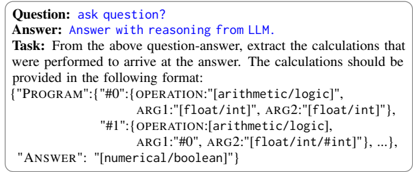
The image presents a task description for extracting calculations from a question-answer pair generated by a Large Language Model (LLM). The task requires identifying the calculations performed to arrive at the answer and providing them in a specific JSON format.
### Components/Axes
The image contains the following components:
* **Question:** A placeholder for a question ("ask question?").
* **Answer:** A placeholder indicating the answer is generated with reasoning from an LLM ("Answer with reasoning from LLM").
* **Task:** A description of the task to extract calculations.
* **Format:** A JSON format specification for representing the extracted calculations.
### Detailed Analysis or ### Content Details
The task description specifies the following JSON format:
```json
{
"PROGRAM": {
"#0": {
"OPERATION": "[arithmetic/logic]",
"ARG1": "[float/int]",
"ARG2": "[float/int]"
},
"#1": {
"OPERATION": "[arithmetic/logic]",
"ARG1": "#0",
"ARG2": "[float/int/#int]"
},
...
},
"ANSWER": "[numerical/boolean]"
}
```
* **"PROGRAM"**: Contains a dictionary of calculation steps.
* Each step is identified by a key like "#0", "#1", etc.
* Each step contains:
* **"OPERATION"**: The type of operation performed (either "arithmetic" or "logic").
* **"ARG1"**: The first argument of the operation (either a "float" or an "int").
* **"ARG2"**: The second argument of the operation (either a "float" or an "int").
* In subsequent steps (e.g., "#1"), "ARG1" can refer to the result of a previous step (e.g., "#0"). "ARG2" can also be a float or int.
* **"ANSWER"**: The final answer, which can be either a "numerical" value or a "boolean" value.
### Key Observations
* The format is designed to represent a sequence of calculations.
* Each calculation step involves an operation and two arguments.
* Arguments can be either numerical values or references to the results of previous calculations.
* The final answer is either numerical or boolean.
### Interpretation
The task aims to extract the computational steps performed by an LLM to arrive at an answer. By representing these steps in a structured JSON format, it becomes possible to analyze the reasoning process of the LLM and potentially debug or improve its performance. The format allows for representing both arithmetic and logical operations, as well as numerical and boolean results. The use of references to previous steps enables the representation of complex, multi-step calculations.