\n
## Text Block: Instruction for Calculation Extraction
### Overview
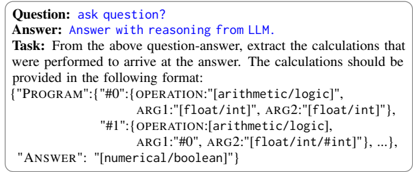
The image contains a block of text outlining a task: extracting the calculations performed to arrive at an answer to a question, and formatting those calculations in a specific JSON-like structure.
### Content Details
The text reads as follows:
"Question: ask question?
Answer: Answer with reasoning from LLM.
Task: From the above question-answer, extract the calculations that were performed to arrive at the answer. The calculations should be provided in the following format:
(["PROGRAM":"[#0"]:(OPERATION:["arithmetic/logic"],
ARG1:["float/int"], ARG2:["float/int"]),
"#1":(OPERATION:["arithmetic/logic"],
ARG1:"#0", ARG2:["float/int/#int"]), ...],
"ANSWER":"[numerical/boolean]")"
### Key Observations
The text defines a structured output format for representing calculations. The format uses a "PROGRAM" key containing a list of calculation steps, each identified by a "#" index. Each step includes an "OPERATION" (arithmetic or logic) and arguments ("ARG1", "ARG2"). The final "ANSWER" key holds the numerical or boolean result. The example uses placeholders like "ask question?", "Answer with reasoning from LLM", "float/int", and "arithmetic/logic" to indicate where specific values should be inserted.
### Interpretation
This text is a set of instructions for a program or a person to parse a question-answer pair and represent the underlying calculations in a machine-readable format. It's designed to facilitate the extraction of reasoning steps from a Large Language Model (LLM) response. The structured format allows for automated analysis and verification of the LLM's calculations. The use of "#0", "#1", etc., suggests a sequential dependency between calculation steps, where the output of one step can be used as input for the next. The inclusion of both "float/int" and "arithmetic/logic" indicates the system should handle both numerical and logical operations.