## Screenshot: Example Task for Textual Information Extraction
### Overview
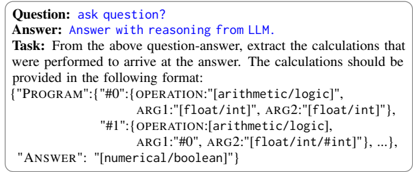
The image is a screenshot displaying a template for extracting calculations and reasoning from a given question-answer pair. It contains structured sections with instructions and placeholders for input.
### Components/Axes
- **Question:** Placeholder for a question ("ask question?")
- **Answer:** Placeholder for an answer ("Answer with reasoning from LLM")
- **Task:** Detailed instructions specifying the extraction of calculations performed to arrive at the answer
- **Format Specification:**
- Programmatic representation of operations (e.g., `OPERATION: "[arithmetic/logic]"`)
- Argument types (e.g., `ARG1: "[float/int]"`)
- Answer representation (e.g., `ANSWER: "[numerical/boolean]"`)
### Detailed Analysis
- The structure is hierarchical:
- **Program** includes numbered operations (`#0`, `#1`, ...) with operations and arguments
- Each operation has a defined `OPERATION` type (arithmetic/logic) and arguments (`ARG1`, `ARG2`) with data types
- The answer is represented as a numerical or boolean value
### Key Observations
- Placeholder text indicates where user-provided content would be inserted
- Strict formatting requirements are specified for operations and arguments
- The example uses a nested JSON-like structure to represent operations and data types
### Interpretation
This template demonstrates a method for breaking down reasoning steps into programmatic components, which could be used for:
- Automated reasoning extraction from natural language explanations
- Structured data generation for training AI models
- Formal verification of AI reasoning processes
The structured format enables unambiguous representation of calculations, potentially improving reproducibility and interpretability of AI-generated reasoning.