## Chart: Evaluation Accuracy and Training Reward vs. Training Steps for Different Algorithms
### Overview
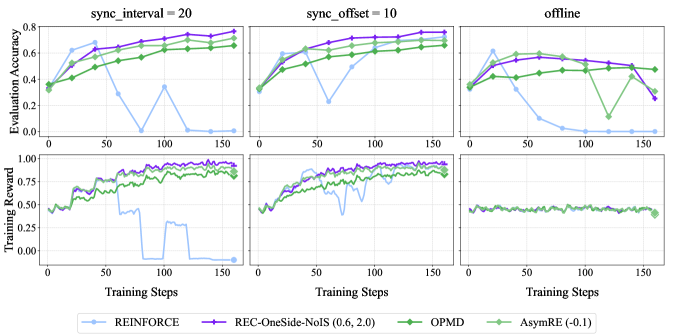
The image presents six line graphs arranged in a 2x3 grid. The top row displays "Evaluation Accuracy" versus "Training Steps," while the bottom row shows "Training Reward" versus "Training Steps." Each column represents a different synchronization setting: "sync_interval = 20," "sync_offset = 10," and "offline." Four different algorithms are compared across these settings: REINFORCE, REC-OneSide-NoIS (0.6, 2.0), OPMD, and AsymRE (-0.1).
### Components/Axes
* **X-axis (all plots):** Training Steps, ranging from 0 to 150.
* **Y-axis (top row):** Evaluation Accuracy, ranging from 0.0 to 0.8. Markers are present at 0.0, 0.2, 0.4, 0.6, and 0.8.
* **Y-axis (bottom row):** Training Reward, ranging from 0.00 to 1.00. Markers are present at 0.00, 0.25, 0.50, 0.75, and 1.00.
* **Titles (top row, left to right):** sync\_interval = 20, sync\_offset = 10, offline
* **Legend (bottom):** Located below the bottom row of plots.
* REINFORCE (light blue line)
* REC-OneSide-NoIS (0.6, 2.0) (purple line with diamond markers)
* OPMD (green line)
* AsymRE (-0.1) (light green line with diamond markers)
### Detailed Analysis
**Column 1: sync\_interval = 20**
* **Evaluation Accuracy:**
* REINFORCE (light blue): Starts around 0.4, increases to approximately 0.6 by step 25, then drops sharply to near 0 by step 75, before recovering to approximately 0.3 by step 100, and then decreasing again to approximately 0.1 by step 150.
* REC-OneSide-NoIS (purple): Starts around 0.4, increases steadily to approximately 0.7 by step 150.
* OPMD (green): Starts around 0.4, increases steadily to approximately 0.7 by step 150.
* AsymRE (light green): Starts around 0.35, increases steadily to approximately 0.7 by step 150.
* **Training Reward:**
* REINFORCE (light blue): Starts around 0.5, increases to approximately 0.7 by step 25, then drops sharply to near 0 by step 75, before recovering to approximately 0.3 by step 100, and then decreasing again to approximately 0.1 by step 150.
* REC-OneSide-NoIS (purple): Starts around 0.45, increases steadily to approximately 0.9 by step 150.
* OPMD (green): Starts around 0.45, increases steadily to approximately 0.9 by step 150.
* AsymRE (light green): Starts around 0.45, increases steadily to approximately 0.9 by step 150.
**Column 2: sync\_offset = 10**
* **Evaluation Accuracy:**
* REINFORCE (light blue): Starts around 0.4, increases to approximately 0.6 by step 25, then drops sharply to near 0.1 by step 75, before recovering to approximately 0.4 by step 100, and then decreasing again to approximately 0.2 by step 150.
* REC-OneSide-NoIS (purple): Starts around 0.4, increases steadily to approximately 0.7 by step 150.
* OPMD (green): Starts around 0.4, increases steadily to approximately 0.7 by step 150.
* AsymRE (light green): Starts around 0.35, increases steadily to approximately 0.7 by step 150.
* **Training Reward:**
* REINFORCE (light blue): Starts around 0.5, increases to approximately 0.7 by step 25, then drops sharply to near 0.1 by step 75, before recovering to approximately 0.4 by step 100, and then decreasing again to approximately 0.2 by step 150.
* REC-OneSide-NoIS (purple): Starts around 0.45, increases steadily to approximately 0.9 by step 150.
* OPMD (green): Starts around 0.45, increases steadily to approximately 0.9 by step 150.
* AsymRE (light green): Starts around 0.45, increases steadily to approximately 0.9 by step 150.
**Column 3: offline**
* **Evaluation Accuracy:**
* REINFORCE (light blue): Starts around 0.6, decreases sharply to near 0 by step 75, before recovering to approximately 0.2 by step 100, and then decreasing again to approximately 0.1 by step 150.
* REC-OneSide-NoIS (purple): Starts around 0.6, remains relatively stable around 0.6.
* OPMD (green): Starts around 0.5, remains relatively stable around 0.5.
* AsymRE (light green): Starts around 0.5, remains relatively stable around 0.5.
* **Training Reward:**
* REINFORCE (light blue): Not visible.
* REC-OneSide-NoIS (purple): Remains relatively stable around 0.6.
* OPMD (green): Remains relatively stable around 0.6.
* AsymRE (light green): Remains relatively stable around 0.6.
### Key Observations
* REINFORCE performs poorly compared to other algorithms, especially in terms of stability. Its performance drops significantly around step 50-75 in all three synchronization settings.
* REC-OneSide-NoIS, OPMD, and AsymRE show similar and more stable performance, with generally increasing evaluation accuracy and training reward over time, except in the offline setting.
* The "offline" setting results in stable but lower performance for REC-OneSide-NoIS, OPMD, and AsymRE compared to the other two synchronization settings.
### Interpretation
The data suggests that the synchronization interval and offset significantly impact the performance of the REINFORCE algorithm, leading to instability and lower rewards. REC-OneSide-NoIS, OPMD, and AsymRE are more robust to these synchronization parameters and achieve higher and more stable performance. The "offline" setting, where there is no synchronization, results in a stable but lower performance ceiling for the latter three algorithms, indicating that some level of synchronization is beneficial for these algorithms. The poor performance of REINFORCE could be due to its sensitivity to the synchronization parameters, causing it to diverge during training.