## Diagram: Future Research Directions Flowchart
### Overview
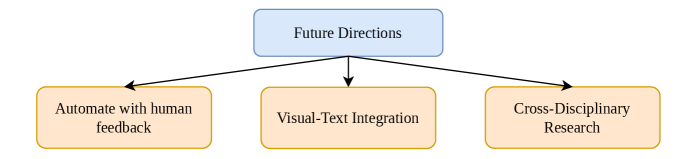
The image displays a simple, hierarchical flowchart diagram illustrating three proposed future research directions stemming from a central theme. The diagram uses a top-down structure with one primary category branching into three distinct sub-categories.
### Components/Axes
* **Central Node (Top):** A single, light blue rectangular box with rounded corners. It contains the text "Future Directions".
* **Sub-Nodes (Bottom):** Three orange rectangular boxes with rounded corners, arranged horizontally in a row below the central node.
* **Connectors:** Three solid black arrows originate from the bottom edge of the central "Future Directions" box. Each arrow points directly downward to one of the three sub-node boxes, indicating a direct relationship or derivation.
### Detailed Analysis / Content Details
* **Text Transcription:**
* Central Node: "Future Directions"
* Left Sub-Node: "Automate with human feedback"
* Middle Sub-Node: "Visual-Text Integration"
* Right Sub-Node: "Cross-Disciplinary Research"
* **Spatial Grounding & Layout:**
* The "Future Directions" box is centered at the top of the diagram.
* The three sub-node boxes are positioned in a horizontal line, centered beneath the main box. They are evenly spaced from left to right.
* The left arrow connects to the "Automate with human feedback" box.
* The middle arrow connects to the "Visual-Text Integration" box.
* The right arrow connects to the "Cross-Disciplinary Research" box.
* **Visual Design:** The diagram uses a clean, minimal aesthetic with a two-color scheme (blue for the parent category, orange for child categories) to visually distinguish hierarchy. All boxes have a subtle drop shadow, giving a slight sense of depth.
### Key Observations
* The structure is strictly hierarchical and non-cyclical, showing a one-to-many relationship.
* The three future directions are presented as parallel, equally weighted concepts, as indicated by their identical styling and horizontal alignment.
* The language is concise and conceptual, suggesting these are high-level strategic goals rather than detailed technical plans.
### Interpretation
This diagram outlines a strategic framework for future development or research. The central theme, "Future Directions," is decomposed into three complementary pillars:
1. **Automate with human feedback:** This suggests a focus on developing automated systems (likely AI/ML models) that are not fully autonomous but are instead refined and guided by continuous human input. This approach prioritizes safety, accuracy, and alignment with human judgment.
2. **Visual-Text Integration:** This points to research into multimodal systems that can process, understand, and generate both visual data (images, video) and textual data in a unified manner. This is a key area for advancing AI that can comprehend the world more holistically.
3. **Cross-Disciplinary Research:** This emphasizes the importance of collaboration across different fields of study (e.g., computer science, cognitive science, ethics, domain-specific sciences) to solve complex problems. It implies that the challenges ahead cannot be solved within a single discipline.
**Relationship & Synthesis:** The three directions are interrelated. Effective "Visual-Text Integration" often requires "Cross-Disciplinary Research" (e.g., combining computer vision with linguistics). Similarly, building systems that "Automate with human feedback" benefits from cross-disciplinary insights into human-computer interaction and ethics. Together, they form a cohesive strategy for advancing towards more capable, reliable, and socially integrated intelligent systems. The diagram serves as a high-level roadmap, prioritizing human-centric automation, multimodal understanding, and collaborative problem-solving.