## Flowchart: Future Directions
### Overview
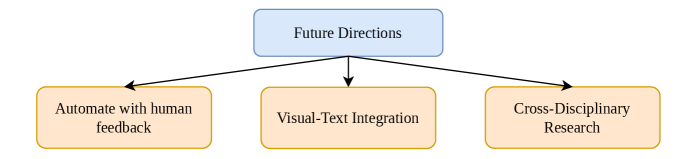
The image is a hierarchical flowchart titled "Future Directions" (blue rectangle at the top center). Three primary branches extend downward from the central title, each represented by orange rectangles with black text. Arrows connect the central title to each branch, indicating a causal or developmental relationship.
### Components/Axes
- **Central Title**: "Future Directions" (blue rectangle, top-center position).
- **Branches**:
1. **Left Branch**: "Automate with human feedback" (orange rectangle, left-aligned).
2. **Middle Branch**: "Visual-Text Integration" (orange rectangle, center-aligned).
3. **Right Branch**: "Cross-Disciplinary Research" (orange rectangle, right-aligned).
- **Connectors**: Black arrows link the central title to each branch, emphasizing their derivation from the overarching theme.
### Detailed Analysis
- **Textual Content**: All labels are in English. No numerical data, charts, or tables are present.
- **Spatial Grounding**:
- The central title is positioned at the top-center, acting as the root node.
- Branches are evenly spaced horizontally below the title, with arrows originating from the title’s base.
- No overlapping elements; clear separation between components.
### Key Observations
- The flowchart emphasizes three distinct but interconnected future research or development directions.
- The use of arrows suggests a top-down flow of ideas or priorities from the central theme to the specific branches.
### Interpretation
This diagram outlines a strategic framework for prioritizing future work, likely in a technical or academic context. The three branches represent divergent yet complementary approaches:
1. **Automate with human feedback**: Focuses on integrating automation while maintaining human oversight.
2. **Visual-Text Integration**: Highlights the fusion of visual and textual data processing.
3. **Cross-Disciplinary Research**: Encourages collaboration across fields to address complex problems.
The structure implies that these directions are foundational and mutually reinforcing, with the central title serving as the unifying concept. The absence of quantitative data suggests this is a conceptual roadmap rather than an empirical analysis.