## Line Graph: Model Accuracy vs. Compute (exaFLOP)
### Overview
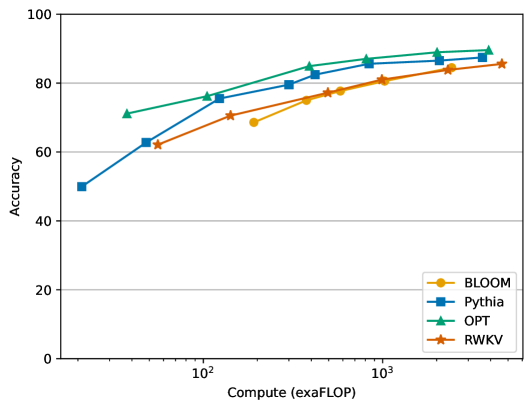
The image depicts a line graph comparing the accuracy of four AI models (BLOOM, Pythia, OPT, RWKV) across varying computational budgets (exaFLOP). Accuracy is plotted on the y-axis (0–100%), and compute is plotted on the x-axis (logarithmic scale: 10² to 10³ exaFLOP). All models show upward trends, with OPT achieving the highest accuracy at the highest compute level.
### Components/Axes
- **X-axis (Compute)**: Labeled "Compute (exaFLOP)" with a logarithmic scale (10² to 10³).
- **Y-axis (Accuracy)**: Labeled "Accuracy" with a linear scale (0–100%).
- **Legend**: Located in the bottom-right corner, mapping colors to models:
- Orange (●): BLOOM
- Blue (■): Pythia
- Green (▲): OPT
- Red (★): RWKV
### Detailed Analysis
1. **BLOOM (Orange)**:
- Starts at ~70 exaFLOP with ~70% accuracy.
- Increases to ~80 exaFLOP with ~75% accuracy.
- Reaches ~1000 exaFLOP with ~85% accuracy.
2. **Pythia (Blue)**:
- Begins at ~50 exaFLOP with ~50% accuracy.
- Rises to ~100 exaFLOP with ~75% accuracy.
- Achieves ~1000 exaFLOP with ~85% accuracy.
3. **OPT (Green)**:
- Starts at ~100 exaFLOP with ~75% accuracy.
- Peaks at ~1000 exaFLOP with ~88% accuracy.
4. **RWKV (Red)**:
- Begins at ~100 exaFLOP with ~70% accuracy.
- Reaches ~1000 exaFLOP with ~85% accuracy.
### Key Observations
- All models improve accuracy with increased compute, but OPT demonstrates the steepest efficiency gain.
- Pythia starts with the lowest accuracy at lower compute levels but converges with BLOOM and RWKV at higher compute.
- OPT consistently outperforms others at the highest compute (1000 exaFLOP).
- RWKV’s accuracy plateaus slightly below Pythia and OPT at 1000 exaFLOP.
### Interpretation
The data suggests that **compute efficiency** significantly impacts model performance. OPT achieves the highest accuracy with the least compute, indicating superior optimization. Pythia and RWKV require more compute to reach comparable accuracy levels, while BLOOM’s performance is mid-tier. The logarithmic x-axis highlights that even small increases in compute (e.g., 10x) yield diminishing returns for some models. This underscores the importance of architectural efficiency in AI development.