\n
## Bar Chart: Number of Snapshots vs. Number of Past Actions
### Overview
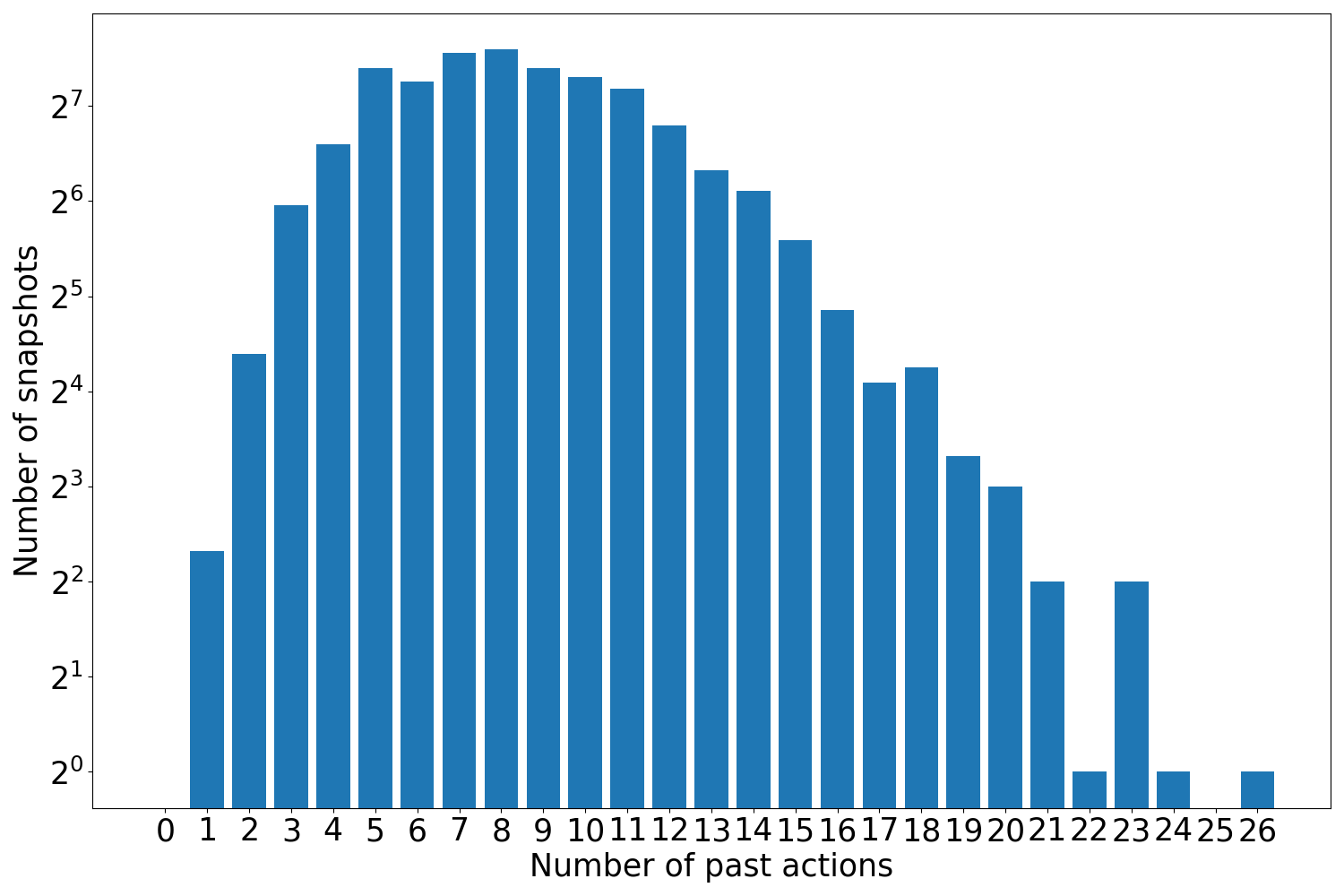
This image presents a bar chart illustrating the distribution of the number of snapshots taken, categorized by the number of past actions. The y-axis represents the number of snapshots, displayed on a logarithmic scale (base 10), while the x-axis represents the number of past actions, ranging from 0 to 26. The chart shows a roughly symmetrical distribution, peaking around 7-12 past actions.
### Components/Axes
* **X-axis Title:** "Number of past actions"
* **X-axis Scale:** Integer values from 0 to 26, with each integer representing a distinct category.
* **Y-axis Title:** "Number of snapshots"
* **Y-axis Scale:** Logarithmic scale (base 10), ranging from 10<sup>0</sup> (1) to 10<sup>7</sup> (10,000,000). The scale markers are 1, 10, 100, 1000, 10000, 100000, 1000000, 10000000.
* **Bar Color:** A single shade of blue is used for all bars.
* **No Legend:** There is no legend present in the image.
### Detailed Analysis
The chart displays the frequency of snapshots for each number of past actions. The trend is as follows:
* **0 Past Actions:** Approximately 3 snapshots.
* **1 Past Action:** Approximately 8 snapshots.
* **2 Past Actions:** Approximately 20 snapshots.
* **3 Past Actions:** Approximately 60 snapshots.
* **4 Past Actions:** Approximately 150 snapshots.
* **5 Past Actions:** Approximately 300 snapshots.
* **6 Past Actions:** Approximately 600 snapshots.
* **7 Past Actions:** Approximately 1100 snapshots.
* **8 Past Actions:** Approximately 1800 snapshots.
* **9 Past Actions:** Approximately 2500 snapshots.
* **10 Past Actions:** Approximately 3000 snapshots.
* **11 Past Actions:** Approximately 3100 snapshots.
* **12 Past Actions:** Approximately 2800 snapshots.
* **13 Past Actions:** Approximately 2400 snapshots.
* **14 Past Actions:** Approximately 1900 snapshots.
* **15 Past Actions:** Approximately 1400 snapshots.
* **16 Past Actions:** Approximately 900 snapshots.
* **17 Past Actions:** Approximately 600 snapshots.
* **18 Past Actions:** Approximately 400 snapshots.
* **19 Past Actions:** Approximately 250 snapshots.
* **20 Past Actions:** Approximately 150 snapshots.
* **21 Past Actions:** Approximately 80 snapshots.
* **22 Past Actions:** Approximately 30 snapshots.
* **23 Past Actions:** Approximately 10 snapshots.
* **24 Past Actions:** Approximately 3 snapshots.
* **25 Past Actions:** Approximately 1 snapshot.
* **26 Past Actions:** Approximately 1 snapshot.
The distribution rises sharply from 0 to approximately 10 past actions, reaches a peak around 7-11, and then declines symmetrically.
### Key Observations
* The distribution is approximately bell-shaped, suggesting a normal distribution or a similar pattern.
* The highest frequency of snapshots occurs when the number of past actions is between 7 and 11.
* The number of snapshots decreases rapidly as the number of past actions moves away from this peak.
* The logarithmic scale on the y-axis compresses the differences in snapshot counts at higher values.
### Interpretation
The data suggests a relationship between the number of past actions and the likelihood of taking a snapshot. The peak around 7-11 past actions indicates that snapshots are most frequently taken after this number of actions have occurred. This could imply that a certain level of activity or progress is required before a snapshot is deemed necessary. The symmetrical decline on either side of the peak suggests that both too few and too many past actions are less likely to trigger a snapshot. The use of a logarithmic scale indicates that the absolute differences in snapshot counts are more important than the percentage differences, especially at higher counts. This could be because the system is designed to prioritize capturing snapshots when the number of actions is within a specific range, regardless of the overall number of snapshots already taken. The data could be related to a system that automatically saves states or checkpoints after a certain number of operations, or a user behavior pattern where snapshots are taken after a period of activity.