## Density Plot & Marginal Distributions: Text Dimensionality Reduction
### Overview
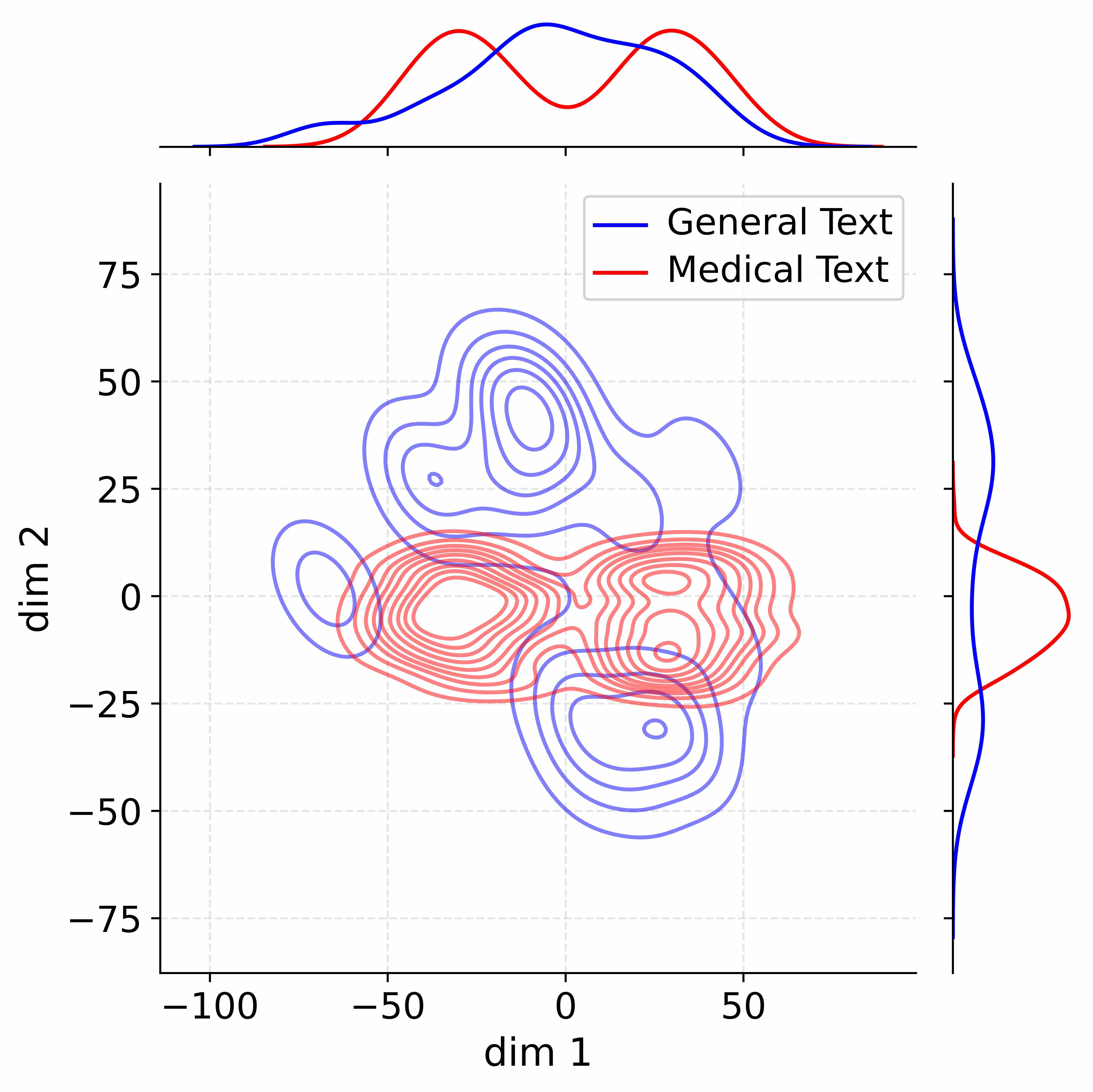
The image presents a 2D density plot visualizing the distribution of two text categories – "General Text" and "Medical Text" – in a reduced dimensional space. Alongside the density plot, marginal distributions (histograms) are shown for each category along the respective dimensions. The plot appears to be the result of a dimensionality reduction technique, likely PCA or t-SNE, projecting higher-dimensional text data onto two dimensions ("dim 1" and "dim 2").
### Components/Axes
* **X-axis:** Labeled "dim 1", ranging approximately from -100 to 60.
* **Y-axis:** Labeled "dim 2", ranging approximately from -75 to 75.
* **Density Plot:** Contour lines represent the density of data points for each text category.
* **Legend (Top-Right):**
* Blue line: "General Text"
* Red line: "Medical Text"
* **Marginal Distributions (Top & Right):** Histograms showing the distribution of each text category along "dim 1" and "dim 2".
### Detailed Analysis or Content Details
**Density Plot Analysis:**
* **General Text (Blue):** The density of "General Text" is concentrated in two main regions. One is centered around (dim1 ≈ -40, dim2 ≈ 40), and the other around (dim1 ≈ 0, dim2 ≈ -30). The contours are somewhat elongated and irregularly shaped.
* **Medical Text (Red):** The density of "Medical Text" is concentrated in a region centered around (dim1 ≈ 40, dim2 ≈ 10). The contours are more compact and circular compared to the "General Text". There is a smaller concentration of "Medical Text" around (dim1 ≈ -20, dim2 ≈ -10).
* **Overlap:** There is some overlap between the density distributions of the two categories, particularly in the region where dim1 is between -20 and 20.
**Marginal Distribution Analysis:**
* **General Text (Blue):**
* **dim 1 (Top):** The distribution is bimodal, with peaks around dim1 ≈ -50 and dim1 ≈ 10. The distribution extends to approximately dim1 = 60.
* **dim 2 (Right):** The distribution is roughly unimodal, peaking around dim2 ≈ 30. It extends to approximately dim2 = 70.
* **Medical Text (Red):**
* **dim 1 (Top):** The distribution is unimodal, peaking around dim1 ≈ 40. It extends to approximately dim1 = 60.
* **dim 2 (Right):** The distribution is roughly unimodal, peaking around dim2 ≈ 10. It extends to approximately dim2 = 60.
### Key Observations
* The two text categories exhibit distinct distributions in the reduced dimensional space, suggesting that the dimensionality reduction has successfully separated them to some extent.
* The "Medical Text" appears to be more clustered than the "General Text", indicating a more consistent representation in this reduced space.
* The bimodal distribution of "General Text" along dim 1 suggests that this dimension captures some underlying variation within the general text corpus.
* The overlap in the density distributions indicates that some instances of "General Text" and "Medical Text" are difficult to distinguish based on these two dimensions alone.
### Interpretation
This visualization likely represents the output of a dimensionality reduction technique applied to text data. The goal is to project high-dimensional text representations (e.g., word embeddings) into a lower-dimensional space (here, 2D) while preserving the relationships between data points.
The separation between "General Text" and "Medical Text" suggests that the dimensionality reduction has captured some semantic differences between the two categories. The clustering of "Medical Text" might indicate that medical texts share more common features or patterns than general texts.
The bimodal distribution of "General Text" could reflect the diversity of topics and writing styles within the general text corpus. The overlap between the distributions suggests that some texts are ambiguous or share characteristics of both categories.
Further analysis, such as examining the features that contribute most to the separation along dim 1 and dim 2, could provide insights into the specific linguistic or semantic differences between "General Text" and "Medical Text". The marginal distributions provide a quantitative view of how each category is distributed along each dimension, which can be useful for understanding the characteristics of each category in the reduced space.