## Chart Type: Line Chart - Proportion of Flips by Iteration
### Overview
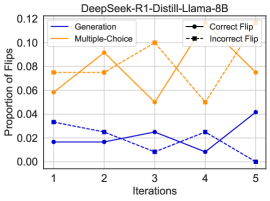
This image displays a line chart titled "DeepSeek-R1-Distill-Llama-8B", illustrating the "Proportion of Flips" across five "Iterations". The chart compares four distinct data series, categorized by task type ("Generation" vs. "Multiple-Choice") and flip outcome ("Correct Flip" vs. "Incorrect Flip"). The data suggests varying performance and trends for these categories over the iterations.
### Components/Axes
* **Chart Title**: DeepSeek-R1-Distill-Llama-8B
* **X-axis Label**: Iterations
* **X-axis Markers**: 1, 2, 3, 4, 5
* **Y-axis Label**: Proportion of Flips
* **Y-axis Markers**: 0.00, 0.02, 0.04, 0.06, 0.08, 0.10, 0.12
* **Legend**: The legend is split into two parts, located within the top-left and top-right of the plot area.
* **Top-left Legend (Task Type)**:
* Solid dark blue line: Generation
* Solid orange line: Multiple-Choice
* **Top-right Legend (Flip Outcome)**:
* Solid black line with circles: Correct Flip
* Dashed black line with squares: Incorrect Flip
* **Combined Legend Interpretation (Color indicates Task Type, Line Style/Marker indicates Flip Outcome)**:
* **Generation - Correct Flip**: Solid dark blue line with square markers.
* **Generation - Incorrect Flip**: Dashed dark blue line with square markers.
* **Multiple-Choice - Correct Flip**: Solid orange line with circle markers.
* **Multiple-Choice - Incorrect Flip**: Dashed orange line with circle markers.
### Detailed Analysis
The chart presents four data series, each tracked over 5 iterations:
1. **Generation - Correct Flip (Solid Dark Blue Line with Squares)**:
* **Trend**: This series starts low, remains stable, increases, drops, and then significantly rises to its peak.
* **Data Points**:
* Iteration 1: Approximately 0.017
* Iteration 2: Approximately 0.017
* Iteration 3: Approximately 0.025
* Iteration 4: Approximately 0.009
* Iteration 5: Approximately 0.042
2. **Generation - Incorrect Flip (Dashed Dark Blue Line with Squares)**:
* **Trend**: This series starts at a moderate level, decreases, drops to a very low point, increases slightly, and then sharply drops to zero.
* **Data Points**:
* Iteration 1: Approximately 0.034
* Iteration 2: Approximately 0.024
* Iteration 3: Approximately 0.009
* Iteration 4: Approximately 0.025
* Iteration 5: Approximately 0.000
3. **Multiple-Choice - Correct Flip (Solid Orange Line with Circles)**:
* **Trend**: This series starts at a moderate level, increases, drops, remains stable, and then increases again.
* **Data Points**:
* Iteration 1: Approximately 0.059
* Iteration 2: Approximately 0.075
* Iteration 3: Approximately 0.050
* Iteration 4: Approximately 0.050
* Iteration 5: Approximately 0.075
4. **Multiple-Choice - Incorrect Flip (Dashed Orange Line with Circles)**:
* **Trend**: This series starts at a high level, increases, peaks, remains stable at the peak, and then decreases.
* **Data Points**:
* Iteration 1: Approximately 0.076
* Iteration 2: Approximately 0.090
* Iteration 3: Approximately 0.100
* Iteration 4: Approximately 0.100
* Iteration 5: Approximately 0.076
### Key Observations
* **Overall Magnitude**: The "Multiple-Choice" task consistently shows a significantly higher proportion of flips (both correct and incorrect) compared to the "Generation" task across all iterations.
* **Generation Performance**: For "Generation", the proportion of "Incorrect Flips" generally decreases over iterations, reaching zero at Iteration 5. Conversely, the proportion of "Correct Flips" for "Generation" shows an upward trend towards the end, peaking at Iteration 5.
* **Multiple-Choice Performance**: For "Multiple-Choice", "Incorrect Flips" are generally higher than "Correct Flips" for most iterations, peaking at 0.10 at Iterations 3 and 4. "Correct Flips" for "Multiple-Choice" show a dip at Iterations 3 and 4, coinciding with the peak of "Incorrect Flips".
* **Crossover Point (Generation)**: At Iteration 4, the "Generation - Correct Flip" proportion (approx. 0.009) is lower than "Generation - Incorrect Flip" (approx. 0.025). However, by Iteration 5, "Generation - Correct Flip" (approx. 0.042) significantly surpasses "Generation - Incorrect Flip" (0.000).
* **Peak Performance**: The highest proportion of flips observed is 0.10, for "Multiple-Choice - Incorrect Flip" at Iterations 3 and 4.
### Interpretation
This chart provides insights into the "flip" behavior of the "DeepSeek-R1-Distill-Llama-8B" model across two distinct task types ("Generation" and "Multiple-Choice") over five iterations. A "flip" likely refers to a change in a decision or output, and the distinction between "Correct" and "Incorrect" flips indicates the quality of these changes.
The data suggests that the "Multiple-Choice" task inherently involves a higher rate of "flips" than the "Generation" task. Furthermore, for "Multiple-Choice", the model tends to make more "Incorrect Flips" than "Correct Flips" for most iterations, particularly struggling at iterations 3 and 4 where incorrect flips peak and correct flips dip. This could imply that the model finds it challenging to consistently make beneficial changes in the multiple-choice setting, or that the task itself is more prone to ambiguous "flips."
In contrast, the "Generation" task shows a promising trend. While starting with a notable proportion of "Incorrect Flips," this rate steadily declines, reaching zero by the final iteration. Simultaneously, the "Correct Flips" for "Generation" show an overall improvement, culminating in the highest proportion of correct flips for this task type at Iteration 5. This indicates that the model, when performing "Generation" tasks, either learns to avoid incorrect changes or becomes more adept at making beneficial changes as iterations progress. The complete elimination of "Incorrect Flips" in "Generation" at Iteration 5 is a significant positive outcome, suggesting that for this specific model and task, the iterative process leads to a highly reliable "flip" mechanism.
Overall, the model appears to be more stable and improves more effectively in making correct "flips" and reducing incorrect ones in "Generation" tasks compared to "Multiple-Choice" tasks over these five iterations. The "Multiple-Choice" performance, with its higher overall flip rates and persistent incorrect flips, might warrant further investigation into the nature of "flips" in that context.