TECHNICAL ASSET FINGERPRINT
91a6c5e35480a91b5df9fb73
Click to view fullscreen
Press ESC or click to close
FOUND IN PAPERS
EXPERT: gemini-2.0-flash VERSION 1
RUNTIME: nugit/gemini/gemini-2.0-flash
INTEL_VERIFIED
## Chart Type: Multiple Line Graphs
### Overview
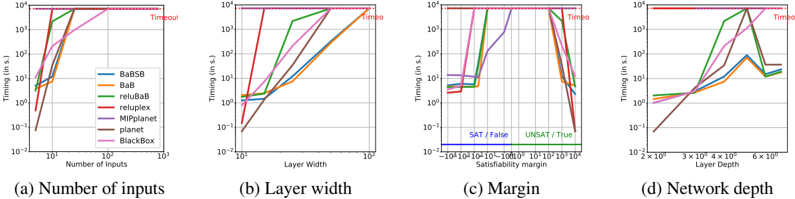
The image contains four line graphs comparing the timing performance (in seconds) of different verification methods (BaBSB, BaB, reluBaB, reluplex, MIPplanet, planet, and BlackBox) against varying parameters: number of inputs, layer width, satisfiability margin, and network depth. The y-axis (Timing) is displayed on a logarithmic scale. A horizontal line labeled "Timeout" is present at the top of each graph, indicating a maximum time limit.
### Components/Axes
**General:**
* **Y-axis (all graphs):** "Timing (in s.)" - Logarithmic scale from 10^-2 to 10^4.
* **Legend (top-left of first graph):**
* BaBSB (Blue)
* BaB (Orange)
* reluBaB (Green)
* reluplex (Red)
* MIPplanet (Purple)
* planet (Brown)
* BlackBox (Pink)
* **Timeout Line:** A horizontal dotted red line at y = 10^4, labeled "Timeout" in red text.
**Graph (a): Number of inputs**
* **X-axis:** "Number of Inputs" - Linear scale from 10^0 to 10^3.
**Graph (b): Layer width**
* **X-axis:** "Layer Width" - Linear scale from 10^1 to 10^2.
**Graph (c): Margin**
* **X-axis:** "Satisfiability margin" - Logarithmic scale from -10^6 to 10^6. Labels "SAT / False" and "UNSAT / True" are present.
**Graph (d): Network depth**
* **X-axis:** "Layer Depth" - Linear scale from 2 x 10^0 to 6 x 10^0.
### Detailed Analysis
**Graph (a): Number of inputs**
* **BaBSB (Blue):** Relatively flat at approximately 10^-1 until around 10^1 inputs, then increases gradually to approximately 10^0 at 10^3 inputs.
* **BaB (Orange):** Starts at approximately 10^-1 and increases to approximately 10^1 at 10^3 inputs.
* **reluBaB (Green):** Increases sharply from approximately 10^0 to the timeout line (10^4) between 10^0 and 10^1 inputs.
* **reluplex (Red):** Increases sharply from approximately 10^-1 to the timeout line (10^4) between 10^0 and 10^1 inputs.
* **MIPplanet (Purple):** Increases sharply from approximately 10^-1 to approximately 10^3 between 10^0 and 10^1 inputs, then continues to increase to the timeout line (10^4) at 10^2 inputs.
* **planet (Brown):** Starts at approximately 10^-1 and increases to approximately 10^0 at 10^3 inputs.
* **BlackBox (Pink):** Increases sharply from approximately 10^-1 to the timeout line (10^4) between 10^0 and 10^1 inputs.
**Graph (b): Layer width**
* **BaBSB (Blue):** Relatively flat at approximately 10^-1.
* **BaB (Orange):** Increases from approximately 10^-1 to approximately 10^2.
* **reluBaB (Green):** Increases sharply from approximately 10^-1 to the timeout line (10^4) between 10^1 and 10^2 layer width.
* **reluplex (Red):** Increases sharply from approximately 10^-2 to the timeout line (10^4) between 10^1 and 10^2 layer width.
* **MIPplanet (Purple):** Increases sharply from approximately 10^-1 to the timeout line (10^4) between 10^1 and 10^2 layer width.
* **planet (Brown):** Increases from approximately 10^-2 to approximately 10^1.
* **BlackBox (Pink):** Increases sharply from approximately 10^-1 to the timeout line (10^4) between 10^1 and 10^2 layer width.
**Graph (c): Margin**
* **BaBSB (Blue):** Remains relatively constant at approximately 10^-2.
* **BaB (Orange):** Remains relatively constant at approximately 10^0.
* **reluBaB (Green):** Increases sharply from approximately 10^-1 to the timeout line (10^4) between -10^1 and -10^0 margin, then drops sharply to approximately 10^1 at 10^1 margin, and then decreases to approximately 10^0 at 10^6 margin.
* **reluplex (Red):** Increases sharply from approximately 10^-1 to the timeout line (10^4) between -10^1 and -10^0 margin, then drops sharply to approximately 10^1 at 10^1 margin, and then decreases to approximately 10^0 at 10^6 margin.
* **MIPplanet (Purple):** Increases sharply from approximately 10^-1 to approximately 10^3 between -10^1 and -10^0 margin, then drops sharply to approximately 10^1 at 10^1 margin, and then decreases to approximately 10^0 at 10^6 margin.
* **planet (Brown):** Remains relatively constant at approximately 10^-1.
* **BlackBox (Pink):** Increases sharply from approximately 10^-1 to the timeout line (10^4) between -10^1 and -10^0 margin, then drops sharply to approximately 10^1 at 10^1 margin, and then decreases to approximately 10^0 at 10^6 margin.
**Graph (d): Network depth**
* **BaBSB (Blue):** Increases from approximately 10^-1 to approximately 10^1.
* **BaB (Orange):** Increases from approximately 10^0 to approximately 10^1.
* **reluBaB (Green):** Increases sharply from approximately 10^0 to the timeout line (10^4) between 2x10^0 and 4x10^0 layer depth, then drops sharply to approximately 10^1 at 6x10^0 layer depth.
* **reluplex (Red):** Increases sharply from approximately 10^-1 to the timeout line (10^4) between 2x10^0 and 4x10^0 layer depth, then drops sharply to approximately 10^1 at 6x10^0 layer depth.
* **MIPplanet (Purple):** Increases sharply from approximately 10^-1 to approximately 10^3 between 2x10^0 and 4x10^0 layer depth, then drops sharply to approximately 10^1 at 6x10^0 layer depth.
* **planet (Brown):** Increases from approximately 10^-1 to approximately 10^0.
* **BlackBox (Pink):** Increases sharply from approximately 10^-1 to approximately 10^3 between 2x10^0 and 4x10^0 layer depth, then drops sharply to approximately 10^1 at 6x10^0 layer depth.
### Key Observations
* The "reluBaB", "reluplex", "MIPplanet", and "BlackBox" methods frequently reach the timeout limit (10^4 seconds) as the number of inputs, layer width, and network depth increase, and as the satisfiability margin approaches the "UNSAT/True" region.
* The "BaBSB", "BaB", and "planet" methods generally exhibit lower timing values and do not reach the timeout limit within the tested ranges.
* The satisfiability margin graph (c) shows a sharp increase in timing for "reluBaB", "reluplex", "MIPplanet", and "BlackBox" as the margin transitions from negative to positive values, followed by a decrease as the margin increases further.
### Interpretation
The graphs illustrate the performance of different verification methods under varying conditions. The "reluBaB", "reluplex", "MIPplanet", and "BlackBox" methods are more sensitive to increases in the number of inputs, layer width, and network depth, often exceeding the timeout limit. The satisfiability margin significantly impacts the timing of these methods, with a peak in computation time observed around the transition from "SAT/False" to "UNSAT/True". The "BaBSB", "BaB", and "planet" methods appear to be more scalable and robust, maintaining lower timing values across the tested parameter ranges. The data suggests that the choice of verification method should be carefully considered based on the specific characteristics of the neural network being analyzed.
DECODING INTELLIGENCE...