## Bar Chart: Prediction Flip Rate for Mistral Models
### Overview
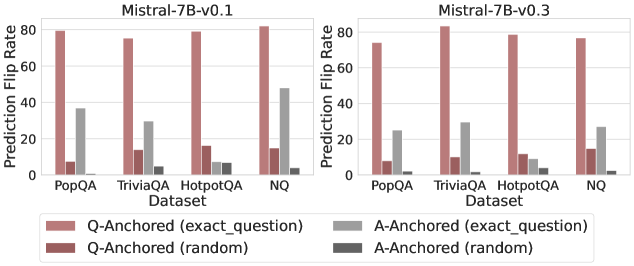
This image presents a comparative bar chart illustrating the Prediction Flip Rate for two versions of the Mistral-7B model (v0.1 and v0.3) across four different datasets: PopQA, TriviaQA, HotpotQA, and NQ. The flip rate is measured for two anchoring methods: Q-Anchored (based on the exact question) and A-Anchored (based on the exact answer), each with both exact and random variations.
### Components/Axes
* **X-axis:** Dataset (PopQA, TriviaQA, HotpotQA, NQ)
* **Y-axis:** Prediction Flip Rate (ranging from 0 to 80, with increments of 10)
* **Models:** Two separate charts, one for Mistral-7B-v0.1 and one for Mistral-7B-v0.3. Each chart has the same X and Y axes.
* **Legend:**
* Q-Anchored (exact\_question) - Light Red
* Q-Anchored (random) - Dark Red
* A-Anchored (exact\_question) - Light Gray
* A-Anchored (random) - Dark Gray
### Detailed Analysis
**Mistral-7B-v0.1 Chart:**
* **PopQA:**
* Q-Anchored (exact\_question): Approximately 80.
* Q-Anchored (random): Approximately 10.
* A-Anchored (exact\_question): Approximately 30.
* A-Anchored (random): Approximately 0.
* **TriviaQA:**
* Q-Anchored (exact\_question): Approximately 75.
* Q-Anchored (random): Approximately 30.
* A-Anchored (exact\_question): Approximately 45.
* A-Anchored (random): Approximately 10.
* **HotpotQA:**
* Q-Anchored (exact\_question): Approximately 15.
* Q-Anchored (random): Approximately 10.
* A-Anchored (exact\_question): Approximately 10.
* A-Anchored (random): Approximately 5.
* **NQ:**
* Q-Anchored (exact\_question): Approximately 80.
* Q-Anchored (random): Approximately 10.
* A-Anchored (exact\_question): Approximately 20.
* A-Anchored (random): Approximately 10.
**Mistral-7B-v0.3 Chart:**
* **PopQA:**
* Q-Anchored (exact\_question): Approximately 80.
* Q-Anchored (random): Approximately 10.
* A-Anchored (exact\_question): Approximately 20.
* A-Anchored (random): Approximately 0.
* **TriviaQA:**
* Q-Anchored (exact\_question): Approximately 80.
* Q-Anchored (random): Approximately 20.
* A-Anchored (exact\_question): Approximately 40.
* A-Anchored (random): Approximately 10.
* **HotpotQA:**
* Q-Anchored (exact\_question): Approximately 20.
* Q-Anchored (random): Approximately 10.
* A-Anchored (exact\_question): Approximately 10.
* A-Anchored (random): Approximately 5.
* **NQ:**
* Q-Anchored (exact\_question): Approximately 80.
* Q-Anchored (random): Approximately 10.
* A-Anchored (exact\_question): Approximately 20.
* A-Anchored (random): Approximately 10.
### Key Observations
* For both models, Q-Anchored (exact\_question) consistently exhibits the highest prediction flip rate across all datasets, particularly on PopQA, TriviaQA, and NQ.
* Q-Anchored (random) consistently shows the lowest prediction flip rate.
* A-Anchored methods generally have lower flip rates than Q-Anchored methods.
* HotpotQA consistently shows the lowest flip rates across all anchoring methods and both models.
* The v0.3 model shows a slight decrease in flip rate for A-Anchored (exact\_question) compared to v0.1 on PopQA and TriviaQA.
### Interpretation
The data suggests that anchoring predictions based on the exact question (Q-Anchored) is more sensitive to changes, leading to a higher prediction flip rate. This indicates that the model relies heavily on the specific wording of the question. The random variation of Q-Anchored shows a significantly lower flip rate, suggesting the model is less sensitive to minor variations in the question when not anchored to the exact phrasing.
The lower flip rates for A-Anchored methods suggest that the model is more stable when anchored to the answer. This could indicate that the model is more confident in its answer predictions than its question-based predictions.
The consistently low flip rates on the HotpotQA dataset might indicate that this dataset is easier for the model to handle, or that the model has been specifically trained to perform well on this type of question.
The slight improvements in the v0.3 model compared to v0.1, particularly in the A-Anchored scenarios, suggest that the model updates have improved stability and reduced sensitivity to anchoring. The difference is subtle, however, indicating that the core behavior remains similar between the two versions.