## Flowchart: Audio Captioning and LLM Integration System
### Overview
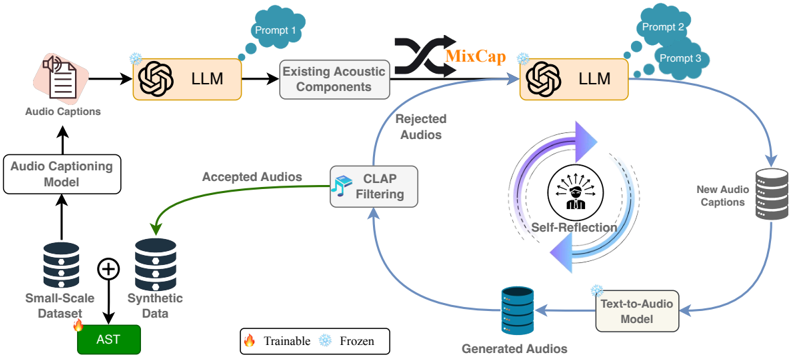
The diagram illustrates a cyclical system for processing audio captions using Large Language Models (LLMs), acoustic components, and self-reflection mechanisms. It emphasizes iterative refinement of audio data through filtering, feedback loops, and text-to-audio generation.
### Components/Axes
1. **Key Components**:
- **Audio Captioning Model**: Processes audio captions using a small-scale dataset and synthetic data.
- **LLM (Large Language Model)**: Interacts with prompts (Prompt 1, Prompt 2, Prompt 3) and existing acoustic components.
- **MixCap**: A module connecting LLMs to acoustic components.
- **CLAP Filtering**: Filters accepted/rejected audios.
- **Self-Reflection**: A feedback loop for iterative improvement.
- **Text-to-Audio Model**: Generates new audios from new captions.
2. **Data Flow**:
- **Inputs**: Audio Captions, Small-Scale Dataset, Synthetic Data.
- **Outputs**: Accepted Audios, Rejected Audios, New Audio Captions, Generated Audios.
3. **States**:
- **Trainable/Frozen**: Indicates adjustable vs. static components (e.g., LLM, CLAP Filtering).
### Detailed Analysis
- **Audio Captioning Model**:
- Takes audio captions as input.
- Outputs accepted/rejected audios after processing small-scale and synthetic datasets.
- Includes an "AST" (possibly an attention mechanism or algorithm) marked as "Trainable."
- **LLM and MixCap**:
- LLM processes prompts (Prompt 1, Prompt 2, Prompt 3) and existing acoustic components.
- MixCap acts as a bridge between LLM and acoustic components, enabling integration.
- **CLAP Filtering**:
- Accepts/rejects audios based on criteria (e.g., relevance, quality).
- Rejected audios re-enter the system via Self-Reflection.
- **Self-Reflection**:
- A feedback loop where rejected audios and generated audios are reprocessed.
- Central to iterative refinement of outputs.
- **Text-to-Audio Model**:
- Converts new audio captions into generated audios.
- Outputs feed back into the system for further processing.
### Key Observations
1. **Cyclical Workflow**: The system emphasizes continuous improvement through feedback loops (e.g., Self-Reflection).
2. **Hybrid Data Use**: Combines small-scale datasets with synthetic data for robustness.
3. **LLM-Centric Design**: LLMs drive prompt-based processing and integration with acoustic components.
4. **Filtering Mechanisms**: CLAP Filtering ensures quality control by rejecting suboptimal audios.
5. **Dynamic Adaptation**: The "Trainable" state of components suggests adaptability to new data.
### Interpretation
This system demonstrates a sophisticated approach to audio captioning and generation, leveraging LLMs for contextual understanding and acoustic components for technical processing. The integration of CLAP Filtering and Self-Reflection highlights a focus on quality assurance and iterative learning. The use of synthetic data alongside small-scale datasets suggests scalability and diversity in training. The Text-to-Audio Model’s role in generating new audios indicates a closed-loop system capable of evolving with new inputs. The "Trainable" state of critical components (e.g., AST, LLM) implies ongoing optimization, making the system adaptable to changing requirements or data distributions.