\n
## Diagram: Synthetic Proof Construction
### Overview
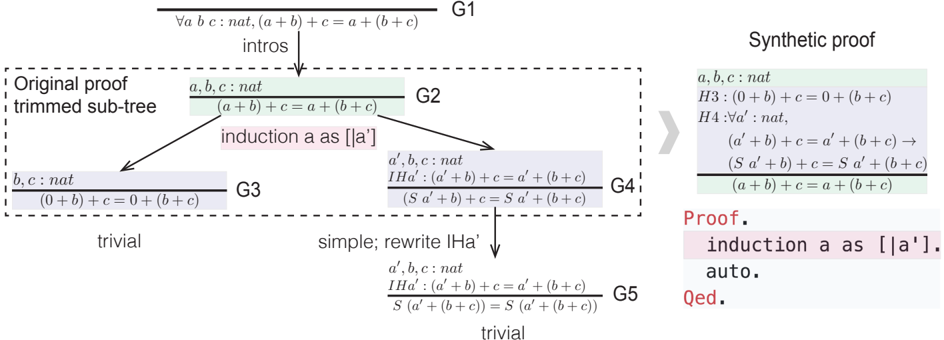
The image depicts a diagram illustrating the construction of a synthetic proof, likely within a formal verification or theorem proving context. It shows a transformation from an "Original proof trimmed sub-tree" to a "Synthetic proof" through a series of intermediate steps (G1-G5). The diagram uses boxes to represent proof states and arrows to indicate transformations or derivations.
### Components/Axes
The diagram is structured into two main sections: the "Original proof trimmed sub-tree" on the left and the "Synthetic proof" on the right. Intermediate states G1 through G5 are positioned between these two sections, showing the progression of the proof. The diagram includes text annotations describing the operations performed at each step (e.g., "intros", "induction a as [a']", "simple; rewrite IHa"). The boxes contain type declarations and logical statements.
### Detailed Analysis or Content Details
**G1:**
* Text: `∀a b c: nat, (a + b) + c = a + (b + c)`
* Text: `intros`
**G2:**
* Box Color: Light Green
* Text: `a, b, c: nat`
* Text: `(a + b) + c = a + (b + c)`
* Text: `induction a as [a']`
**G3:**
* Box Color: Light Blue
* Text: `b, c: nat`
* Text: `0 + b + c = 0 + (b + c)`
* Text: `trivial`
**G4:**
* Box Color: Light Green
* Text: `a', b, c: nat`
* Text: `IHa : (a' + b) + c = a' + (b + c)`
* Text: `(S a' + b) + c = S a' + (b + c) → (a' + b) + c = a' + (b + c)`
**G5:**
* Box Color: Light Blue
* Text: `a', b, c: nat`
* Text: `IHa' : (a' + b) + c = a' + (b + c)`
* Text: `S (a' + b + c) = S (a' + (b + c))`
* Text: `trivial`
**Synthetic Proof (Right Side):**
* Text: `a, b, c: nat`
* Text: `H3: (0 + b) + c = 0 + (b + c)`
* Text: `H4: ∀a': nat, (a' + b) + c = a' + (b + c) → (S a' + b) + c = S a' + (b + c)`
* Text: `(a' + b) + c = a' + (b + c)`
**Proof Steps (Bottom Right):**
* Text: `induction a as [a'].`
* Text: `auto.`
* Text: `Qed.`
**Arrows:**
* An arrow originates from G1 and points to G2, labeled "intros".
* An arrow originates from G2 and splits into two arrows, one pointing to G3 and the other to G4, labeled "induction a as [a']".
* An arrow originates from G3 and points to G4, labeled "trivial".
* An arrow originates from G4 and points to G5, labeled "simple; rewrite IHa".
* An arrow originates from G5 and points to the "Synthetic proof" section, labeled "trivial".
* A double-sided arrow connects G2 and G4, indicating a relationship between the two states.
### Key Observations
The diagram demonstrates a proof by induction. The original proof is simplified and transformed into a synthetic proof through a series of logical steps. The use of color-coding (light green and light blue) seems to differentiate between different types of proof states or goals. The "trivial" labels suggest that certain steps are straightforward and require minimal explanation.
### Interpretation
This diagram illustrates a common technique in formal verification: constructing a proof by breaking it down into smaller, manageable steps. The "Synthetic proof" represents a more structured and potentially more easily verifiable proof than the original. The diagram highlights the importance of induction as a proof strategy and the use of rewriting rules (e.g., "rewrite IHa") to simplify expressions. The diagram is not presenting numerical data, but rather a logical flow and transformation of statements. The diagram is a visual representation of a mathematical proof process, demonstrating how a complex proof can be built up from simpler components. The use of annotations and color-coding aids in understanding the logical flow and the purpose of each step. The diagram suggests a focus on clarity and rigor in the proof construction process.