TECHNICAL ASSET FINGERPRINT
91cdc5154af25a1f768f0c61
Click to view fullscreen
Press ESC or click to close
FOUND IN PAPERS
EXPERT: healer-alpha-free VERSION 1
RUNTIME: free/openrouter/healer-alpha
INTEL_VERIFIED
## Diagram: Mathematical Proof Tree for Associativity of Addition
### Overview
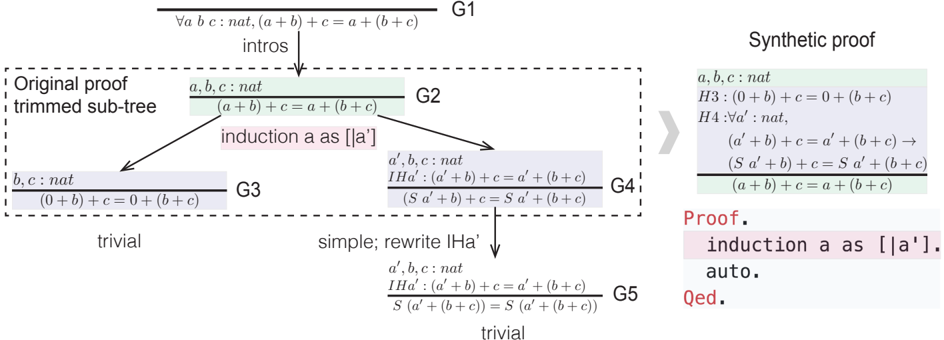
The image displays a formal proof derivation tree for the theorem of associativity of addition for natural numbers (`(a + b) + c = a + (b + c)`). It contrasts an "Original proof trimmed sub-tree" (left) with a condensed "Synthetic proof" (right), illustrating how a detailed, step-by-step logical derivation can be synthesized into a more concise form. The diagram is a technical visualization likely from the field of formal methods, automated theorem proving, or proof theory.
### Components/Axes
The diagram is divided into two primary sections:
1. **Left Section (Original Proof Tree):**
* A dashed box labeled **"Original proof trimmed sub-tree"** encloses the core derivation.
* The tree consists of five nodes labeled **G1** through **G5**, connected by arrows indicating the flow of logical inference.
* Each node contains a **sequent** (a logical statement of the form "assumptions ⊢ conclusion") and often a **tactic** or annotation describing the proof step applied.
* **Key Labels & Annotations:**
* `intros`: A tactic to introduce assumptions.
* `induction a as [[a']`: A tactic to perform induction on variable `a`.
* `trivial`: An annotation indicating a goal solved by basic reasoning.
* `simple; rewrite IHa'`: An annotation indicating a simplification step followed by rewriting using the induction hypothesis (`IHa'`).
2. **Right Section (Synthetic Proof):**
* Labeled **"Synthetic proof"** at the top.
* Presents a linear, textual proof script.
* Contains a highlighted block (light purple background) showing the core inductive step.
* Ends with the keywords `Proof.`, `Qed.` which are typical in proof assistant languages (e.g., Coq, Lean).
### Detailed Analysis
**Original Proof Tree (Left Section):**
* **Node G1 (Root):**
* **Sequent:** `∀ a b c : nat, (a + b) + c = a + (b + c)`
* **Tactic:** `intros`
* **Description:** The initial goal. The `intros` tactic moves the universally quantified variables `a, b, c` into the context as assumptions.
* **Node G2:**
* **Context:** `a, b, c : nat`
* **Goal:** `(a + b) + c = a + (b + c)`
* **Tactic:** `induction a as [[a']`
* **Description:** After introducing variables, the proof proceeds by mathematical induction on `a`. The tactic `induction a` generates two sub-goals: the base case and the inductive step.
* **Node G3 (Base Case):**
* **Context:** `b, c : nat`
* **Goal:** `(0 + b) + c = 0 + (b + c)`
* **Annotation:** `trivial`
* **Description:** This is the base case where `a = 0`. The goal is solved by basic arithmetic definitions (`trivial`).
* **Node G4 (Inductive Step - Initial):**
* **Context:** `a', b, c : nat`, `IHa' : (a' + b) + c = a' + (b + c)`
* **Goal:** `(S a' + b) + c = S a' + (b + c)`
* **Description:** This is the inductive step. It assumes the property holds for `a'` (the Induction Hypothesis, `IHa'`) and must prove it for `S a'` (the successor of `a'`, representing `a' + 1`).
* **Node G5 (Inductive Step - Simplified):**
* **Context:** `a', b, c : nat`, `IHa' : (a' + b) + c = a' + (b + c)`
* **Goal:** `S ((a' + b) + c) = S (a' + (b + c))`
* **Annotation:** `trivial`
* **Description:** The goal from G4 is simplified (likely by unfolding the definition of addition for successors). The resulting goal is `S ((a' + b) + c) = S (a' + (b + c))`. Applying the induction hypothesis `IHa'` inside the successor function `S` makes this goal `trivial`.
**Synthetic Proof (Right Section):**
* **Context:** `a, b, c : nat`
* **Proof Script:**
```
H3 : (0 + b) + c = 0 + (b + c)
H4 : ∀a' : nat,
(a' + b) + c = a' + (b + c) →
(S a' + b) + c = S a' + (b + c)
```
* This appears to be a reconstructed or summarized version of the key hypotheses generated during the proof.
* **Core Tactic:** `induction a as [[a']`. This single line replaces the entire branching tree structure from G2-G5.
* **Conclusion:** `auto.` followed by `Qed.`. The `auto` tactic likely solves the base and inductive cases automatically using a predefined set of rules, synthesizing the detailed steps shown on the left.
### Key Observations
1. **Proof Structure:** The diagram explicitly shows the two branches of an inductive proof (base case and inductive step) stemming from node G2.
2. **Automation vs. Detail:** The left side shows the detailed, human-readable logical steps. The right side shows how a proof assistant can compress these steps using powerful automation tactics (`auto`).
3. **Role of Induction Hypothesis:** The critical element `IHa'` is clearly visible in nodes G4 and G5, showing how the inductive assumption is used to prove the successor case.
4. **Spatial Layout:** The original proof tree flows top-to-bottom and left-to-right. The synthetic proof is placed to the right, connected by a gray arrow, suggesting a transformation or synthesis process.
### Interpretation
This diagram serves as a pedagogical or technical illustration of **proof synthesis** in formal verification. It demonstrates the relationship between a detailed, step-by-step natural deduction proof (the tree) and a concise, tactic-based proof script (the synthetic proof).
* **What it shows:** The core message is that complex logical derivations can be automatically generated or simplified by a proof assistant. The "trimmed sub-tree" represents the essential logical skeleton that a human might write, while the "synthetic proof" represents the optimized code a system can produce.
* **Why it matters:** In formal methods, the goal is to prove mathematical theorems or software correctness with machine-checked rigor. This diagram highlights the tooling that makes this feasible: users can outline a proof strategy (like induction), and the system handles the low-level logical details (`trivial`, `auto`), bridging the gap between human intuition and machine verification.
* **Underlying Pattern:** The transformation from a branching tree to a linear script exemplifies the **compression of logical evidence**. The information content (the proof of associativity) is preserved, but its representation is made more efficient for both human reading (the synthetic script) and machine processing. The dashed box around the "original proof" may indicate that this is the minimal, essential structure extracted from a potentially larger, more verbose initial proof.
DECODING INTELLIGENCE...