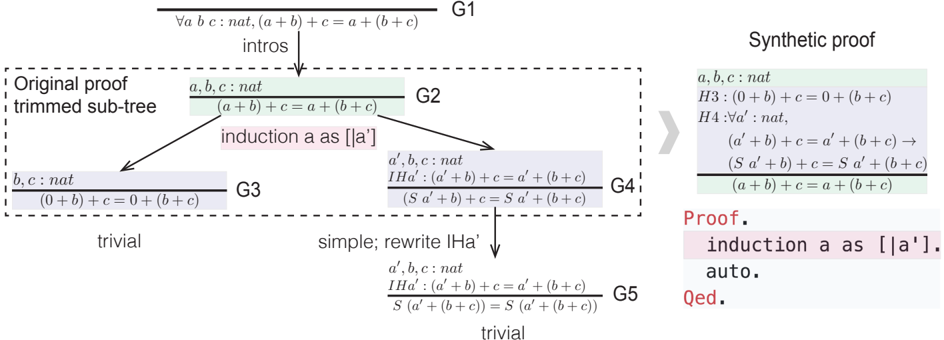
## Diagram: Comparison of Original and Synthetic Proofs in Formal Verification
### Overview
The diagram contrasts an original proof structure (left) with a synthetic proof (right), illustrating steps in formal verification. It uses labeled components (G1–G5, H3–H4) to represent mathematical assertions and proof tactics.
### Components/Axes
- **Original Proof (Left Side)**:
- **Trimmed Sub-Tree**: Contains components G1–G4 with mathematical assertions.
- **G1**: `∀a b c : nat, (a + b) + c = a + (b + c)` (associativity of addition).
- **G2**: Same as G1, labeled as "induction a as [[a']]".
- **G3**: `(0 + b) + c = 0 + (b + c)` (trivial case for `a = 0`).
- **G4**: `(a' + b) + c = a' + (b + c)` (rewritten induction hypothesis `IHa'`).
- **G5**: Trivial assertion `S (a' + (b + c)) = S (a' + (b + c))`.
- **Synthetic Proof (Right Side)**:
- **H3**: `(0 + b) + c = 0 + (b + c)` (trivial case).
- **H4**: `∀a' : nat, (a' + b) + c = a' + (b + c) → (S a' + b) + c = S a' + (b + c)` (inductive step).
- **Proof Steps**:
- `induction a as [[a']].`
- `auto.` (automated proof tactic).
- `Qed.` (conclusion of proof).
### Detailed Analysis
- **Original Proof**:
- **G1–G4**: Establish associativity of addition via induction. G3 handles the base case (`a = 0`), while G4 represents the inductive hypothesis.
- **G5**: Trivial equality after simplification.
- **Synthetic Proof**:
- **H3**: Directly asserts the base case.
- **H4**: Combines the inductive hypothesis with the successor function `S` to prove the inductive step.
- **Proof Tactics**: Uses `induction` to decompose `a` into cases and `auto` to discharge subgoals automatically.
### Key Observations
1. **Simplification**: The synthetic proof reduces redundancy by leveraging `auto` to handle trivial subgoals.
2. **Inductive Structure**: Both proofs rely on induction over `a`, but the synthetic version explicitly separates base and inductive cases.
3. **Notation**: The use of `S` (successor) and `→` (implication) aligns with dependent type theory conventions.
### Interpretation
The diagram demonstrates how formal proofs can be streamlined using automated tactics (`auto`) and structured induction. The synthetic proof abstracts away low-level case analysis, focusing on high-level logical structure. This reflects a common pattern in proof assistants like Coq, where automation reduces manual case handling. The equivalence `(a + b) + c = a + (b + c)` is foundational in arithmetic, and the diagram highlights its role in both manual and automated verification workflows.