## Diagram: Problem Decomposition
### Overview
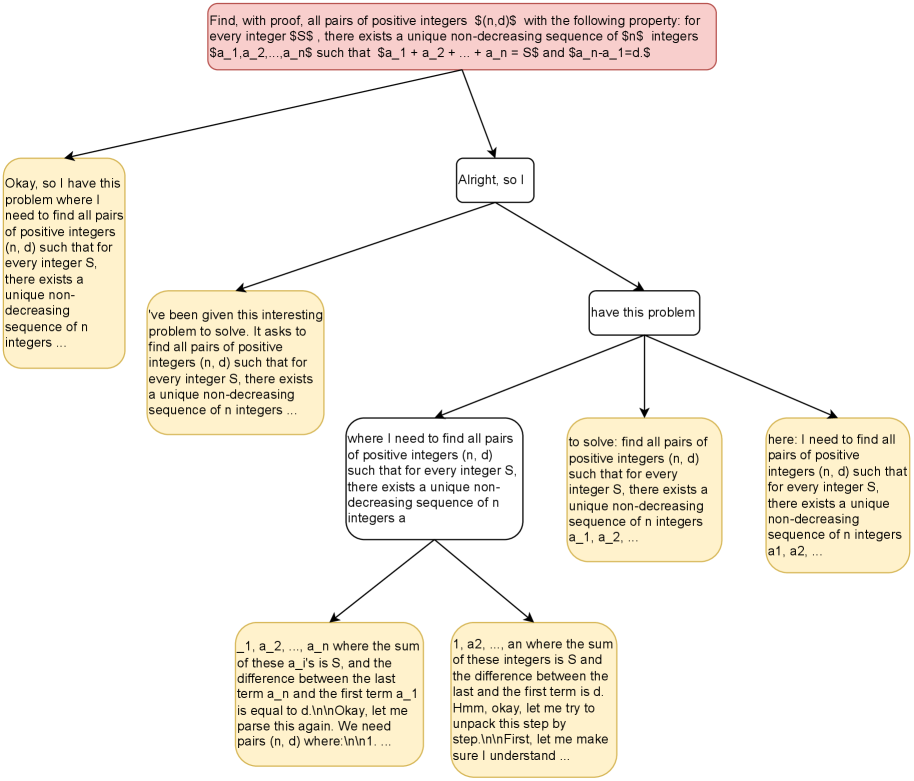
The image is a diagram illustrating the decomposition of a mathematical problem. It shows a top-down approach, breaking down the initial problem statement into smaller, more manageable sub-problems. The diagram uses rounded rectangles to represent the problem statements and sub-problems, connected by arrows to indicate the flow of thought.
### Components/Axes
* **Nodes:** Rounded rectangles containing text representing problem statements or sub-problems.
* **Edges:** Arrows indicating the flow of thought or decomposition.
* **Root Node (Top):** A red rounded rectangle containing the original problem statement.
* **Intermediate Nodes:** Yellow rounded rectangles representing sub-problems or intermediate steps.
### Detailed Analysis
**1. Root Node (Top, Red):**
* Text: "Find, with proof, all pairs of positive integers $(n,d)$ with the following property: for every integer $S$, there exists a unique non-decreasing sequence of $n$ integers $a_1,a_2,...,a_n$ such that $a_1+a_2 + ... + a_n = S$ and $a_n-a_1=d.$"
**2. Second Level Nodes (from left to right):**
* **Node 1 (Yellow):** "Okay, so I have this problem where I need to find all pairs of positive integers (n, d) such that for every integer S, there exists a unique non-decreasing sequence of n integers..."
* **Node 2 (Yellow):** "'ve been given this interesting problem to solve. It asks to find all pairs of positive integers (n, d) such that for every integer S, there exists a unique non-decreasing sequence of n integers..."
* **Node 3 (Black):** "Alright, so I"
* **Node 4 (Black):** "have this problem"
* **Node 5 (Yellow):** "where I need to find all pairs of positive integers (n, d) such that for every integer S, there exists a unique non-decreasing sequence of n integers a"
* **Node 6 (Yellow):** "to solve: find all pairs of positive integers (n, d) such that for every integer S, there exists a unique non-decreasing sequence of n integers a_1, a_2, ..."
* **Node 7 (Yellow):** "here: I need to find all pairs of positive integers (n, d) such that for every integer S, there exists a unique non-decreasing sequence of n integers a1, a2, ..."
**3. Third Level Nodes (from left to right):**
* **Node 8 (Yellow):** "_1, a_2, ..., a_n where the sum of these a_i's is S, and the difference between the last term a_n and the first term a_1 is equal to d.\n\nOkay, let me parse this again. We need pairs (n, d) where:\n\n1...."
* **Node 9 (Yellow):** "1, a2,..., an where the sum of these integers is S and the difference between the last and the first term is d. Hmm, okay, let me try to unpack this step by step.\n\nFirst, let me make sure I understand..."
### Key Observations
* The diagram starts with a formal mathematical problem statement and decomposes it into smaller, more intuitive sub-problems.
* The decomposition process involves rephrasing the problem in different ways to gain a better understanding.
* The final level of decomposition focuses on understanding the relationship between the variables and constraints.
### Interpretation
The diagram represents a problem-solving process where a complex mathematical problem is broken down into smaller, more manageable parts. The process involves rephrasing the problem, identifying key components, and attempting to understand the underlying relationships. The diagram suggests a thought process that aims to simplify a complex problem by decomposing it into smaller, more understandable steps. The use of natural language alongside mathematical notation indicates an attempt to bridge the gap between formal mathematics and intuitive understanding.