## Diagram: Mathematical Problem Decomposition Tree
### Overview
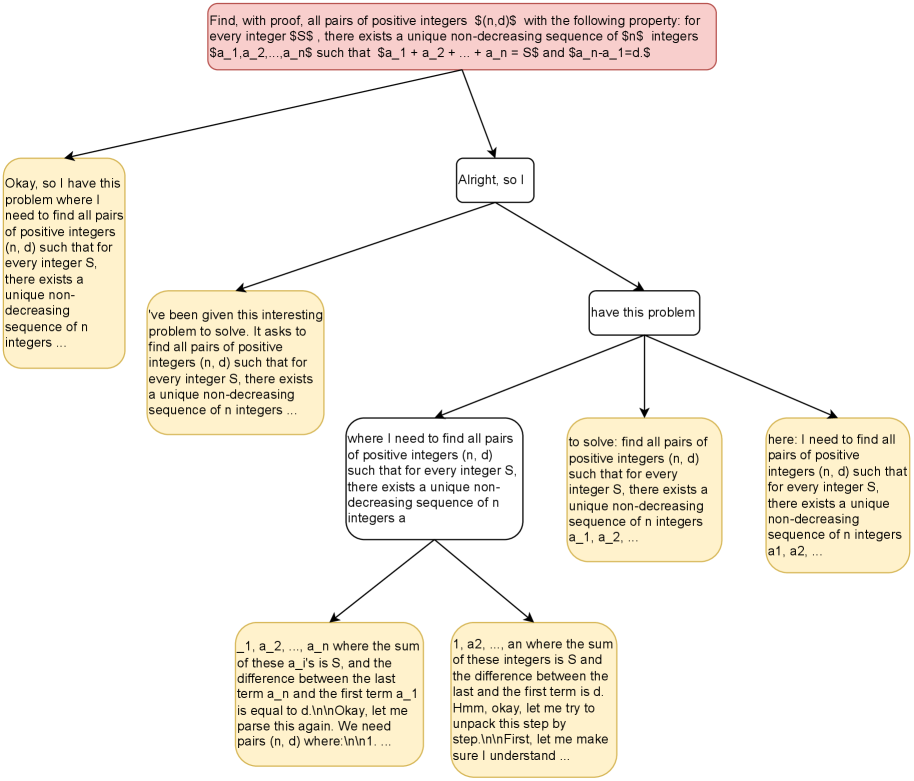
The image displays a hierarchical tree diagram representing a "Chain of Thought" or problem-decomposition process. The root node contains a formal mathematical problem statement, while the subsequent branches illustrate various ways to restate, parse, or "unpack" that problem into conversational or analytical segments. The diagram appears to visualize how an AI or a student might break down a complex mathematical prompt.
### Components/Axes
* **Structure:** A top-down tree diagram with a single root node and multiple levels of branching.
* **Nodes:** Rectangular boxes with rounded corners.
* **Color Coding:**
* **Red/Pink (Top):** The root node containing the original problem statement.
* **White (Intermediate):** Nodes acting as connectors or partial phrases.
* **Yellow/Cream (Leaf/Terminal):** Nodes containing restatements or detailed breakdowns of the problem.
* **Flow:** Directed arrows indicate the progression from the formal problem to various conversational restatements.
### Detailed Analysis
#### Root Node (Top, Center)
* **Content:** "Find, with proof, all pairs of positive integers $(n,d)$ with the following property: for every integer $S$, there exists a unique non-decreasing sequence of $n$ integers $a_1, a_2, ..., a_n$ such that $a_1 + a_2 + ... + a_n = S$ and $a_n - a_1 = d$."
#### Level 1 Branches
* **Left Branch (Yellow):** "Okay, so I have this problem where I need to find all pairs of positive integers $(n, d)$ such that for every integer $S$, there exists a unique non-decreasing sequence of $n$ integers ..."
* **Right Branch (White):** "Alright, so I"
#### Level 2 Branches (from "Alright, so I")
* **Left Branch (Yellow):** "'ve been given this interesting problem to solve. It asks to find all pairs of positive integers $(n, d)$ such that for every integer $S$, there exists a unique non-decreasing sequence of $n$ integers ..."
* **Right Branch (White):** "have this problem"
#### Level 3 Branches (from "have this problem")
* **Left Branch (White):** "where I need to find all pairs of positive integers $(n, d)$ such that for every integer $S$, there exists a unique non-decreasing sequence of $n$ integers $a$"
* **Level 4 (Left-most, Yellow):** "_1, a_2, ..., a_n where the sum of these a_i's is S, and the difference between the last term a_n and the first term a_1 is equal to d.\n\nOkay, let me parse this again. We need pairs (n, d) where:\n\n..."
* **Level 4 (Left-center, Yellow):** "1, a2, ..., an where the sum of these integers is S and the difference between the last and the first term is d. Hmm, okay, let me try to unpack this step by step.\n\nFirst, let me make sure I understand ..."
* **Center Branch (Yellow):** "to solve: find all pairs of positive integers $(n, d)$ such that for every integer $S$, there exists a unique non-decreasing sequence of $n$ integers $a_1, a_2, ..."
* **Right Branch (Yellow):** "here: I need to find all pairs of positive integers $(n, d)$ such that for every integer $S$, there exists a unique non-decreasing sequence of $n$ integers $a_1, a_2, ..."
### Key Observations
* **Redundancy:** There is a high degree of repetition across the nodes. The core mathematical problem is restated in almost every branch, indicating a process of "thinking aloud" or iterative prompt refinement.
* **Progression:** The diagram moves from a formal, rigid mathematical statement at the top to more conversational, "human-like" phrasing as it descends.
* **Decomposition:** The bottom-most nodes (Level 4) are the only ones that attempt to break down the mathematical constraints (sum $S$ and difference $d$) into actionable steps, whereas the higher nodes are primarily restating the prompt.
### Interpretation
This diagram is a visual representation of an LLM (Large Language Model) or a human problem-solver's internal reasoning process.
1. **Prompt Engineering/Chain-of-Thought:** The structure suggests a "Chain of Thought" prompting technique where the model is forced to restate the problem multiple times to ensure it has parsed the constraints correctly before attempting a solution.
2. **Mathematical Context:** The problem itself is a classic number theory/combinatorics problem involving integer partitions. The model is attempting to identify the conditions under which a partition of $S$ into $n$ parts is unique given a fixed range $d$.
3. **Self-Correction:** The presence of phrases like "Okay, let me parse this again" and "Hmm, okay, let me try to unpack this step by step" in the bottom nodes suggests that the system is actively attempting to self-correct or clarify its understanding of the variables $n$, $d$, and $S$ before proceeding to the actual calculation.